This article explores the progress that atmospheric pressure photoionization (APPI) has made in its relatively short history for LC–MS analysis. Specifically, the authors examine the combination of APPI and electrospray ionization (ESI).

This article explores the progress that atmospheric pressure photoionization (APPI) has made in its relatively short history for LC–MS analysis. Specifically, the authors examine the combination of APPI and electrospray ionization (ESI).

After teaching a training class in China, John Dolan was reminded of how chromatographers worldwide encounter the same types of problems, such as method transfer. This month's column is dedicated to method transfer problems.

This study evaluates the use of HPLC to estimate the log P (the octanol–water partition coefficient) of two compounds, apocynin and diapocynin. The paper will discuss the effects of an unexpected reversal of retention that occurred when these compounds were chromatographed with various amounts of methanol–water mobile phases.

Trade extra resolution for speed.

The use of dual polarization interferometry (DPI) to measure the behaviour of alkyl-modified surfaces under different solvent regimes is described. The empirically observed and modelled behaviour of grafted long alkyl chain adlayers on a silica surface were in good agreement. The empirical data was also compared with data using analogous systems and these also matched well. This approach has the potential to gain much greater insight into the behaviour of reversed-phase (RP) columns and could help to design column surfaces that are resistant to phase collapse.

In 2001, the second glossary of common and not-so-common terms and "buzz words" for reference to HPLC columns and column technology was published. It is time for an update since new terms have arisen or, in some cases, their original meanings have expanded or changed.

Reversed-phase liquid chromatography (LC) is a simple and easy-to-use technique that will give satisfactory separations for the samples that most of us encounter. Here, John Dolan examines the pros and cons of this technique.

This article describes the method development and performance characteristics of the validated LFI assay and evaluates stability in human plasma.

High performance liquid chromatography (HPLC) enhances throughput in countless processes, including environmental analysis, dissolution testing, separation of biomolecules, and total drug analysis. To take advantage of the benefits of HPLC technology, samples and solvents must be cleared of particulate contaminants. Doing so protects instrument components and minimizes maintenance costs. This article outlines HPLC technology, explains the importance of sample preparation, and reviews the factors that must be considered when preparing HPLC samples by membrane filtration. The data from experiments to test these factors show that the physicochemical characteristics of membrane filters can affect HPLC results.

This month's "LC Troubleshooting" installment examines the possible reasons your retention times could have changed. If the root cause can be identified and corrected, no adjustment in flow rate will be necessary.

This article describes the factors that affect the selection of columns for two-dimensional (2D) LCxLC separations.

In this installment of "Column Watch," Ron Majors examines the various approaches to increasing the speed of high performance liquid chromatography (HPLC) separations.

How to avoid an expensive shot in the dark.

The retention behaviour of several compounds has been compared for their selectivity using reversed-phase high performance liquid chromatography with binary water mobile phases composed of methanol, acetonitrile or tetrahydrofuran as modifiers.

Since 1950, Pittcon has served as a platform for recognition of scientists whose pioneering research helped make dramatic advances in their specific disciplines. The Spectroscopy Society of Pittsburgh (SSP), one of the two sponsoring societies that organize Pittcon, first presented its Spectroscopy Award in 1957 and has recognized the work of leading spectroscopists every year since. The second Pittcon co-sponsor, the Society for Analytical Chemists of Pittsburgh (SACP), began recognizing leading analytical chemists with their annual award in 1978. The list of award recipients is a "who's who" of scientists, including Nobel Laureates, whose work advanced scientific discoveries at an amazing pace while laying the groundwork for the development of modern day instrumentation, including mass spectrometry, ICP, FT-IR, and hyphenated instrumental techniques. This two-part article will provide a historical perspective on the accomplishments of several Pittsburgh Spectroscopy Award and Pittsburgh Analytical Chemistry Award winners, highlighting some of the work recognized in each decade leading up to Pittcon 2008. Part I will chronicle the years 1957 through 1977 while Part II will highlight the years 1978 through Pittcon 2008.


For the last six months, "LC Troubleshooting" has been concentrating on the process for the development of isocratic methods (those for which the mobile phase composition is constant throughout the run). The use of a gradient scouting run to speed isocratic method development is the subject of this month?s "LC Troubleshooting."

How do I get the most out of my efforts?

In the previous installments of this series on efficient development of LC methods (1?5), we have concentrated on improving resolution by modifying the mobile phase, choosing a different stationary phase, or changing some other condition, such as column temperature. In this month?s "LC Troubleshooting" installment, we take a look at trading some of that resolution for a faster separation.

In this installment of "Column Watch," columnist Ron Majors examines the role of pressure in high performance liquid chromatography (HPLC) from two viewpoints: the impact of the ultrahigh pressures encountered in ultrahigh-pressure liquid chromatography (UHPLC) on chromatographic parameters and increases in column pressure encountered in normal daily use. The latter is of more practical consequence to HPLC users since increased back pressure usually implies that something has gone wrong with the column. Pressure increases due to physical and chemical contamination are explored and practical approaches to solve these problems are suggested.

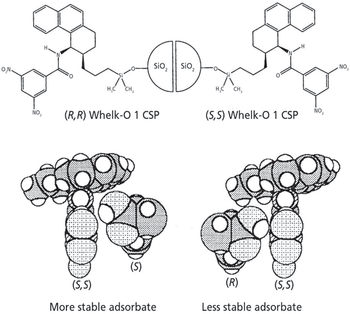
Basic information on stereochemistry is provided in this article to help readers develop a better understanding of the separation mechanisms that come into play in various separation methods used for chiral compounds. This knowledge can allow readers to select a desirable chiral separation method, based upon the molecular structure of the chiral compound of interest. Logical reasons for the selection process are discussed later in this article.

Faster isn't always better.

Potentiometry is a new detection method for liquid chromatography (LC) and capillary electrophoresis (CE). The principle behind this method is familiar to chromatographers because the signals depend on the partitioning tendency of analytes over the sensor coating and the eluent. This partitioning provokes a change in the surface potential and the detection of these changes can be classified as "potentiometric". A conversion algorithm is needed to convert the generated signals to concentration-related tracings (chromatograms).

High performance liquid chromatography–solid phase extraction–nuclear magnetic resonance (HPLC–SPE–NMR) is a novel hyphenation technology that concentrates single chromatographic peaks to elution volumes matching those of NMR flow probes. The SPE unit facilitates the solvent exchange from the mobile phase of the optimized HPLC assay to a deuterated NMR solvent. The well-defined NMR solvent conditions make spectra comparisons feasible, which means databases and spectra catalogues can be used to swiftly identify analytes. The ability to accumulate analytes on the SPE cartridges by multiple trapping reduces the need to perform residual solvent suppression experiments and allows heteronuclear NMR experiments to be performed overnight. Structure elucidation of natural products directly from crude extract HPLC samples has become the key application of this technique.

This month, Chromatography Online's Technology Forum looks at the topic of HPLC/TLC and the trends and issues surrounding it. Joining us for this discussion are Eike Reich from Camag, Gerda Morlock, from University of Hohenheim, and Colin poole, from Wayne University.

Polymer-based columns still are widely used in size-exclusion chromatography (SEC) and ion chromatography-ion-exchange chromatography - they have always been used in these modes, even back in 1987.