



LCGC North America
John Dolan ponders te question of whether or not you will be prepared when that method eventually fails.

LCGC North America
John Dolan ponders te question of whether or not you will be prepared when that method eventually fails.

LCGC North America
In part I of a two-part series, the author introduces several methods to reduce error in your chromatographic analyses.

LCGC North America
This month's installment of "Column Watch" is the first of a two-part series in which Ron Majors examines the trends and highlights in columns and consumables at Pittcon 2006.
LCGC Europe
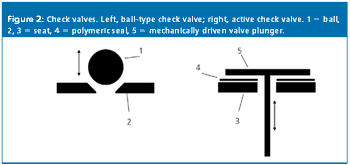
Check valves can be replaced with new ones, but often a simple cleaning procedure is sufficient to restore normal operation.

LCGC Europe
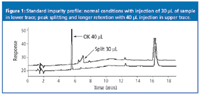
Capillary gas chromatography (GC) is a well-established separation technique. Rick Parmely reviews some of the capillary column basics by investigating a standard test mixture and observing some of the chromatographic effects that can affect peak response, peak shape and column bleed. He provides guidelines for obtaining the best performance from a capillary column. He discusses peak tailing, column overload, ghost peaks and column bleed and speculates on "when to give up." He concludes with a set of fundamental steps to be used in achieving better GC analyses.

LCGC North America
John Dolan explores how an on-line discussion group can be a great source for free consultation from experts in the field.

LCGC North America
The first of a two-part series addresses HPLC pumps, sample introduction systems, and columns for nanoLC-MS.
LCGC Europe
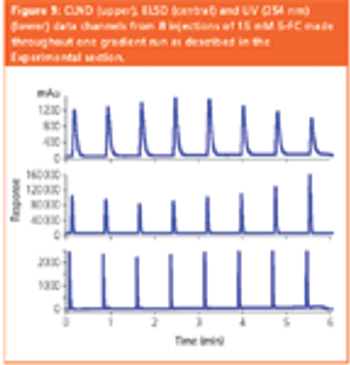
This article assesses the extent to which some familiar HPLC detectors can provide reliable quantitative analytical measurements when no suitable primary reference standard exists. The advantages and limitations of two candidate detector schemes are discussed ? evaporative light-scattering detection (ELSD) and chemiluminescent nitrogen detection (CLND). It was found that when the ERETIC (Electronic REference To access In-vivo Concentrations) method in proton NMR was used as a "gold standard" reference procedure the ability of CLND to provide reliable single calibrant quantification is superior to ELSD. Furthermore, ELSD showed bias towards underestimation of chromatographically-resolved impurities, resulting in an overestimation of analyte purity.

LCGC North America
Check valves are the number one problem area for most LC pumps.

LCGC North America
Purification of synthetic, natural and biological compounds in any quantity usually requires the use of preparative HPLC.
LCGC Europe
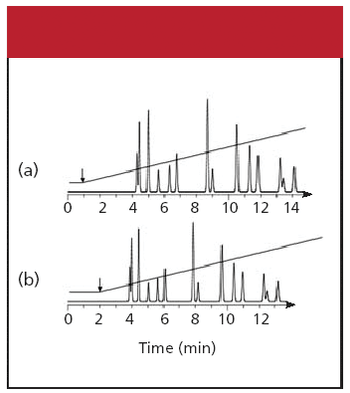
A more practical parameter for system suitability would be to use the peak width for a reference peak...
LCGC North America
LCGC North America and its companion publication, LCGC Europe, are targeted for chromatographers in the United States and Europe, respectively. Sometimes I wonder whether or not the same types of problems are encountered by workers in liquid chromatography (LC) on both sides of the Atlantic. As I write this installment of "LC Troubleshooting," I have just completed three weeks of teaching LC short courses in Europe. I can assure you that the content of the questions I get in these classes is the same, no matter where they are taught. This column is based upon questions gleaned from the most recent courses - you can see that there are no national borders for LC problems.
LCGC North America
The minimum peak size for reportable results for a liquid chromatographic (LC) method depends upon the application and the signal-to-noise ratio (S/N).

LCGC North America
Higher productivity and faster analyses are two of the driving forces for continued improvement in high performance liquid chromatography (HPLC) column technology.
LCGC North America
No column lasts forever, but in this month's installment of "LC Troubleshooting," John Dolan offers some tricks to help extend a column's life.
LCGC Europe
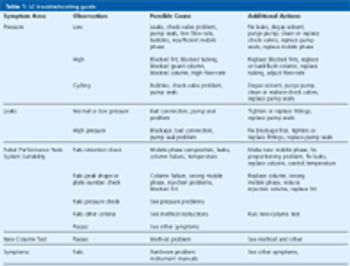
Once the visual problems have been eliminated as problem sources, you are left with problems related to system performance.
LCGC Europe
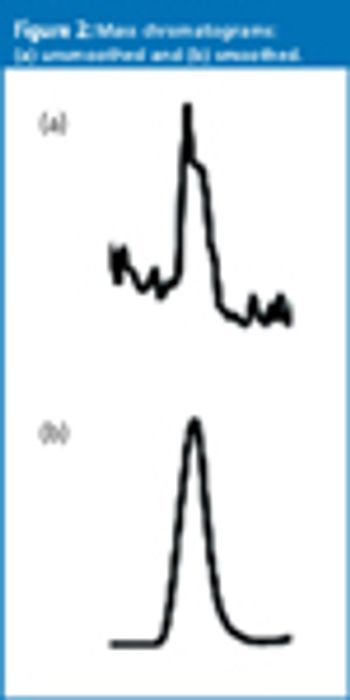
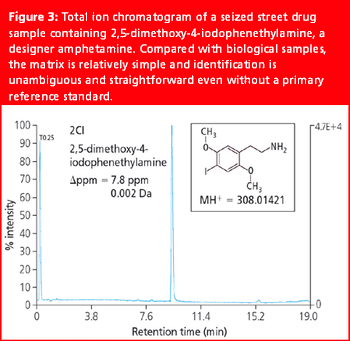
Because of progress in liquid chromatography/time-of-flight mass spectrometry (LC/TOF-MS) instrumentation, data processing and reporting, the measurement of compounds' accurate masses is becoming routine practice in screening analysis based on target databases. As such databases of monoisotopic masses can be easily updated with recent data from the literature; rapid characterization of new compounds and metabolites is possible without the need for primary reference standards. This approach has already been established in comprehensive toxicological urine screening and in analysis of drugs-of-abuse in seized street drug samples. Currently, a mass accuracy within 5 ppm can be routinely achieved, and confirmation via a numerical isotopic pattern match (SigmaFit) is provided by a new generation LC/TOF-MS instrument.

LCGC Europe
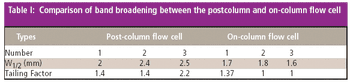
A problem that is encountered occasionally in liquid chromatography (LC) separations is the presence of unusually broad peaks in the chromatogram. This problem is seen most often in isocratic separations, but it can occur with gradients as well. This month's instalment of "LC Troubleshooting" will cover some techniques to help determine the reason these wide peaks are seen.
LCGC North America
The authors describe a new laser-induced flourescence detector for application to both capillary electrophoresis (CE) and high-performance liquid chromatography (HPLC).
LCGC North America
Ron Majors discusses advances in multidimensional chromatography and comprehensive multidimensional chromatography.
LCGC North America
This month's "LC Troubleshooting" is aimed at those who are just starting out in the liquid chromatography business, as John Dolan presents some helpful tips.

LCGC North America
HPLC 2005 was held in Stockholm, Sweden, June 26-30. In this month's installment of "Column Watch," Ron Majors covers this year's hot topics including proteomics, column technology - especially monoliths - microfluidics, and multidimensional and high-throughput separations.

LCGC North America
The use of a simple Excel-based "Golf Score Card" tool can facilitate assessments and instrument acquisistion decisions by collating and weighting the relative importance of the many criteria that impact the final purchase decision. The authors describe this process.

LCGC North America
Some simple practices will help to make problems with gradient methods rare rather than frequent. this month's installment of "LC Troubleshooting" presents a baker's dozen of these tips.

LCGC Europe
Sometimes the mobile phase conditions selected for reversed-phase and ion-pairing methods seem either arbitrary or mysterious.