

HPLC

Latest News


i17_t-460303-1416914872941.gif

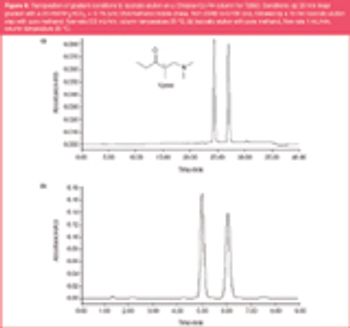
An ultrahigh-pressure liquid chromatography (UHPLC) method was developed to separate paroxetine from several of its related compounds using a systematic screening protocol that monitors combinations of selectivity factors including column chemistry, organic modifier, and pH. When the best combination of these factors was selected, the method was optimized by varying gradient slope and temperature.

i4-460299-1416914894801.gif

HPLC 2007 was held in Ghent, Belgium in June. Last month, columnist Ron Majors summarized some the important column developments as well as other Symposium highlights. This month, he winds up coverage with additional highlights in the areas of technology and applications. Among the topics covered are stationary phase preparation and characterization, multi-dimensional and comprehensive LC, temperature studies, detectors and an application overview.

i8_t-454547-1408665170053.jpg

In the fourth installment in a series on method development for liquid chromatography (LC), with an emphasis on devloping trouble-free methods quickly. John Dolan started out by considering some of the goals we might have and some method development strategies.

i9_t-454546-1408665177537.gif

Columnist Ron Majors covers some of the highlights of HPLC 2007 including honorary sessions, best poster awards, and the latest developments in HPLC column technology.

This month's Technology Forum looks at the topic of HPLC/Ion Chromatography Focus and the trends and issues surrounding it. Joining us for this discussion is Chris Pohl, VP and Chief Science Officer at Dionex Corporation, Larry Tucker from Metrohm-Peak, and Yuichi Fusho of Shodex.

i8_t-447623-1408672265249.jpg

In this installment of "Column Watch" columnist Ron Majors revisits expert predictions from a survey conducted in 1987. A cross section of column experts of the time were asked a series of questions on the future directions in high performance liquid chromatography (HPLC) column technology. Now, 20 years later, these predictions are contrasted against current column technology. In many cases, the experts were entirely correct, while in other cases, they were dead wrong. Some current trends were not even considered 20 years ago. The author backs up his analysis with current survey information.

i4-441415-1416913908078.gif

Modern gas chromatography (GC) capillary columns are rugged and forgiving but some care should be taken when handling and using these high-efficiency columns. In this instalment of "Column Watch", the authors discuss the issues surrounding avoiding column breakage, stationary phase damage and column contamination. Prolonging the life of a column by keeping an oxygen-free system, providing a cleaner sample and not exceeding the upper temperature limit of the stationary phase are highlighted in this practical discussion.

i4-441441-1408653206057.jpg

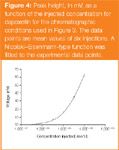
An evaporative light scattering (ELS) detector is a powerful detection tool if the solutes are less volatile than the eluent. Three main processes occur successively: nebulization, evaporation of the liquid chromatographic (LC) effluent and measurement of the light scattering by the residual particles. This leads to a non-linear calibration curve such as, A= a.m b where A is the peak area,m the sample mass and b the response coefficient measured as the slope of Log A = b>Log m + Log a.

i4-441439-1408653223211.gif

Column temperature plays an important role in controlling peak spacing (selectivity) in reversed-phase liquid chromatography (LC) separations. Temperature has long been known to affect retention time, and more recently, its use in adjusting selectivity has gained popularity (see reference 1 for a review of temperature selectivity). In preparation of a paper for the most recent Pittsburgh Conference, I had an opportunity to reexamine some data that compare temperature selectivity with other variables used to control selectivity in LC separation. This month's instalment of "LC Troubleshooting" examines temperature selectivity and its relationship to pH selectivity.

i8_t-435317-1417780370805.jpg

High-performance liquid chromatography (HPLC) is a powerful tool for the enantioselective separation of chiral drugs. However, the selection of an appropriate chiral stationary phase (CSP) and suitable operating conditions is a bottleneck in method development and a time- and resource-consuming task. Multimodal screening of a small number of CSPs with broad enantiorecognition abilities has been recognized as the best strategy to achieve rapid and reliable separations of chiral compounds. This paper describes the generic screening strategy developed at Johnson & Johnson Pharmaceutical Research and Development (J&J PRD) to successfully develop enantioselective HPLC methods for chiral molecules of pharmaceutical interest.

i1-434996-1408659602955.jpg

lthough liquid chromatography (LC) is most commonly associated with analytical techniques that are found inside the laboratory, LC also has been used in industrial applications for separation of a wide range of products for decades. The technique recently has been applied to requirements in the pharmaceutical and biotechnology industries, both inside the laboratory and in industrial settings. With global sales of over $1.7 billion, the market for preparative LC has encountered a stellar growth over the past few years.

i3_t-434921-1408659656538.jpg

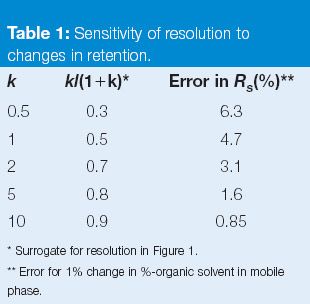
The topic of this month's instalment of "LC Troubleshooting" was prompted by a manuscript I recently reviewed and a question I received from a reader of this column. Both inputs related to the variability of retention times observed in liquid chromatography (LC) methods. Variable retention is a topic that has been touched on many times over the history of this column, sometimes just in passing and other times in depth. Yet, it seems to be a problem that keeps recurring, so I think it is worth considering again.

i1-429504-1408665722402.jpg

Chiral technology has become a very important aspect for scientists involved in the pharmaceutical, chemical, and agricultural industries. The chiral enantiomers can have vitally different pharmacological effects in biological systems. In fact, the U.S. Food and Drug Administration mandates that only therapeutically active isomers must be introduced to the prescription drug market.