

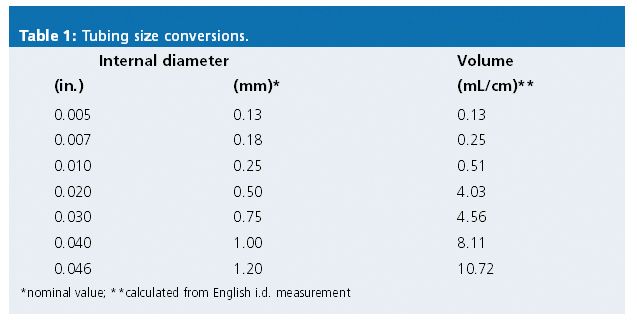

LCGC North America
LCGC North America
LCGC North America
LCGC North America

LCGC North America
What do you do when the sample changes inside the column?

LCGC North America
Measurement of chiral purity is a necessary means of quality control for drug substances that exhibit chiral centers. This article describes a simple and practical approach to setting up system suitability and validation for chiral purity assays.
LCGC North America
In any field there are often "misconceptions" or "myths" that are perpetuated and passed on to the next generation.

The Column
Software traditionally used to control and process data in analytical instruments is now being expanded to include functions such as automated system monitoring with maintenance feedback alerts and interactive diagnostic routines that enable users to quickly track and resolve the source of many system problems. As a back up to these functions, a second layer of expert support is being made available by some instrument vendors to address more complex servicing issues. For larger or more elaborate instrument installations, monitoring and diagnostic software functions can be integrated with remote servicing expertise in a networked configuration to provide continuous proactive instrument maintenance. The benefits of these innovations include lower and more predictable operating costs, reduced system downtime, and more efficient utilization of the instrument user's time.
LCGC North America
LCGC North America
Dissolution testing is a mandatory test for the physical evaluation of solid dosage forms such as capsules, tablets, ointments, and creams. The most basic form of testing measures the rate of dissolution or solubility of a drug tablet. Dissolution testing also can be used in ADME and bioavailability studies, release rates of a drug substance under different conditions, as well as provide information as to the efficacy of in-vivo performance.
LCGC North America
This month's "LC Troubleshooting" takes a look at the important components that are used to connect various parts of the LC system and how to use them wisely.

LCGC Europe
Because each sample is unique, you will need to check for carryover under the conditions of each method.
LCGC North America
LCGC North America
John Dolan addresses two column-related problems reported by readers - the first deals with a column that takes several injections to "settle down" for each batch of samples while the second problem relates to short column life due to early fouling of the column.

LCGC Europe
The gradient linearity and step tests are two of the most useful performance tests that can be made for a liquid chromatography (LC) system. These check the linearity of gradient generation and the accuracy of mobile phase proportioning. These tests, and examples of problems detected as a result of these tests, have been the subject of at least seven "LC Troubleshooting" columns over the last 18 years.1–7 We strongly recommend that every LC system undergo these tests at least on an annual basis, and preferably semiannually. When a new and different example of a problem detected by these tests is discovered, it is hard to bypass the opportunity to share it with our readers. So this month, you get yet another example of how an LC system can fail.
LCGC Europe
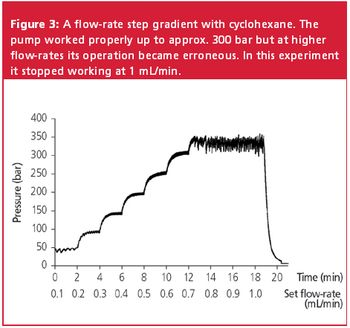
If cyclohexane is mixed with even low amounts of other solvents, the melting pressure increases remarkably.
LCGC North America
The market for high performance liquid chromatography (HPLC) continues to be one of the most dynamic markets of the analytical instruments industry. A few years ago, the HPLC market began showing signs of maturity with little product innovation and slower growth rates. Although innovations in mass spectrometry (MS) helped to fuel growth, HPLC was an afterthought and considered to be a mere inlet to MS. However, the recent development of fast liquid chromatography (LC) systems is energizing the HPLC market.

LCGC North America
The popular HPLC 2006 Symposium was held in June in San Francisco, California. It is the premier annual meeting in liquid phase separations technology.

The Column
In this article, we present data acquired on a 24-column microparallel LC system using a HPLC technique adapted from a routinely used method for measuring lactic acid.

LCGC North America
Carryover is the appearance of an analyte in a run when a clank containing no analyte is injected. In this month's "LC Troubleshooting," John Dolan shows us how to measure it, and some ways to reduce carryover.

LCGC North America
The authors work to develop a universal high performance liquid chromatography method that is capable of simultaneously retaining and separating both cations and anions within a single chromatographic analysis for the purpose of quantification in pharmaceutical products.

The Column
Midazolam is a central nervous system depressant that is commonly used as a sedative before surgical or other medical procedures.

LCGC North America
In the second of a two-part series, Marlin K.L. Bicking continues to explain his work concerning integration errors in peaks with approximately equal sizes (small peak ratios).
LCGC North America
In this month's installment of "LC Troubleshooting," John Dolan takes a look at solvent strength and sees how we can use it to make predictable changes in the peak movement for reversed-phase LC separations.
LCGC North America
Globally, 2005 sales of pharmaceuticals have been estimated at approximately $550 billion. A significant fraction of this amount was due to the top pharmaceutical companies in the world. The top five companies alone were responsible for total revenues of $168 billion, or 30% of the entire market.