






LCGC North America
In part two of this series, John Dolan looks at the signal-to-noise ratio and its relationship to uncertainty in a measurement.
LCGC North America
In part two of this series, John Dolan looks at the signal-to-noise ratio and its relationship to uncertainty in a measurement.
Special Issues
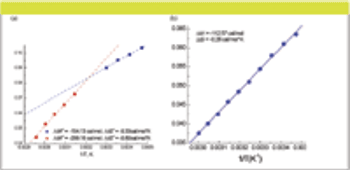
A fast enantiomeric separation of a chiral aromatic amine was achieved, using ultra high pressure liquid chromatography and highly sulfated β-cyclodextrin (S-β-CD) as a chiral additive in the mobile phase. The stationary phase consisted of a core shell support with a particle size of 2.7 µm. Under these conditions the baseline separation was obtained within 2.5 min. The influence of the concentration of the additive, along with the thermodynamics of the separation, were studied. Molecular mechanics calculations were consistent with the experimental data for the order of elution, providing further evidence of these interactions. The enantiomeric separation at high temperature (90 °C) using only water as mobile phase also was achieved for the first time.

Special Issues
Due to economic crisis all over the world it is a time of cost-friendly analyses. Superficially porous and monolithic columns are the tools to serve this purpose. These columns are new generation and can be used for ultrafast separations. This article describes the state-of-the-art for these stationary phases for high performance liquid chromatography (HPLC). The emphasis has been placed on their preparation, properties, applications, comparison, and future perspectives. It has been observed that superficially porous columns may be the choice of future for ultrafast separations.
Special Issues
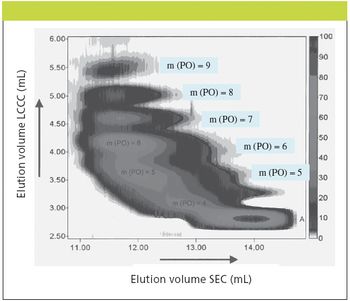
The use and evolution of the two-dimensional liquid chromatography (LCxLC) technique is explored with respect to instrumentation and applications.

Special Issues
During the last four to five years, chromatographers have witnessed some significant advances in technology, from the instrument perspective, with systems operating up to 15,000 psi using new and significantly improved detectors, sometimes operating in multiple dimensions, and from the column perspective, with smaller particle sizes and new chemistries and configurations.
Special Issues
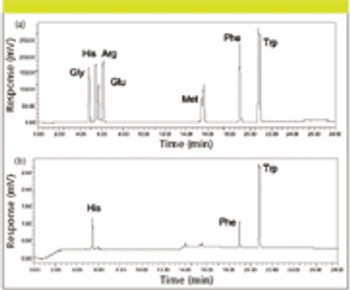
Over the past several years, charged aerosol detection (CAD) has become a widely used technology in the pharmaceutical laboratory. From formulation to stability and even quality control, many analysts are turning to this technology due to its advantages of sensitivity, ease of use, dynamic range, and applicability to a wide range of analyses in the drug development process. In this article, we will examine the operation and use of CAD in a regulated environment, briefly address method development and validation specifics, and highlight a few examples illustrating some of its advantages when used in the pharmaceutical laboratory.

LCGC Europe
An overview of contemporary techniques in environmental analysis.
LCGC Europe
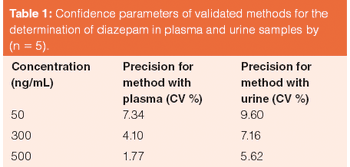
A rapid and simple high performance liquid chromatography (HPLC) method with basic extraction assays was developed to investigate free diazepam levels in the plasma and urine samples of patients medicated with this drug for the management of alcohol withdrawal syndrome. The HPLC analysis was optimized and evaluated for linearity, imprecision, recovery, detection and quantification limits. The method showed linearity between 50–500 ng/mL (r2 ≥ 0.990). Coefficients of variations (%CV) were calculated to be in the range of 1.77–9.60. According to ICH guidelines, theoretical limits of detection (LOD) and quantification (LOQ) for plasma and urine were calculated as 8.3 ng/mL, 27.5 ng/mL and 8.2 ng/mL, 26 ng/mL respectively. Diazepam monitoring in plasma and urine displayed remarkable variations. The importance of adjusting doses according to individual requirements and the routine monitoring of plasma or urine for patients under medication is highlighted.
Special Issues
The primary goal of early phase development is to gain a fundamental knowledge of the chemistry of drug substances and drug products to facilitate optimization of synthetic schemes and drug product formulations. At the same time, methods are required for release and stability studies to support clinical trials. Ultimately, the knowledge gained during early development translates into designing control methods for commercial supplies. Our approach to meeting this challenge is based upon the use of a primary method along with orthogonal methods. This paper will discuss the overall strategy, with an emphasis on the chromatographic conditions selected to provide systematic othogonality for a broad range of drugs. Case studies will be presented to demonstrate the utility of orthogonal methods to resolve issues that could not have been addressed using a single release and stability method.

LCGC North America
This month's "LC Troubleshooting" looks at some different calibration models, how to decide if a calibration curve goes through zero, and some problems that can occur if the wrong choices are made.

LCGC North America
Ron Majors brings readers his yearly review of all that was new and innovative at the annual Pittsburgh Conference.
LCGC North America
This month's "LC Troubleshooting" discussion will center on the recommendations of the CDER document, especially in terms of what it means from a practical method performance standpoint.

LCGC North America
Guest columnist Dick Henry traces the history of HPLC back more than 40 years, starting with his days at DuPont.
LCGC North America
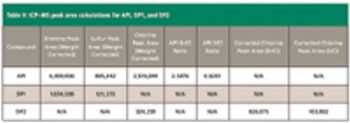
The authors investigate applications for ICP-MS detection with reversed-phase HPLC.

LCGC Europe
Using a fixed length-variant of the kinetic plot method, it is illustrated how an analysis that is performed near the optimal flow-rate of a given commercial column can, in many cases, be performed between 50–200% faster by switching to a longer column and operating it at a higher pressure - at least, if the available instrument pressure admits so. The present article aims to show that short columns are not always the best choice to get the fastest separation.
LCGC North America
At the beginning of the year, it is good to look back in time- are there things that we can learn from the past? After a series of troubleshooting and method development seminars in Istanbul, Turkey, and Amman, Jordan, John Dolan looks back.

LCGC North America
This second part of the series describes the data loss inherent in most early method development experiments due to coelution, peak exchange, and the general difficulty of accurately identifying peaks across the experiment trial chromatograms.

LCGC North America
Guest authors show how mixed modes can be used successfully in the optimization of protein purification, and discuss how various experimental parameters can be used to regulate the binding of proteins to mixed-mode sorbents.
LCGC Europe
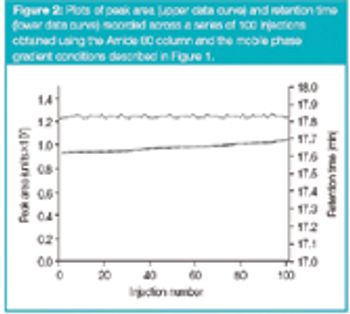
Cytosine (chemical name 4-amino-2-hydroxypyrimidine) is a pyrimidine derivative with a hetereocyclic aromatic ring and two substituents (amine and keto groups) attached and is a polar compound of significant biological and pharmaceutical interest. In response to the intended use of bulk cytosine as a raw material in pharmaceutical manufacturing, a method for the determination of the purity of cytosine was developed.
LCGC North America
This month's "LC Troubleshooting" installment will take a look at the design of these durable pumps and also examine some of the potential weaknesses and how to overcome them.

LCGC North America
An alphabetical listing of all 2008 LCGC articles by author and subject.
LCGC North America
This installation of "Validation Viewpoint" describes how statistically rigorous quality-by-design (QbD) principles can be put into practice to accelerate each phase of liquid chromatography (LC) instrument method development.
LCGC North America
All the buzz lately about LC columns packed with particles smaller than 3 mm often comes with warnings about extracolumn effects. This month's installment will take a look at what these effects are and more.

LCGC Europe
The combination of reversed-phase high performance liquid chromatography (RP-HPLC), atmospheric pressure ionization (API), mass spectrometry (MS) and tandem mass spectrometry (MS/MS) is ideal for determining and characterizing analytes in complex biological matrices. This review looks at the importance of parameters such as hydrophobicity, ionization properties, molecular mass and, partially, the molecular structure resulting from applied LC–MS–MS systems in analytical laboratories. The use of these parameters to investigate biomolecules and their unambiguous identification is also described.

LCGC North America
HPLC with ELSD continues to grow in popularity as a "quasi- universal" detector. Improvements in ELSD instrument design, including low temperature evaporation, have recently been commercialized...