Biodiesel is generally produced by the transesterification of vegetable oil or animal fat with methanol. The triglycerides present in the feed oil (vegetable oil or animal fat) are reacted with methanol in the presence of KOH as the catalyst.

Biodiesel is generally produced by the transesterification of vegetable oil or animal fat with methanol. The triglycerides present in the feed oil (vegetable oil or animal fat) are reacted with methanol in the presence of KOH as the catalyst.

The release of certain chemicals from building products is of increasing concern due to their potential detrimental effect on human health and the environment; therefore, new regulations requiring the production of low emission materials are currently being implemented.

Robust hardware and automated software are critical to method ASTM D7169. The Shimadzu GC-2010, equipped with an advanced flow controller, has proven to be reproducible and effective, and Shimadzu distillation GC software has achieved automation by integrating calibration, integration, calculation, and report functions.

Many methods have been proposed to determine acylglycerols in biodiesel samples. This analysis is commonly performed by GC/FID (ASTM D6584/EN14105 methods).

The fully automated combustion ion chromatography (CIC) system presented here combines a highly efficient combustion system with the separation power of ion chromatography (IC).

Capillary PLOT columns can be a simpler alternative to packed column setups for propylene analysis. Here we demonstrate a single column setup that provides fast baseline resolution of propylene impurities.

Spice and fragrance essential oil raw materials frankincense (Boswellia carterii) from India and Somalia, sandalwood (Santalum album) from India and Indonesia, and corn mint (Mentha haplocalyx) from the United States were analyzed for on-site analytical profiling and confirmation of quality and purity of therapeutic grade essential oils from raw materials.

Oils for foods and cooking are derived from oilseeds like canola, soybeans, corn, flax, and cotton.

As global interest in alternate fuel sources increases, many laboratories are researching effective ways to test, develop, and produce fuel from renewable energy sources.

Biodiesel is much in the news today as an alternate fuel source that is safe and nontoxic. It is renewable, via farming and recycling, and is biodegradable. It is cleaner burning than petroleum-based gasolines, with virtually no sulfur and with no net carbon load to the atmosphere.

Solid phase microextraction (SPME) is a well established sampling technique that is often used to isolate volatile organic components in gaseous mixtures.

Escalating costs and increasing demands for helium, coupled with diminishing helium supply, have given rise to the investigation and use of hydrogen as an alternate choice of carrier gas for use in gas chromatography (GC) applications. This application note illustrates that the use of hydrogen as a carrier gas as an alternative to helium in refinery gas applications is not only possible, but also results in improved performance and higher sample throughput.

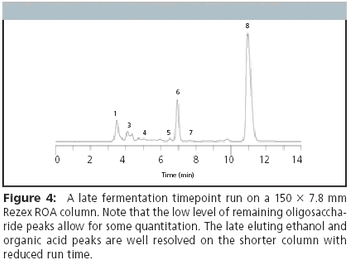
Political priorities as well as economic interests have fueled a dramatic growth in the biofuel industry, due much in part to research funding and tax incentives. Currently the world's ethanol production is estimated to be over 16 billion gallons a year. This number is expected to increase in the next few years, reaching an estimated yearly production of 20 billion gallons by 2012. Today, many ethanol producers add fermentors to expand their production capacity. In order to continue using existing HPLC equipment for the increased monitoring, increased analytical throughput is needed.

Viscotek has been a strong advocate of good chromatography as a prerequisite for GPC (Gel Permeation Chromatography) data accuracy. Our recent work in application development has been driven by extremely difficult samples from industrial, biopharmaceutical, and academic sources. These samples present challenges ranging from sample solubility, column adsorption, as well as detection issues. This report will attempt to highlight a new approach that could be very helpful in certain advanced GPC applications.

Viscotek has been a strong advocate of good chromatography as a prerequisite for GPC (Gel Permeation Chromatography) data accuracy. Our recent work in application development has been driven by extremely difficult samples from industrial, biopharmaceutical, and academic sources. These samples present challenges ranging from sample solubility, column adsorption as well as detection issues. This report will attempt to highlight a new approach that could be very helpful in certain advanced GPC applications.

Azo dyes are used widely in the manufacture of various consumer goods such as leather, textiles, plastics, paper, hair care products, and cosmetics. On September 11, 2003, the European Union enacted European Parliament Directive 2002/61/EC, prohibiting the manufacture and sale of consumer goods containing specified azo dyes (1). The azo dyes of concern are those that can be reduced to aromatic amines. There are 22 aromatic amines classified as carcinogenic or potentially carcinogenic to humans.

The Zebron ZB-Bioethanol GC column reduces fuel ethanol analysis time to less than 8 min, while providing complete resolution of methanol and ethanol from all denaturant components. This newly developed GC column is suitable for analysis following ASTM Method D 5501 and Europe prEN 15376.

Urea and allantoin are added to cosmetic products for skin protection and regeneration, especially for the treatment of dry skin, and analyzed for QC purposes. As polar compounds, they are not ideal for reversed-phase HPLC separations. Neutral hydrophilic compounds like urea and allantoin are best analyzed by hydrophilic interaction chromatography (HILIC). Traditional HILIC columns use silica modified with a hydrophilic group such as diol or cyano. Analytes are adsorbed and subsequently eluted with mobile phases containing high percentages of organic solvent (>75%).


The performance of lubricating oil is significantly degraded by the presence of fuel contaminants such as gasoline and diesel. Recycled oil is particularly susceptible to this form of contamination. Consequently, producers and distributors of lubricating oil must go to great lengths to ensure the levels of fuel contamination are kept to a safe limit (typically 4–5%) in these products.

The analysis of crude oil by means of different atmospheric pressure ionization (API) techniques is described. Crude oil is analysed without any separation prior to API-Fourier transform mass spectrometry. The use of a quadrupole/hexapole device to selectively enhance a certain mass range is demonstrated. Automated generation of molecular formulas from accurate mass measurements enables rapid compound identification.