

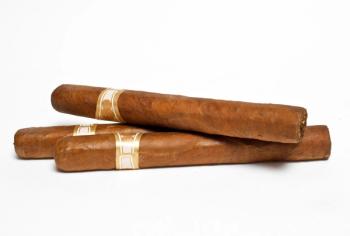
Scientists from Shanghai Jiao Tong University and the Sichuan China Tobacco Industry Company used gas chromatography-ion mobility spectrometry (GC-IMS) to analyze the flavor profiles of different cigars.
Aaron Acevedo is the Assistant Editor for LCGC and Spectroscopy. Direct correspondence to: aacevedo@mjhlifesciences.com
Scientists from Shanghai Jiao Tong University and the Sichuan China Tobacco Industry Company used gas chromatography-ion mobility spectrometry (GC-IMS) to analyze the flavor profiles of different cigars.

Scientists from Universidad Autónoma del Estado de Hidalgo recently tested a new dispersive solid phase micro-extraction (DSPME) technique for removing naphthol isomers from water samples.

National Institute of Pharmaceutical Education and Research (NIPER) scientists recently highlighted LC–MS’s use in improving drug modalities.

Scientists from the Federal University of Santa Catarina reviewed recent advancements made in the chromatographic analysis of endocannabinoids and phytocannabinoids in biological samples.

Here are the top five articles published on LCGC International this week.

Scientists from the Swedish university analyzed the different ways water and trifluoroacetic acid (TFA) affect peptides in sub- and supercritical fluid chromatography (SFC) separations.

Connecticut Agricultural Experiment Station scientists recently used gas chromatography with flame ionization detection (GC-FID) to measure different components in cannabis hemp samples.

University of Messina scientists recently used GC-based techniques to help characterize essential oil from Piper gaudichaudianum Kunth, a plant native to Brazil.

LCGC International recently asked analytical scientists in industry and academia to share how mentorship has impacted their careers.
Here are the top five articles published on LCGC International this week.

Mankind Research Centre scientists recently tested a new solid phase extraction (SPE)-based approach coupled with GC–MS for analyzing small molecule N–nitrosamine impurities in antitussive syrups.

São Paolo State University scientists recently used pyrolysis gas-chromatography–mass spectrometry and dispersive liquid-liquid microextraction to determine flame retardants in sewage.

In a new study, scientists developed a new high-performance liquid chromatography (HPLC) system to optimize miniaturized liquid chromatography (LC).

Dr. Harisingh Gour University scientists recently used micellar liquid chromatography to test how effectively different washing techniques remove insecticides.
Here are the top five articles published on LCGC International this week.

University of Campinas and Iowa State University scientists recently combined vacuum-assisted sorbent extraction (VASE) and gas chromatography-mass spectrometry (GC–MS) to determine polycyclic aromatic hydrocarbons in açaí-based food products.

Scientists from the Institute of Environmental Assessment and Water Research developed and optimized a method for determining various pesticides in human urine.

Northwestern Polytechnical University scientists recently tested a new approach for integrating micro-lenses and slits into portable liquid chromatography (LC) systems.

University of Washington scientists used comprehensive two-dimensional (2D) gas chromatography (GC×GC) paired with time-of-flight mass spectrometry (TOFMS) to study moisture-damaged cacao beans.

Tianjin Centers for Disease Control and Prevention scientists used chromatography techniques to determine bisphenol analogues (BPs) in human urine.

Dalian Maritime University scientists recently used high-performance liquid chromatography tandem triple quadrupole mass spectrometry HPLC-MS/MS to help detect amphetamine-type drugs in water.

Scientists from Università Politecnica delle Marche reported on baseline separation of isotopologoues of some amphetamine (AMP) derivatives on achiral and polysaccharide-based chiral columns.
Here are the top five articles published on LCGC International this week.

Chinese Academy of Inspection and Quarantine scientists recently used gas chromatography–tandem mass spectrometry (GC–MS/MS) to create a new detection method for screening hazardous substances in teethers.

Carol Robinson of the University of Oxford has received the European Inventor Award 2024 for Lifetime Achievement from the European Patent Office for her work bringing mass spectrometry to structural biology.

At HPLC 2024 in Denver, Colorado, various sessions will be led by experienced scientists, covering different aspects of chromatography techniques and maximizing their effectiveness. Here is some information about tomorrow’s sessions.

During a presentation at the conference in Denver, Colorado scientists from Merck and Novilytic spoke about chromatography techniques used for different kinds of pharmaceutical analysis.
Here are the top five articles published on LCGC International this week.

PEAK Scientific, a provider of laboratory gas generation solutions, has opened a new facility in South Korea.

Tarun Anumol of Agilent Technologies discusses the biggest challenges laboratories are experiencing in PFAS testing along with some potential solutions.