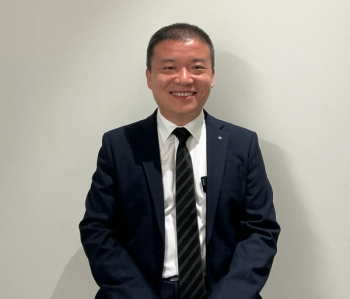
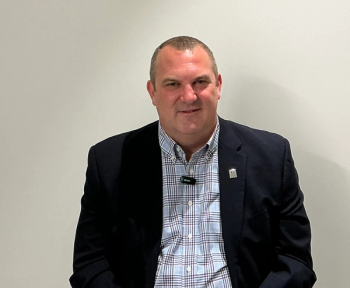
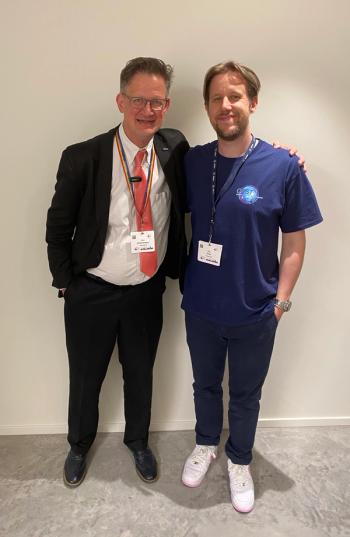
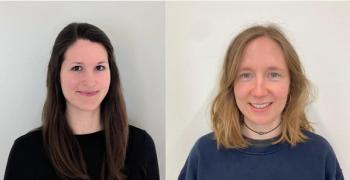
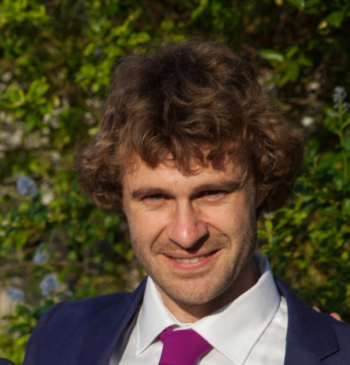
Pirok was presented with the award during the Hyphenated Techniques and Separations Technology (HTC-18) conference in Leuven, Belgium.

Pirok was presented with the award during the Hyphenated Techniques and Separations Technology (HTC-18) conference in Leuven, Belgium.

Gertrud E. Morlock, chair of food science at Justus Liebig University Giessen sat down with LCGC International to discuss the 2LabsToGo portable technology.

Elia Psillakis from the Technical University of Crete, Greece presents an update on the latest developments on sustainability and separation science.

Yelena Sapozhnikova from the United States Department of Agriculture spoke to The Column about her innovative research investigating PFAS in plastic food storage bags using targeted and non-targeted liquid chromatography–tandem mass spectrometry.

Experts from academia and industry present on the innovative research projects they are working on.

At Analytica 2024 in Munich, Germany, LCGC International sat down with Sebastiaan Eeltink of Vrije Universiteit Brussel to talk about three-dimensional liquid chromatography (3D–LC) separations.

Causon, of the University of Natural Resources and Life Sciences in Austria, spoke with LCGC at Analytica 2024 about his newest ion mobility–mass spectrometry (IM-MS) project, MobiliTraIN.

A session focusing on important developments in high-throughput analysis in the pharmaceutical sector using LC–MS kicked off Monday morning at Pittcon 2024.

Lidia Montero and Miguel Herrero from the Institute of Food Science Research in Spain discuss the evolving role of comprehensive two-dimensional liquid chromatography (LC×LC) and multi-second dimension LC×LC (multi-2D LC×LC) in food analysis.

The Column interviewed Tony Edge, President of ChromSoc and Chair of the ISC Permanent Scientific Committee, to find out what participants can expect from the world’s oldest dedicated chromatography conference, being held this year in Liverpool, UK.

LCGC spoke to Hans-Gerd Janssen from the Unilever Foods Innovation Centre in The Netherlands about the advantages of a novel, rapid method to analyze antioxidants that inhibit oxidation.

Alasdair Matheson spoke to Jacob de Boer of Vrije Universiteit Amsterdam about a recent innovative research project investigating per- and polyfluoroalkyl substances (PFAS) in fast food packaging.

LCGC spoke with Leon Barron from the Imperial College London about his work measuring contaminants of emerging concern in water.

Giorgia Purcaro of the University of Liège discusses the advantages offered by the liquid chromatography–comprehensive multidimensional gas chromatography time-of-flight mass spectrometer/flame ionization detector (LC–GCxGC–TOF-MS/FID) method in the analysis of mineral oil.

LCGC Europe spoke to Leon Barron from Imperial College London, UK, about his work developing a fully miniaturized workflow incorporating a three-dimensional-printed passive sampler device (3D-PSD) to monitor contaminants of emerging concern (CECs) in river water.

LCGC Europe spoke to Giorgia Purcaro from the University of Liège in Belgium, about her work investigating mineral oil hydrocarbons (MOH) using GCxGC and the practical advantages that a novel LC–GCxGC–TOF-MS/FID method offers the analyst.

Szabolcs Fekete, winner of the HTC 2022 Innovation Award, reveals the benefits of ultra-short columns to investigate COVID-19.

Anneli Kruve and Pilleriin Peets from Stockholm University in Sweden, discuss their latest research in machine learning and nontargeted liquid chromatography–mass spectrometry (LC–MS) to assess ecotoxicity.

Miniaturized LC systems offer the analyst the scope to use less organic solvent and consume less energy. As the demand for green chemistry techniques and methods continues to grow there is demand for smaller and more portable liquid chromatography (LC) analytical instruments.

The Berlin-based manufacturer of high-tech laboratory measuring instruments, Knauer, celebrated the company’s 60th anniversary in July.

LCGC is proud to announce that Szabolcs Fekete is the winner of the 2022 HTC Innovation Award. Fekete was honoured at the Hyphenated Techniques and Separations Technology (HTC-17) conference in Ghent, Belgium on Friday 20 May 2022 for his outstanding contributions to the field of separation science.

The Column spoke to Stefan Van Leeuwen and Bjorn Berendsen about a novel nontargeted approach to analyze PFASs using LC–HRMS with FIF.

Filip Cuyckens from Janssen R&D in Belgium spoke to LCGC Europe about recent innovative approaches he and his team developed to support drug metabolism and pharmacokinetic studies, and the inventive role that two-dimensional liquid chromatography (2D-LC) plays in his laboratory to boost sensitivity, solve recovery issues, and increase overall efficiency.

The Column spoke to Irma Bongers from Wageningen Food Safety Research (WFSR) in The Netherlands, about a recent research project to analyze prohibited pharmaceutical active substances (PPAS) in milk.

Markes International moved its entire Welsh operations in March this year to relocate from Llantrisant to a newly refurbished site in Bridgend, which is twice as large as its former premises.

Lipidomics researchers from Örebro University have developed a method to analyze levels of per- and polyfluoroalkyl substances (PFAS) in human breast milk using UHPLC–QTOF-MS.

LCGC Europe spoke to Hans-Gerd Janssen from the Unilever Foods Innovation Centre in The Netherlands, about the advantages of a novel, rapid method to analyze antioxidants that inhibit oxidation, and he explains that the maturity of GC technology is actually an advantage to the analyst.

This month we interview Katelynn Perrault, Associate Professor of Forensic Sciences and Chemistry at Chaminade University of Honolulu in Honolulu, Hawaii, about her work translating 1D GC methods to effective comprehensive 2D GC (GC×GC) methods for forensic applications and the benefits that GC×GC offers the analyst.

Per- and polyfluoroalkyl substances (PFAS) in surface water have become a major concern due to their persistency and toxicity. We recently spoke to Stefan Van Leeuwen and Bjorn Berendsen of Wageningen Food Safety Research (WFSR), in The Netherlands, about their novel research into non-targeted PFAS screening using an LC–HRMS method with fragment ion flagging.

In the first of the series, Mariosimone Zoccali, discusses the development of a powerful analytical method to analyze important bioactive molecules using online SFE–SFC–QqQ-MS.