

The Application Notebook
Comprehensive multidimensional gas chromatography time-of-flight mass spectrometry has emerged as an excellent instrumental option for the characterization of small metabolite profiles.
The Application Notebook
Comprehensive multidimensional gas chromatography time-of-flight mass spectrometry has emerged as an excellent instrumental option for the characterization of small metabolite profiles.

The Application Notebook
Development and production of biopharmaceuticals is a growing segment of the pharmaceutical industry. The development of vaccines is only one - but as a result of the current H1N1 flu hysteria it is the most striking - segment of this emerging field. Recombinant proteins, ranging from insulin products to therapeutic antibodies, represent another important group of biopharmaceuticals. With the introduction of the first so-called biosimilars in Europe the demand for highly efficient analysis methods is further increasing. Newly developed stationary phases for the typical modes of biochromatography of native proteins such as SEC or IEC open up new opportunities for increasing throughput in the bioanalytical lab.

The Application Notebook
Corn stover is the above-ground portion of the plant minus the kernels and it accounts for a large percentage of the global supply of lignocelluosic biomass available as feedstock for fermentation systems used for biofuel production.
The Application Notebook
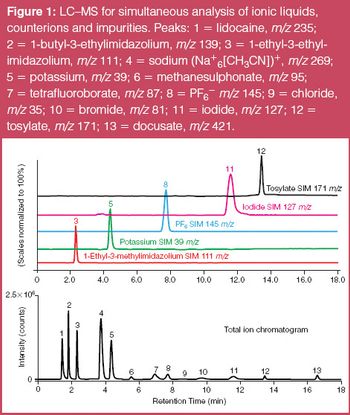
The term ionic liquid refers to organic salts with relatively low melting points (below 100 °C) that usually consist of an organic cation or anion and a counterion, in either organic or inorganic form.

The Application Notebook
The QuEChERS method for pesticide analysis was first introduced by USDA scientists in 2003.1 The EN method 15662:2007 is a European variation to the QuEChERS method.2,3
The Application Notebook
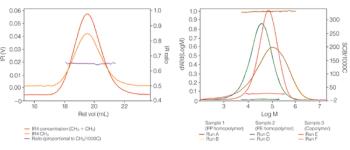
The analysis of the molar mass distribution of polyethylene and polypropylene resins by GPC/SEC has always been considered a demanding task because of the requirement of high temperature operation for dissolution and complex hardware design, which often results in high maintenance cost, in particular related to the autosampler/injector and detector units, and in other problematic and consuming tasks such as solvent handling added to column fragility, sample degradation or detector sensitivity–stability.

The Application Notebook
To guide the development of aggregate free protein formulations, there is an urgent need for complementary methods that allow a sensitive detection, characterization and quantification of different types of protein aggregates.

The Application Notebook
Over-expression of recombinant proteins is commonly used for the production of protein reagents in industry and academia. Problems often occur relating to the stress put on the cells to deal with this huge increase in synthesis. Cellular proteins that are part of the protein synthesis machinery are often up-regulated under such conditions. Large quantities of the recombinant protein can be bound to these cellular proteins, making purification difficult.

The Application Notebook
A critical part of research and quality control analysis of proteins involves verifying the primary and secondary structure of a protein. Peptide mapping is the main technique used to determine the structure of a protein as well as identify any post-translational modifications.
The Application Notebook
Oxidation of amino acid residues can alter a protein's biological activity, half-life and immunogenicity. Peptide maps can be used to detect oxidized peptide fragments. Peptides are commonly separated by RP-HPLC; however, hydrophobic interaction chromatography (HIC) is an alternative technique offering different selectivity.
The Application Notebook
Recent advances in ultrafast liquid chromatography
The Application Notebook
As a result of their high toxicity and carcinogenicity, aflatoxins are of major concern for food producers, the food processing industry and consumers. Most countries have legislation setting maximum permissible limits for aflatoxins, which are in the low micrograms per kilogram for food matrices.
The Application Notebook
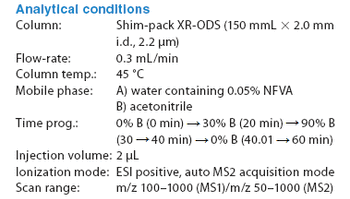
"Amino acid" is a generic term referring to organic chemistry compounds that have amino and carboxyl groups. There are many known types of amino acids with natural origin. In addition to being the basic unit comprising proteins (one of the main constituents of living organisms), they are the raw material necessary for synthesis of physiologically active low-weight molecules such as neurotransmitters. Even as individual units they possess various types of physiological activity. They are researched widely in the fields of medicine and food. Recently, they are being widely used in health foods such as supplements.
The Application Notebook
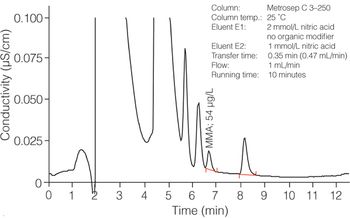
The analytical challenge treated in the present work consists in determining sub-ppb concentrations of low-molecular-weight amines in the presence of strongly retained cationic drugs by using ion chromatography (IC) with upstream in-line coupled-column matrix elimination (CCME).

The Application Notebook
This study uses the challenging analysis of a complex, multi-organ peptide digest of Caenorhabditis elegans (C. elegans) to compare the performance of a novel linear ion trap mass spectrometer and a quadrupole time-of-flight (Q-TOF) mass spectrometer.
The Application Notebook
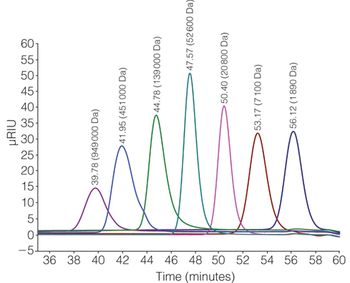
Polyacrylonitrile (PAN) is an important component of many synthetic products such as heavy-duty fibres, synthetic ropes, flame resistant plastics and clothing.
The Application Notebook
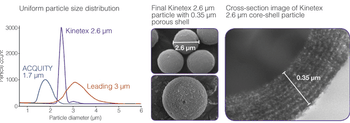
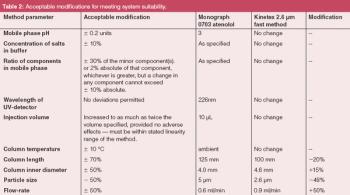
Recently a newly developed Kinetex 2.6 µm core-shell chromatographic particle has been commercialized that offers the performance benefits of sub-2 µm fully-porous particles but at substantially lower operating pressures.
The Application Notebook
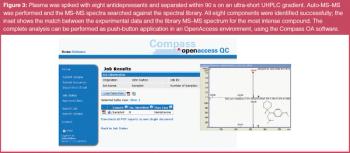
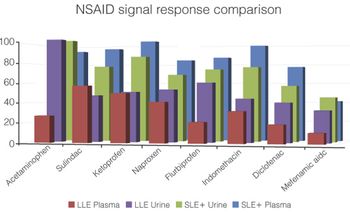
In this application, we demonstrate the use of supported liquid extraction (SLE) for the extraction of beta blockers and NSAIDS from plasma compared with traditional liquid–liquid extraction. SLE was demonstrated to yield consistent LOQs using lower sample volumes.

The Application Notebook
The flexibility to use short sub-2 micron columns on UHPLC instruments at high flow-rates permits fast analysis with high resolution of complex samples. An Agilent ZORBAX Rapid Resolution High Definition (RRHD) Eclipse Plus C18 1.8 µm column separated seven different biocides in less than 1 minute with high resolution. A flow-rate of 1.7 mL/min was used on 2.1 × 50 mm column to achieve the rapid separation. The Agilent 1290 Infinity LC system was used as the column pressure just exceeded 1000 bar at this high flow-rate. A sample of hand sanitizer was found to contain 2-phenoxyethanol and methylparaben using the method.

The Application Notebook
Liquid chromatography coupled with mass spectrometry (LC–MS) is one of the most powerful analytical tools for organic compound analysis.

The Application Notebook
Hydroxyethyl starch (HES) is one of the most important plasma expanders.