Click here to view the full LCGC Europe E-newsletter from 5 September.

Metrohm launches the 940 Professional IC Vario, the new high-performance ion chromatography system for research applications and routine use. The 940 Professional IC Vairo is Metrohm?s most versatile IC system yet.

Chromatography can be approximated by a series of equilibrium events between the mobile phase and stationary phase. Here, LCGC Blog editor Kevin Schug discusses an exceptional spreadsheet macro written by an undergraduate researcher that helps users visualize the development of chromatographic separations.

Alan Rawle, Divisional Applications Manager at Malvern Instruments (Malvern, UK), has been accepted as a Fellow of the Royal Society of Chemistry (FRSC).

Emmanuel Barillot, Director of Bioinformatics and Systems IT at the Institut Curie (Paris, France), has received an Agilent Thought Leader Award. Agilent will contribute financial support, products, and expertise to the work by Barillot to develop a database of cellular signalling pathways and a visualization tool to help the pharmaceutical industry develop more effective cancer treatments. The web-based tool will enable the identification of off-pathway effects of new drugs.


PSS Polymer Standards Service GmbH


Malvern Instruments Ltd.

Wyatt Technology Corporation


Toxicology Laboratory at the Veterans Administration, Portland, Oregon, USA, Agilent Technologies

Wyatt Technology Corporation


Click the title above to open the LCGC Europe September 2013 Applications Book, Vol 26 No s9, in an interactive PDF format.

The 40th International Symposium on High Performance Liquid Chromatography and Related Techniques (HPLC2013-Hobart) will take place at the Hotel Grand Chancellor, Hobart, Tasmania, Australia, from 18–21 November 2013.

A review of the trends at this year's symposium, including discussions of column technology, sample preparation, and detector usage.

How do you identify the cause of unstable retention times?

In this instalment, a way of utilizing HR-MS systems to characterize the structures of metabolites is introduced. This results in a general workflow for metabolism studies for drug discovery and development.


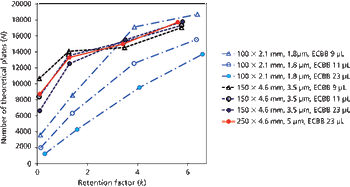
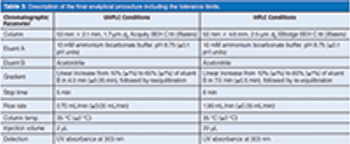
Secrets to Successfully Translating and Transferring HPLC Methods


In this instalment, John Hinshaw compares the GC separation process to a long-distance run through a long corridor with some unique properties. The runners are separated in various ways.

The American Chemical Society (ACS) has named Daniel W. Armstrong, professor of chemistry and biochemistry at the University of Texas (UT) Arlington, to its 2013 Class of Fellows.

Wyatt Technology Application Note

The reasons that make HPLC so ubiquitous; the fundamentals on how we conduct HPLC separations; and a few opportunities with far-reaching impacts in life sciences for separation scientists are discussed in this article.

Understanding the chemistry behind gas chromatography (GC) separations can lead to faster problem identification and improved troubleshooting.

In contrast to isocratic separations, gradient elution can sometimes seem to be counter-intuitive. Yet with the proper perspective, the things we intuitively understand about isocratic methods apply in a similar manner to gradients.

Material identification is a common need in many industries, most notably for pharmaceutical manufacturing where the United States Pharmacopeial Convention (USP) defines many identification tests.