

Richard Henry discusses what chromatographers need to learn, from measuring dispersion and using Van Deemter and Van 't Hoff plots to getting familiar with mobile phase variables.
Richard Henry discusses what chromatographers need to learn, from measuring dispersion and using Van Deemter and Van 't Hoff plots to getting familiar with mobile phase variables.

The Column
There are over 100 different types of vanilla, all characterized by different aroma profiles. To determine vanilla origin, and for quality control purposes, laboratories typically rely on headspace or thermal desorption techniques used in combination with gas chromatography–mass spectrometry (GC–MS). This article explains more.

The Column
A new study published in the journal Analytical Chemistry by scientists from the University of California Davis, the National Marine Mammal Foundation, and the Chicago Zoological Society in the USA presents a novel breath analysis method for Atlantic bottlenose dolphins (Tursiops truncatus) that could be used to monitor and assess the health of wild marine mammal populations.

The Column
A team of researchers at the University of Huddersfield, UK, has investigated the potential of okra for emulsification of certain food products using size-exclusion chromatography (SEC) and fourier transform infrared (FTIR) spectroscopy.1 Okra is a flowering plant and originates from Africa. Okra pectins are acidic, random coil polysaccharides composed of galactose, rhamnose, and galacturonic acid. Pectins are used in the food industry for their gelling, stabilizing, and thickening properties. Okra pectins differ quite substantially from those extracted from apple, citrus, and beet in terms of protein and acetyl contents, indicating their greater hydrophobicity and suggesting that pectin derived from okra can be used as an effective emulsifying agent.?
The Column
Scientists from the Helmholtz Centre for Environmental Research in Germany, have developed a high performance liquid chromatography tandem mass spectrometry (HPLC–MS–MS) method to determine the internal concentrations of 34 test compounds in zebrafish (Danio rerio) embryos.
LCGC North America
LCGC North America Editorial Advisory Board
Professor Georges Guiochon, Distinguished Professor at the University of Tennessee in Knoxville, USA sadly passed away last week on October 21st 2014 at the age of 83. Professor Guiochon was a famous and flamboyant figure in the chromatography community with a prolific output that led to a deeper understanding of the separation mechanisms involved in chromatography.

Some practical insights into optimizing LC–MS eluents and parameters to avoid signal suppression.
E-Separation Solutions
Click here to view the complete E-separation Solutions newsletter from November 6, 2014.
The Column
Click the title above to open The Column November 06, 2014 North American issue, Volume 10, Number 20, in an interactive PDF format.
The Column
Click the title above to open The Column November 06, 2014 Europe & Asia issue, Volume 10, Number 20, in an interactive PDF format.
LCGC North America June 2014 BPA statement
LCGC Europe June 2014 BPA Statement
Special Issues
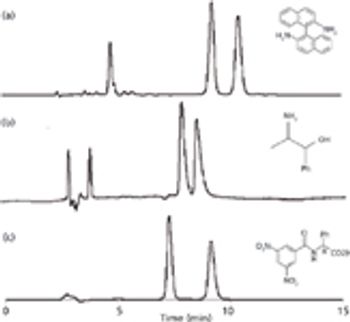
A review of chiral separations, which remain a decided area of interest, particularly in the pharmaceutical and agrochemical fields.
Special Issues
Ron Majors presents a brief introduction to the articles presented in this supplement.
Special Issues
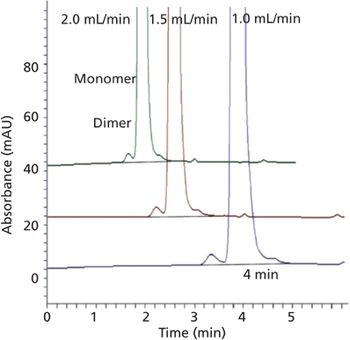
Size-exclusion chromatography is an important technique in biopharmaceutical characterization. This article discusses its use for soluble aggregation analysis and quantitation.

Special Issues
Chromatography has taken a prominent place in the characterization and analysis of protein therapeutic drugs and today it plays a critical role in the biotechnology laboratory.

Special Issues
Controlling particle size distribution is examined as a possible route to further improve the performance of particle-based columns.

Special Issues
An examination of the development of new types of columns based on different particle types, sizes, and other physical characteristics and how they can improve the speed and efficiency of HPLC used to support more expansive and complicated analyses.
LCGC E-Books
LCGC Europe
Click the title above to open the LCGC Europe 2014 Recent Developments in LC Column Technology Supplement, Vol 27 No s11, in an interactive PDF format.
LCGC Asia Pacific
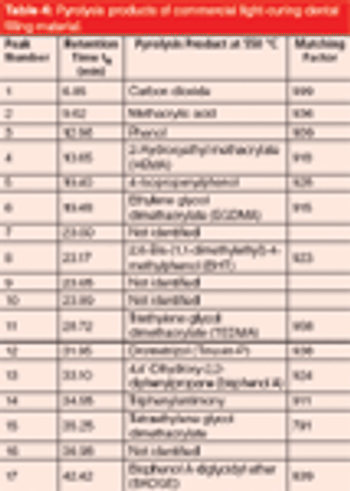
The pyrolysis–GC–MS method enables direct analysis of solid or liquid polymers without sample pretreatment, as illustrated here for various materials, including a dental filling material and a car wrapping foil.

LCGC Asia Pacific
Have you wondered how your GC system sets and controls gas pressures, flows, and carrier gas velocities electronically? Here, we describe the requirements for and the operation of electronic gas control systems for GC columns and detectors.

LCGC North America
How large an injection can you make if the injection solvent is not matched to the mobile phase?

LCGC North America
An explanation of why HPLC eluent systems are designed as they are.

LCGC North America
Here, we examine the various way that chromatographers and chromatography data-handling systems locate and measure peaks.

LCGC Europe
This month's "GC Connections" examines the various ways - and their attendant benefits and drawbacks - that chromatographers and chromatography data-handling systems locate and measure peaks.

LCGC Europe
An explanation of why HPLC eluent systems are designed as they are.

LCGC Europe
How large an injection can you make if the injection solvent is not matched to the mobile phase?

LCGC North America
To obtain the best performance from your UHPLC system, you need the right tubing and fittings. Here is what you need to know.