






LCGC North America
John Dolan considers some techniques to improve detection limits, no matter what the application is.
LCGC North America
John Dolan considers some techniques to improve detection limits, no matter what the application is.

LCGC North America
This month's installment of "MS - The Practical Art" reprises a talk from Chris Lipinski that examines the analytical road ahead in drug discovery and the quest to expand the chemistry landscape and its inherent analytical demands.
LCGC North America
HPLC is among the most dynamic markets in the laboratory analytical and life science instrument industry. The market can be segmented into six different categories, which include conventional HPLC, capillary/nano LC, fast LC, preparative HPLC, amino acid analyzers, and gel permeation chromatography systems. Conventional HPLC systems, which account for the majority of the market, are standard HPLC instruments with typical flow rates between 1–10 mL/min. However, other HPLC systems designed for specific applications and that remedy some of the shortcomings of conventional LC systems, are becoming more significant in the market.

LCGC North America
LCGC Europe
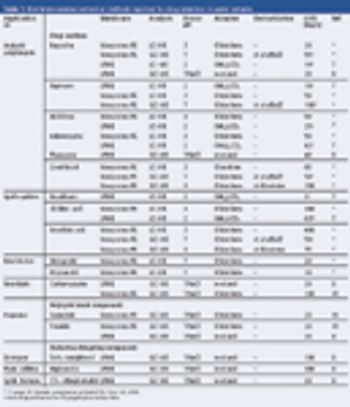
The concept of membrane-controlled processes is widespread in nature. Nearly all biological mechanisms concerning mass transport and exchange are regulated by membrane barriers and a variety of technical and biotechnological applications have been devised based on this mechanism. Membrane applications in analytical chemistry are geared towards the enrichment of target substances from an aqueous solution or the separation of compounds from a complex matrix. This article describes membrane-assisted extraction processes to separate traces of polar pharmaceutical substances the so called emerging micropollutants from aqueous samples. Basic prospects and examples of membrane-supported extractions are presented.

LCGC Europe
Excess variability is not acceptable in a pharmaceutical method.
LCGC Europe
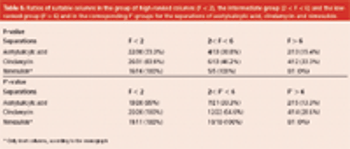
This article gives an overview of the performance of a previously developed system for the ranking of C18 reversed-phase columns applied to different pharmaceutical analyses. The separation of eight different drug substances from their respective impurities was studied. The chromatographic procedure for acetylsalicylic acid, clindamycin hydrochloride, buflomedil hydrochloride, chloramphenicol sodium succinate, phenoxymethylpenicillin and nimesulide was performed according to the corresponding European Pharmacopoeia monograph. The separations of dihydrostreptomycin sulphate and vancomycin were performed according to literature. It was found that that the column ranking system is a helpful tool in the selection of suitable columns in these analyses.

The Column
Through the years, Pittcon has provided a platform for leading researchers to present new breakthroughs in their scientific endeavors.
E-Separation Solutions
Beginning in February, Steve Brown, LCGC technical editor of 18 years, will answer your technical questions. Each month, one question will be selected to appear in this space, so we welcome your submissions. Please send all questions to the attention of "Ask the Editor" at [email protected]. We look forward to hearing from you.
Regis Technologies, Inc. partners with pharmaceutical, biotechnology, and other companies to help expedite drugs to market by providing synthesis and separations services. Regis Technologies announced today it has added Supercritical Fluid Chromatography (SFC) to its separations services and will offer GMP separations April 1, 2007.

LCGC Europe
In any field there are often "misconceptions" or "myths" that are perpetuated and passed on to the next generation. These myths are often driven by a lack of understanding by practitioners of the real issues. In this instalment of "Column Watch", the 10 most popular myths around high performance liquid chromatography (HPLC) column technology will be demystified by discussing the issues at hand. Among some of the popular myths that will be dispelled are that "All C18 (L1) columns are the same", "You can't reverse an HPLC column", "High temperature always leads to better separations" and "The higher the carbon load the better the reversed-phase column".

LCGC Europe
This article describes and compares a number of approaches to increase the speed of liquid chromatographic separations. On a standard LC column, a gain of a factor two in the run time (from 10 to 5 minutes) was achieved by increasing the flow-rate two-fold. On a monolithic column, a column operated at high temperature (120 ?C) and a short column, flow-rates could be increased typically five-fold, resulting in run times in the order of 2 minutes. This was accompanied by a sometimes considerable loss in separation efficiency. A combination of a very short run time and unaffected separation efficiency was realized on a UPLC system, designed for use at higher pressure. By working at approximately 800 bar, the analytes could be well separated within 30 seconds.
LCGC Europe
This month's instalment of "LC Troubleshooting" presents two examples of sample degradation inside the liquid chromatography (LC) column. Depending upon the type of samples you analyse, sample degradation might or might not be a problem that you encounter regularly. However, most of us run a sufficiently wide variety of sample types over our careers that we will probably run into some samples that do not behave as expected.

LCGC North America
Emerging as a complementary analytical tool to LC-MS, LC-ICP-MS brings added value to the determination of inorganic element containing molecules of biological importance.
LCGC North America
Chromatographers worldwide suffer from the same problems.
LCGC North America
The environmental market peaked about fifteen years ago when the United States government passed a large body of new environmental laws and strengthened existing ones, dramatically increasing the number of mandated tests. As a result, the analytical instruments market received a boost in new instrument sales. While growth from the environmental market has slowed considerably since, the total market is still quite significant.

The Application Notebook
The analysis of peptides and additives using a new HPLC innovative column technology, Pathfinder, was shown. For the analysis of flavours in lemon juice GC–MS with a new MS library, FFNSC, with linear retention indices was used.

The Application Notebook
Soft drink formulas often include preservatives, artificial sweeteners, flavours or caffeine in their list of ingredients. Using the Acclaim OA column, as many as eight common additives may be determined in a single run. Many of these additives are hydrophilic organic acids for which this column was designed. Notably, benzoate and sorbate, which do not resolve on C18 columns at low pH, are fully separated.

The Application Notebook
Column lifetime is a more and more important issue when developing an analytical method for HPLC. Besides sample treatment, column cleaning and storage, operational parameters of the analytical method will have an influence on column lifetime. This question may not always be addressed early enough in the methods development process.
LCGC Europe
The authors describe a study that was conducted to evaluate the correlation between the slope of the response line and the response factor of an ELSD that are ordinarily regarded as independent numerical coefficients.

LCGC Europe
Sometimes it is easy to ignore the fittings and tubing that are used to connect various parts of the liquid chromatography (LC) system. After all, it's the pump, injector, column and detector that do all the work - right? Well, yes and no. It is possible to compromise an otherwise excellent separation by the improper use of fittings, but with reasonable care, you should not have problems with most applications. This month's instalment of "LC Troubleshooting" takes a look at the important components that are used to connect various parts of the LC system and how to use them wisely.
LCGC Europe
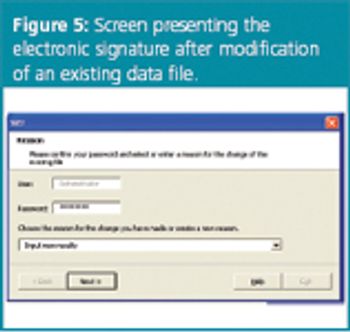
In a good laboratory practice (GLP) environment, data-handling software cannot be used until it is validated. This even applies to the most simple program that performs calculations or stores data. A detailed documentation of the set-up and the performance of the software - called software validation - is required. The development and validation requirements are described in this article and illustrated with a software for robustness testing (SRT), which guides the user step-by-step through the experimental set-up and interpretation of robustness tests. This software was developed in an Excel (Windows XP) environment and is used as part of method validation in laboratories that require compliance with GLP and 21 CFR Part 11. The software was subjected to software validation regulations and is compliant with electronic records and signature rules (21 CFR Part 11) as it creates, delivers and stores electronic data. The validation tests are based on the computerized system validation (CSV) -..

LCGC Europe
This article assesses the advantages of including certified reference materials in collaborative method validation studies in food analysis. A recently conducted collaborative trial on the determination of acrylamide in bakery and potato products is described to illustrate this.
LCGC North America
LCGC North America