In this month's "LC Troubleshooting," we look at two questions submitted by readers that relate to mobile phase.


In this month's "LC Troubleshooting," we look at two questions submitted by readers that relate to mobile phase.

The established kinetic plots clearly show that monolithic columns are suited for large plate number separations whereas in the small plate number range the 3 ?m packed bed system is to be preferred.

Although there are other possible causes, the most common source of fronting peaks is a disturbance in the column packing bed. The fix is straightforward: replace the column.

A good pretreatment system combines reverse osmosis and electrodeionization technologies.

The authors look at three column performance problems encountered frequently in today's laboratory.

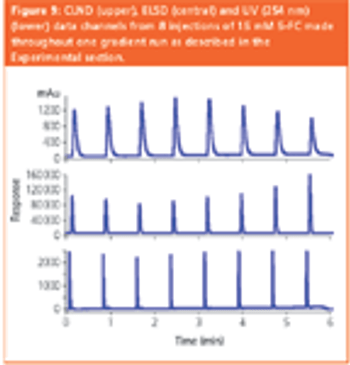
A detection method based upon aerosol charging was examined for its applicability and performance with high performance liquid chromatography.

The authors address the specific separation problems of proteins and assess whether 2D liquid chromatography could possibly be considered as an alternative to traditional 2D gel electrophoresis in the future.

In the last part of this series, the authors provide a technical review of the means for method adjustment and the pertinent regulations concerning the required validation of adjusted methods.

This month, John Dolan offers some suggestions for distinguishing between overload and the presence of a minor peak.

Guest columnist Matt Przybyciel reviews the structure, behavior, and applications of both alkyl- and phenyl-fluorinated phases in HPLC.

Some possible solutions to the ubiquitous paek-tailing problem are presented by the author.

This month, John Dolan turns his attention to the unexplained forces that seem to inhabit laboratories in spite of the most ardent troubleshooting efforts.

As LC-UV and LC-MS have become preferred instrumental methods for fast, sensitive analysis, many scientists are searching for ways to optimize performance.

This month’s column provides an overview of green chemistry issues relating to preparative chiral SFC chromatography in support of preclinical development in the pharmaceutical industry.

Bob McDowall stresses the importance of using accurate and precise time and date stamps to ensure the integrity of the data and results generated by computerized systems in any chromatography laboratory.

Columnist Leslie Ettre looks back at the life and contributions of Csaba Horvath, one of the giants in the field of chromatography.

This article examines the results of chromatographic performance when using different buffers. A study of the origins of the differences in peak shape obtained when using varying buffers–additives is presented with regard to the analysis of basic peptides in reversed-phase HPLC.

The authors provide the latest information on new stationary phases for modern TLC and high performance TLC (HPTLC), along with helpful hints on how to get the most out of this flexible form of chromatography.


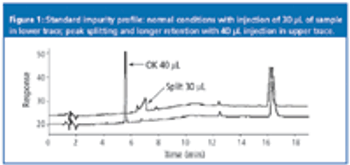
In this month’s column, John Dolan addresses a reader’s peak-splitting problem and suggests ways to avoid such occurrences in the future.

When is it time to throw in the towel?

This month's installment of "Column Watch" is the conclusion of a two-part series in which Ron Majors examines the trends in column introductions at Pittcon 2005. Here, he discusses gas chromatography columns, sample preparation products, hardware, and accessories.

In this article, Jo Webber tackles the problem of ensuring data integrity in pharmaceutical manufacturing. She shows how, by using modern technology and well integrated systems, quality can be improved.

Co-occurrence of several mycotoxins (deoxynivalenol, zearalenone, T-2-toxin, HT-2 toxin) produced by field fungi, such as Fusarium graminearum and Fusarium culmorum, requires several analysis methods for their characterization. A reliable method for the determination of type A- and B-trichothecenes and zearalenone in cereal-based samples is presented. To achieve optimal mass spectrometric detection, electrospray ionization (ESI) and atmospheric pressure chemical ionization (APCI) were compared. Best results were obtained with ESI by implementing a two-period switching for the ionization polarity. The limit of quantification differs for each individual substance within the range 1–10 ppb. Mean recoveries using a standardized clean-up procedure were in the 54–93% range.