
A report on the meeting that took place in April this year in York.

A report on the meeting that took place in April this year in York.

Column author, John Dolan, presents a simple but powerful isolation technique for identifying problems with LC methods and equipment.

The authors use the stochastic model to estimate the fundamental characteristics of the separation process.

A C18 stationary phase based upon a titanized silica support was prepared through reaction with octadecyltrimethoxysilane.

A look at the latest developments in preparative-scale columns, bulk packing materials, and column hardware designs.

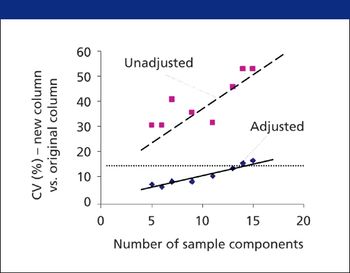
The author focuses on a simple but powerful tool for isolating problems in the laboratory.

The separation of individual congeners of commonly used fluorescent whitening agents is described.


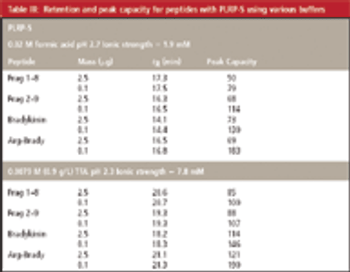
The authors study the solubility of five buffers commonly used in reversed-phase liquid chromatography.

In this month's column, John Dolan addresses some of the guidelines regarding system suitability tests and comments on their significance for those developing chromatographic methods.

A selection of mini application note write-ups

GC column bleed has been postulated to be caused by "backbiting" of the siloxane chain and volatility of noncrosslinked oligimers...

The authors discuss the application of shear-driven chromatography, a technique that depends on viscous drag to propel mobile phase in high-resolution/high-speed liquid chromatography. This method, it is claimed, overcomes the pressure- and voltage-drop limitations of both HPLC and CEC. Early development of the technique is reviewed and updated with the current status of the group's work. Also covered are the challenges faced and opportunities available to interface such systems to MS and UV/vis absorption detectors.

In this month's instalment, the authors cover the topics of column-switching techniques and parallel chromatography for LC?MS?MS methods, and describe the time benefits that can be achieved using such systems. An example set-up is presented and the authors outline the various steps required to perform such analyses routinely.

Sounds simple, but what is required?

A simple, rapid, and sensitive method is presented for clinical measurements of ascorbic acid and malondialdehyde in human serum.

How the use of peptide standards can indicate control as well as provide guidelines for method development.

A look at ways to get more out of your detector.

The second part of a two-part series examining new column introductions at Pittcon 2004.

This article describes the optimum performance laminar chromatography technique and gives a brief account of recent applications in which it has been used.

In the first of a two-part series, Ron Majors examines new column introductions at Pittcon with special attention to high performance liquid chromatography columns and packings for reversed-, normal- and bonded-phase; ion exchange; ion and size-exclusion chromatography. He also considers speciality HPLC columns.

Following on from a previous instalment, this month's column assesses evaporative light-scattering detection as a complementary detection mode and builds upon the previous discussion in terms of detector applications.

In this month's column, the authors present a relatively simple method for selecting the appropriate curve-fitting function and thus ensure that the requirements of current guidelines can be met.

This month'ss "Column Watch" is the first of a two-part series that examines new column introductions at Pittcon 2004.