UHPLC

Latest News


What are the most useful chromatography books on your bookshelf? What are the most useful web-based resources (such as websites, downloadable documents, videos) about separation science? What are the most useful tools supporting your work (such as calculators and simulators)? In this installment, Dwight Stoll compiles input from the separation science community (both individuals and vendors) to guide you to the resources that people find most useful.

ChromSoc Meeting Review Backdrop.jpg

The three-day Chromatographic Society meeting was held on Monday 15th until Wednesday 17th May 2017 and was hosted by Pfizer at Discovery Park in Sandwich, Kent, UK. This comprehensive symposium featured oral presentations from leading practitioners of supercritical fluid chromatography (SFC) and ultrahigh-pressure liquid chromatography (UHPLC) from throughout Europe. Some of the latest innovations and applications were described and the lectures were augmented and supported by a comprehensive exhibition of instrumentation and consumables. The attendees gained insight into practical application of these techniques across a variety of industries-particularly the pharmaceutical industry. As was anticipated, in a comprehensive programme there was a significant focus on SFC for chiral and preparative-scale analysis.

figure 1 L.png

This instalment in our series on ultrahigh-pressure liquid chromatography (UHPLC) highlights its benefits in fast analysis, high-resolution separations, high performance liquid chromatography (HPLC) method development, reduced solvent and sample usage, and enhanced sensitivity and precision performance.

Gert Desmet.jpg

A recent argument was raised in the scientific press that in pursuit of greater speed and separation resolution, ultrahigh performance liquid chromatography (UHPLC) is faced with practical limitations and will struggle with its own version of Moore’s law.

Imma Ferrer.jpg

Environmental analyses of food, soil, and water have changed dramatically over the last decade. Topics such as pesticides, food additives, and natural products have become important as food products are globally grown and distributed (1). Monitoring their quality is critical to international business. Pharmaceuticals, fluorinated surfactants, and endocrine disruptors in water are major new topics, where not only parent compounds are unknown but also their metabolites and degradation products are often more important or more abundant than the parent compound (2). New environmental issues, such as hydraulic fracturing and its wastewater, have captured our attention as the production of oil and gas has increased exponentially in the past decade (3). With this technology comes the problem of wastewater disposal and groundwater contamination. These environmental issues have greatly benefited from the combination of ultrahigh‑performance liquid chromatography (UHPLC) mated to high resolution mass spectrometry (HRMS

figure 1.png

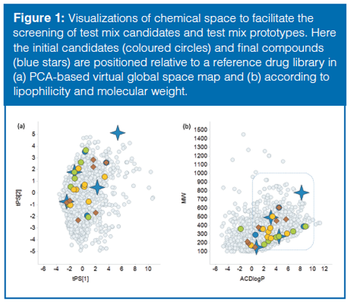
Chromatographic techniques with mass spectrometric detection are important enablers in modern drug discovery. With the development of robust instrumentation and implementation of user-friendly software (or software packages), non-expert users can now walk up to easily accessible advanced chromatographic systems and perform experiments at their own convenience. Although remarkable improvements in robustness and ease-of-use have happened since the introduction of the first high performance liquid chromatography–mass spectrometry (HPLC–MS) systems, the instrument performance still needs to be qualified and monitored to ensure consistent high-quality results. This article will demonstrate how a simple test mixture of carefully selected compounds can facilitate both the development of generic ultrahigh-pressure liquid chromatography–mass spectrometry (UHPLC–MS) methods and automated performance monitoring of multiple instruments located in separate laboratories and buildings.

figure 11484756873668.jpg

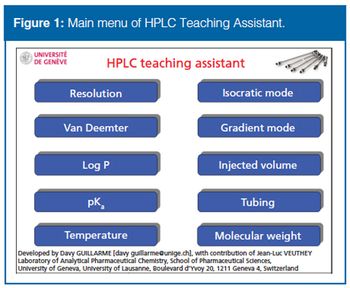
The free spreadsheet-based program HPLC Teaching Assistant was developed for effective and innovative learning and teaching of liquid chromatography. This software allows teachers to illustrate the basic principles of high performance liquid chromatography (HPLC) using virtual chromatograms (simulated chromatograms) obtained under various analytical conditions. In the first instalment of this series, we demonstrate the possibilities offered by this spreadsheet to illustrate the concept of chromatographic resolution, including the impact of retention, selectivity, and efficiency; understand the plate height (van Deemter) equation and kinetic performance in HPLC; recognize the importance of analyte lipophilicity (log P) on retention and selectivity in reversed-phase HPLC mode; and manipulate or adapt reversed-phase HPLC retention, taking into account the acido-basic properties (pKa) of compounds and the mobile-phase pH.

Blue-Figure-5-web.jpg

UHPLC instruments from different manufacturers and instruments with different configurations can produce significant variations in chromatographic separation. The variety in instrument configuration increases the complexity of the method development process, which now requires a more thorough evaluation of the effect of instrument variations on the method. The studies presented here determined the typical inter-instrument variations in dwell volume, extra-column dispersion, and mixing efficiency as measured by mobile phase compositional accuracy. Additionally, the dwell volume and extra-column dispersion were independently and systematically varied to evaluate the resulting impact on resolution for a small molecule test mixture during gradient elution. To account for these inter-instrument variations, dwell volume and wash-out volume method translation and adjustment techniques were evaluated.

MSPA_Figure-1_web.jpg

Non-targeted metabolite profiling by ultrahigh-performance liquid chromatography coupled with mass spectrometry (UHPLC–MS) is a powerful technique to investigate the influence of genetic and environmental influence on metabolic phenotype in plants. The approach offers an unbiased and in-depth analysis that can reveal molecular markers of desirable phenotypic traits which can be complementary to genetic markers in plant breeding efforts. Here, the power of non-targeted metabolite profiling is illustrated in a study focused on the determination of molecular markers in malting barley that are predictive of desirable malting quality for brewing applications.

Fig-5-web.jpg

During the course of my scientific career beginning in the 1960s, I have grown up with the birth of modern LC column technology, the refinements of the instrumentation, and the development of widespread application of this most powerful separation and analysis technique. In this installment, I would like to share with you some of my observations and experiences with the beginning, the growth period, and the maturation of HPLC columns, where I have focused nearly 33 years of writing for this magazine. I will explore some of the early column breakthroughs beginning with the development of large superficially porous particles (SPP), the porous irregular and spherical microparticulate particles, inorganic and organic polymeric monoliths and the rebirth of the current generation of SPP. In next month’s installment I will look into my crystal ball and see what the future of HPLC and UHPLC holds.


 Volume 33 Number 4Pages 234-247This is our annual review of new liquid chromatography (LC) columns and accessories introduced at Pittcon and throughout the previous year. This year, Michael Swartz, former author of our "Innovations in HPLC" and "Validation Viewpoint" columns, steps in as a guest columnist to write the review.

When I was asked to edit a supplement for LCGC again, I was delighted. My background in physical chemistry has always made me captivated by separation theory; my career in industry has taught me to be practical in its use.

A QuEChERS-based ultrahigh-performance liquid chromatography triple quadrupole tandem mass spectrometry (UHPLC–QqQ–MS–MS) method was used to determine pesticides in nutraceutical products from green tea (Camellia sinensis),

Myths About UHPLC

Click here to view the complete E-Separation Solutions newsletter from November 14, 2013.