

LCGC North America
Improving and optimizing EPA Method 593 using solid phase extraction (SPE) enhances sensitivity and maximizes efficiency while screening by LC–MS-MS for different female birth control hormones present in drinking and waste water.
LCGC North America
Improving and optimizing EPA Method 593 using solid phase extraction (SPE) enhances sensitivity and maximizes efficiency while screening by LC–MS-MS for different female birth control hormones present in drinking and waste water.
LCGC Europe
Using oral fluid as the matrix, a viable and simple solid phase extraction method for a wide range of drugs is developed. Several oral fluid collection devices were evaluated to determine the effectiveness of the cleanup procedure, ultimately confirming that the method is both robust and widely applicable.
LCGC Europe
An ultra-sensitive sample preparation technique using solid phase extraction (SPE) microelution 96-well plates effectively concentrates peptides and allows for cleanup of small volume.
LCGC North America
A suite of unknown drug compounds from whole blood are analyzed by LC–MS-MS, requiring the need for an effective yet nonspecific cleanup technique. The resulting method demonstrates a simple and fast sample preparation procedure that is suitable for screening many compounds.
LCGC Europe
A suite of unknown drug compounds from whole blood are analyzed by LC–MS-MS, requiring the need for an effective yet nonspecific cleanup technique. The resulting method demonstrates a simple and fast sample preparation procedure that is suitable for screening many compounds.
LCGC North America
An ultra-sensitive sample preparation technique using solid phase extraction (SPE) microelution 96-well plates effectively concentrates peptides and allows for cleanup of small volume.
LCGC North America
WAX type columns are the industry standard analyzing a wide range of compounds with polar functional groups. The new Agilent DB-WAX Ultra Inert GC column is presented.
LCGC Europe
WAX type columns are the industry standard analyzing a wide range of compounds with polar functional groups. The new Agilent DB-WAX Ultra Inert GC column is presented.
LCGC Europe
Starch is used for a variety of industrial and nu¬tritional purposes. Its functional properties are influenced by the ratio and molar masses of its mac¬romolecular constituents, which vary with source, crop year, and climate. Starch contains large homopolymers of amylose (AMY) and amylopectin (AMP).
LCGC North America
This Application Note describes the comparison of complex hop aroma profiles by GC–MS, and the identification of aroma-active terpenoids aided by soft electron ionisation.
LCGC Europe
This Application Note describes the comparison of complex hop aroma profiles by GC–MS, and the identification of aroma-active terpenoids aided by soft electron ionisation.

Special Issues
An effective analytical method for detecting pesticide residues in olive oil

Special Issues
The resolution, sensitivity, and mass accuracy of the Agilent 7200 GC/Q-TOF system provide rapid, simple, and reliable analysis of trace levels of sulfur compounds in coffee.
Special Issues
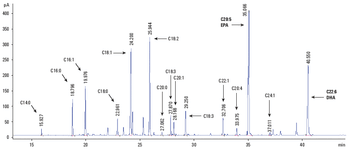
The automated derivatization of fatty acids (FAs) was performed with the Agilent 7696A Sample Prep WorkBench. Since free fatty acids show tailing in gas chromatography, transformation of fatty acids into fatty acid methyl esters (FAMEs) is widely used.

Special Issues
Polychlorinated dibenzo-p-dioxins (PCDD) and polychlorinated dibenzofurans (PCDF) are fat-soluble, highly toxic, ubiquitous environmental contaminants found at trace levels in all foodstuffs and animal feed.
The Application Notebook
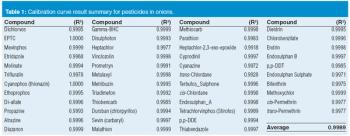
Most recently formulated pesticides are smaller in molecular weight and designed to break down rapidly in the environment.

The Application Notebook
SPME-GC–MS with on-column injection can be successfully employed for flavour profiling of food samples. The on-column injector of the GC-2010 can be used for SPME without any modifications, only an external ring adapter was used to facilitate the injection. The data can be compared with sensorial data of food.

The Application Notebook
The composition and analysis of fragrance components in home and personal care (HPC) products is very complex and unquestionably time consuming.

The Application Notebook
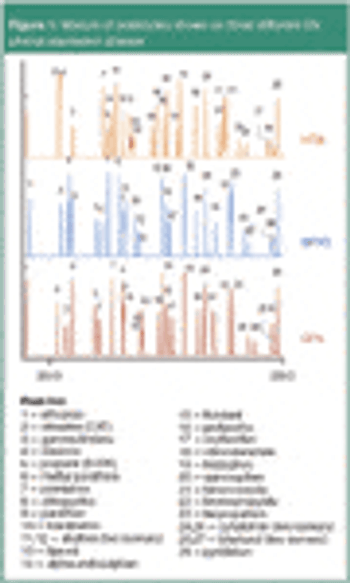
The QuEChERS method for pesticide analysis was first introduced by USDA scientists in 2003. The EN method 15662:2007 is a European variation to the QuEChERS method. The method uses acetonitrile extraction, followed by the salting out of water from the sample using anhydrous magnesium sulphate (MgSO4, NaCl and buffering citrate salts to induce liquid–liquid partitioning.
The Application Notebook
The separation of structurally diverse analytes is often complicated by chance coelutions with other analytes or with matrix related compounds. Often the column is blamed, but while such coelutions make analysis difficult they do not necessarily indicate a faulty column, poor chromatography or method design.

The Application Notebook
Trace-level chlorinated hydrocarbon analyses using methods such as U.S. EPA Method 551.1 are important tools for assessing organochlorine contamination in water. The wide diversity of target organochlorine compounds can prove chromatographically challenging due mainly to their high volatility and limited retention. This application note shows the benefits of using an Agilent J&W HP-1ms Ultra Inert Capillary GC column as the primary column for detection in this dual-column analysis.

The Application Notebook
Biodiesel is much in the news today as an alternate fuel source that is safe and nontoxic. It is renewable, via farming and recycling, and is biodegradable. It is cleaner burning than petroleum-based gasolines, with virtually no sulfur and with no net carbon load to the atmosphere.

The Application Notebook
Most U.S. Environmental Protection Agency (U.S. EPA) methods for analysis of volatile organic compounds (VOCs) specify purging with helium for 11 min at 40 mL/min, making purge-and-trap (P&T) one of the biggest consumers of helium in a laboratory. Compared to helium, nitrogen is abundant, inert, and can be purchased at affordable prices.

The Application Notebook
Over the past 15 years, little has changed for the commercial environmental laboratory's ability to automate U.S. EPA Method 8260 for water and soil purge and trap analysis. As work loads have increased, reporting levels have decreased due to MS sensitivity improvements. However, it has become increasingly difficult for laboratories to run at high levels of productivity due to autosampler reliability, carryover, and internal standard reproducibility challenges. Each of these issues has been addressed in a new Centurion WS autosampler (see Figure 1) designed specifically for the commercial environmental laboratory.

The Application Notebook
Illegal drug use worldwide is at an all time high. Forensic laboratories are seeing increased sample loads creating an immediate need for fast and accurate analysis to positively identify confiscated materials in criminal investigations. This application highlights the value of gas chromatography with time-of-flight mass spectrometry (GC-TOFMS) for drug testing in forensic laboratories. A method was developed to successfully identify twenty drugs of abuse in 4.5 min. This GC-TOFMS method shows good chromatographic peak shape for even the most challenging drug analytes; even the peak shapes for amphetamine and methamphetamine were exceptional considering they were analyzed underivatized. The total ion chromatogram (TIC) for the twenty drug analytes is shown in Figure 1.

The Application Notebook
Synthetic fused silica capillary tubing is a vital component in many scientific techniques. The general perception is that most laboratory glass products are fragile and easy to break. The opposite is true of fused silica capillary; with its protective coating it is both strong and durable when handled properly.

The Application Notebook
GC–MS method is presented for the quantitative determination and confirmation of melamine residues in milk products. The milk sample was cleaned up using Agilent's SampliQ SCX SPE cartridges before derivatization. The derived extracts were analysed by GC–MS with EI in synchronous SIM/scan mode on a Agilent J&W DB-5ms Ultra Inert column.

The Application Notebook
Thermal agility is a term that describes the ability of an oven to heat up and cool down. Both steps comprise the complete cycle time which, in turn, determines sample throughput. Fast GC accessories provide an attractive means of increasing sample throughput because they are easy to implement and deliver reliable performance at low cost. They require little or no bench space and do not incur additional costs for consumables and support equipment such as autosamplers, data acquisition software, and computers. Fast oven cooling is especially attractive because methods do not have to be re-validated since the separation parameters remain unchanged.

The Application Notebook
The Clean Air Act (CAA) (1) provides the U.S. Environmental Protection Agency authority to enforce regulations limiting emissions of volatile organic compounds (VOCs) and other air pollutants. The Compendium of Methods for the Determination of Toxic Compounds in Ambient Air includes a variety of sampling and analysis methods (2, 3), including use of single- and multi-sorbent tubes. Concentrating a large volume of sample onto a sorbent tube, followed by thermal desorption onto a GC column provides an efficient, cost-effective means of monitoring VOCs at parts per billion (ppb) or parts per trillion (ppt) levels.

The Application Notebook
Hydrogen, commonly used as a carrier gas instead of Helium for gas chromatography (GC) can be supplied via cylinders or by the electrolysis of water using an in-house generator containing metallic electrodes or an ionomeric membrane. An in-house generator can provide a significant increase in safety and convenience with a reduction in operating costs.