Articles by Thermo Fisher Scientific

In this webinar, we will discuss the use of new, affordable HRMS instruments in quantitative clinical research analyses, demonstrating the sensitivity and selectivity of these instruments for this work. Examples of clinical research quantification work in HR full scan or MS-MS mode will be presented and compared with results from triple-quadrupole-MS. We will also discuss an example of Qual/Quan analysis in a study of the fate of an anti-cancer agent in humans, where over 40 metabolites were identified and quantified. We will also show metabolomics data underscoring the versatility of HRMS instruments.
The application of high resolution, accurate mass (HRAM) mass spectrometry coupled with multidimensional chromatographic separations, bioaffinity isolation techniques, and online sample preparation methods to detect, identify, and quantify emerging contaminants (including endocrine disruptors, pharmaceuticals, and surfactants) in wastewater and drinking water.
The overarching goal of Lee’s research is to gain an increased understanding of how emerging contaminants are transported, transformed and induce deleterious effects within aquatic ecosystems.

NOTE: This is a large file. Please allow several minutes for download.

Thermo Scientific Application Note
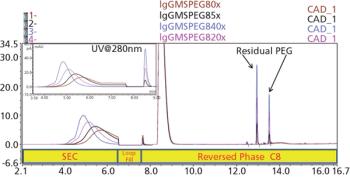
Biotherapeutic peptides and proteins are often PEGylated (covalently bonded to polyethylene glycol polymers) to improve bioavailability, reduce immunogenicity, and extend circulating half-life (1). Achieving the desired properties for each application depends on optimizing the number and site of polymers attached, chain length, and the degree of chain branching.

Simple, rapid and accurate methods have been developed for the analysis of simple carbohydrates including mono- or disaccharides, or as fairly small glycans (6–11 residues) liberated from glycoproteins using charged aerosol detection combined with mass spectrometry techniques.

Selective cleavage of proteins by the enzyme trypsin helps characterize larger proteins. While MS provides structural information, quantitative analysis is often based on detection by UV at 214 nm.
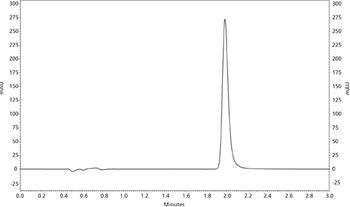
This application note demonstrates the use of the Thermo Scientific Syncronis C18 1.7 ?m column for the determination of esomeprazole by UHPLC-UV.
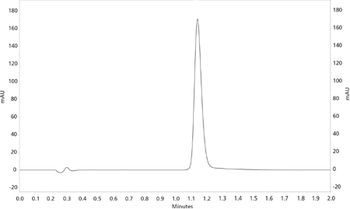
This application note demonstrates the use of the Thermo Scientific Accucore RP-MS column for the determination of telmisartan by HPLC-UV.

U.S. EPA Method 531.2 describes the determination of widely used carbamate pesticides in raw surface water using HPLC with fluorescence detection following postcolumn derivatization, which enhances method sensitivity and selectivity as compared to UV absorbance detection.
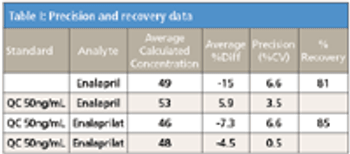
A liquid chromatography tandem mass spectrometry method for enalapril and enalaprilat from human plasma has been developed using Thermo Scientific SOLA cartridges. Sample preparation is fast, efficient, and reproducible giving excellent recovery levels for each compound.

Tetracycline (TC), a common antibiotic used to treat urinary tract infections, acne, gonorrhea, and other conditions, yields a toxic degradation product, 4-epianhydrotetracycline (EATC). General Chapter 226 of the U.S. Pharmacopeia and National Formulary (USP-NF), referred to by monographs for epitetracycline and drug products containing tetracycline hydrochloride (TC-HCl), prescribes an antiquated assay for EATC impurity in TC.
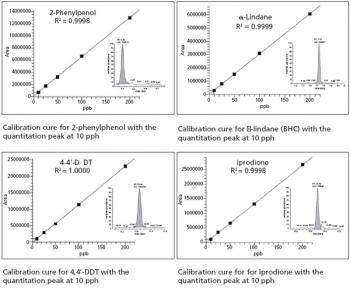
International regulations on maximum residue levels (MRLs) of pesticides in food cover hundreds of individual contaminants at the 10 ppb or below range. The analysis of citrus oil for pesticide contamination holds specific challenges.

The screening of pesticides, mycotoxins, and veterinary drugs is of great importance in regulated environments such as food or feed analysis. Due to some of the limitations of traditional triple quadrupole approaches (for example, targeted analyte detection, limited number of compounds, and unidentified unknown compounds), there is currently a trend towards use of full-scan MS data for the analysis of residue samples. Current screening approaches mainly rely on the use of ToF instruments coupled to U-HPLC delivering mass accuracy (~5 ppm) at a maximum resolution of <15,000. This can produce inaccurate mass measurements due the presence of unresolved background matrix interferences. In this work we show a full-scan MS screening approach with the Thermo Scientific Exactive mass spectrometer, a novel single-stage Orbitrapâ„¢ MS capable of providing precise mass accuracies at resolutions of up to 100,000 without the need for internal mass calibration.
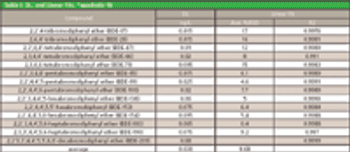
Polybrominated diphenyl ethers (PBDEs) are bioaccumulativetoxic compounds that are used as flame retardants. They have high boiling points and low thermal stability which makes analysis by GC–MS challenging. Additional bromines increase the thermal instability. A method was developed to analyze for polybrominated biphenyls using a large volume injection, short analytical column, and high mass tuning algorithm on the Thermo Scientific DSQ II with detection by EI Single Ion Monitoring (SIM).

