

LCGC North America
The results from a reader survey on sample preparation techniques
LCGC North America
The results from a reader survey on sample preparation techniques
LCGC North America
Ionic liquids have tunable selectivity for specific classes of analytes, giving them distinct advantages over organic solvents.
LCGC North America
Howard G. Barth and Ronald E. Majors Liquid–solid extraction is the most popular method, but sometimes modern approaches such as PLE/ASE and MAE are possible.
LCGC North America
By achieving selectivity in other portions of the analytical cycle, we can lower the burden on sample preparation.
LCGC North America
An alternative approach to liquid–liquid extraction is explored.

LCGC North America
Turbulent flow chromatography is often used for on-line sample cleanup of biological matrices in liquid chromatography–mass spectrometry applications.
LCGC North America
The practical aspects of hollow-fiber liquid-phase microextraction in the three-phase mode (HF3LPME) are described.
LCGC North America
Combining a membrane with a solid sorbent can improve selectivity and save time in sample preparation.
LCGC North America
Miniaturization and solvent substitution are two key approaches.
LCGC North America
New methods are available for whole blood analysis. Here, various approaches are compared and contrasted.

LCGC Europe
An interview with the inventors about the successes, challenges and potential future directions of this technique.
LCGC North America
In this installment, the subject of LPME is reviewed, with emphasis on the use of hollow fibers.
LCGC North America
The inventors of the QuEChERS technique present an update and a look at the future.
LCGC North America
How the combination of an electroextraction with hollow-fiber liquid-phase microextraction can lead to a selective, rapid new method.
LCGC North America
Ron Majors discusses the technique of Salting-out Liquid-Liquid Extraction (SALLE) and provides some examples of its successful applications.
LCGC North America
The guest columnists review SBSE and HSSE and examine their advantages and limitations, along with providing approaches to overcoming the latter.

LCGC Europe
Columnist Ron Majors discusses some of the practical considerations in the successful application of the popular yet age-old technique of solvent extraction (also known as liquid–liquid extraction, or LLE). After a brief review of the basics, guidelines on the selection of the appropriate extraction solvents and how to use acid–base equilibria to ensure efficient extractions of ionic and ionizable compounds are provided. Problems in LLE and the solutions to these problems are highlighted. A newer technique called dispersive liquid–liquid microextraction (DLLME) is introduced.
LCGC North America
Guest authors from South Africa review the application of membranes in the extraction, preconcentration, and separation of various contaminants in food.
LCGC North America
Columnist Ron Majors discusses some of the practical considerations in the successful application of the popular yet age-old technique of solvent extraction (also known as liquid–liquid extraction, or LLE).
LCGC North America
This installment of SPP will compare and contrast the various types of polymeric and non-polymeric sorbents. The major advantages or polymeric sorbents will be discussed, and some applications will illustrate the versatility of polymeric SPE.
LCGC North America
The authors discuss a preparative process using the principles of countercurrent chromatography. This process is faster, capable of loadings from milligrams to hundreds of grams, and uses robust equipment.
LCGC Europe
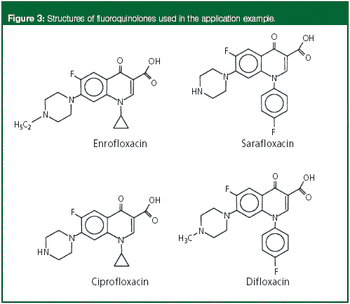
Selective sample preparation techniques are particularly attractive for the analysis of trace amounts of small molecules in complex matrices. In this month's instalment, columnist Ron Majors covers the field of immunoextraction, a technique that employs immobilized antibodies to selectively capture specific analytes using molecular recognition via antibody–antigen interactions. Recently, the introduction of commercial products for specific high-volume environmental and food safety applications should spur further applications of this technique.

LCGC North America
In this month?s installment, columnist Ron Majors covers the field of immunoextraction, a technique that employs immobilized antibodies to selectively capture specific analytes using molecular recognition via antibody?antigen interactions. Recently, the introduction of commercial products for specific high-volume environmental and food safety applications has spurred further applications of this technique.

LCGC Europe
This month's instalment of "Sample Prep Perspectives" describes a new extraction technique called QuEChERS (standing for quick, easy, cheap, effective and safe and is pronounced "catchers") for the sample preparation of pesticides in foods and agricultural samples. The technique uses simple glassware, a minimal amount of organic solvent and various salt/buffer additives to partition analytes into an organic phase for clean up by dispersive solid-phase extraction (d-SPE). The technique provides good recoveries, is reproducible and costs less than other sample preparation approaches. The technique is being adopted by many laboratories worldwide. It has the potential for applications outside of the pesticide in foods area.

LCGC Asia Pacific
In this instalment of "Sample Preparation Perspectives", columnist Ron Majors discusses advanced topics such as multimodal SPE, restricted-access media, molecular imprinted polymers, immunoaffinity extraction phases and other class-or compound-specific sorbents...

LCGC North America
This month's installment of "Sample Prep Perspectives" describes a new extraction technique called QuEChERS (standing for quick, easy, cheap, effective, and safe and is pronounced "catchers") for the sample preparation of pesticides in foods and agricultural samples.

LCGC North America
This installment of "Sample Prep Perspectives" discusses techniques for the reduction/depletion of high-abundance proteins.

LCGC Europe
Traditional methods for the sample preparation of insoluble solid materials have represented one of the more time consuming and labour-intensive efforts in analysis. In this instalment of "Sample Prep Perspectives", Ron Majors examines modern sample preparation methods for solids that often involve increased temperature and higher pressure to speed up the extraction process. In addition, modern sample preparation methods have been automated to relieve analysts of the drudgery associated with traditional methods. Here, he reports on automated Soxhlet extraction, supercritical fluid extraction, pressurized fluid extraction–accelerated solvent extraction, and microwave-assisted extraction and updates earlier coverage.
LCGC North America
Although the majority of solid-phase extraction (SPE) is performed with conventional bonded silica- and polymeric-phases, difficult and complex samples may require more specialized stationary phases. In this installment of "Sample Prep Perspectives," columnist Ron Majors discusses advanced topics such as multimodal SPE, restricted-access media, molecular imprinted polymers, immunoaffinity extraction phases, and other class- or compound-specific sorbents. These phases provide additional selectivity, and procedures using them can be automated. Representative applications will be presented.

LCGC Europe
Capillary extraction (CEx) is used to study the solventless in-tube extraction of naphthalene, acenaphthene, phenanthrene, fluoranthene, chrysene, benzo(a)pyrene and coronene in aqueous samples prepared by analyte spiking into clean waters or, as an alternative, by using the generator–column method of sample preparation. Analysis of laden extractors is conveniently performed by high-resolution gas chromatography (GC), with a flameionization detector (FID). Extraction set-ups and main extraction variables are investigated from a practical point of view. For 2- to 4-ring polycyclic aromatic hydrocarbons (PAHs), equilibrium times are within a few minutes, analytical sensitivity is in the parts-per-billion (ppb) range and reproducibility is better than 10% relative standard deviation (RSD) (n = 6). Coronene behaviour is unique and presumably determined by extreme hydrophobicity and thus very negligible aqueous solubility: in-tube extraction of coronene seems possible only if starting from oversaturated..