The Application Notebook-06-01-2008

i1-547884-1408670599245.jpg

The Application Notebook

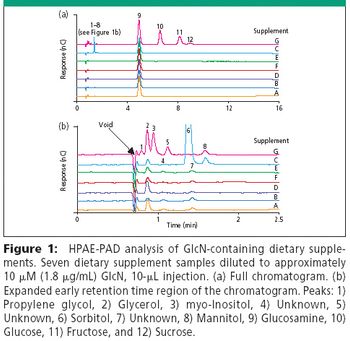
Glucosamine (GlcN) is a major structural component in the biosynthesis of glycosaminoglycans, compounds involved in normal joint function. Use of GlcN as a dietary supplement in the management of osteoarthritis has attracted considerable attention; it is one of the five nonvitamin, nonmineral supplements most frequently used by US adults (1). The US FDA currently regulates dietary supplements to ensure that they are produced under cGMP (2).

i2-547853-1408670694139.gif

The Application Notebook

Urea is commonly used in protein purification, including large-scale purification of recombinant proteins for commercial purposes, and in recombinant protein manufacturing to denature and solubilize proteins (1). In aqueous solutions, urea degrades to cyanate and ammonium, with the maximum degradation rate occurring at neutral pHs commonly used in biological buffers (2). Cyanate is problematic in urea solutions because it carbamylates proteins, which causes unwanted modifications that can alter the protein's stability, function, and efficiency. Therefore, an accurate, sensitive method for determining cyanate in urea-containing buffers is required.

i1_t-547962-1408670476140.gif

The Application Notebook

There has been an increasing interest in the presence and availability of compounds in plant materials that may possess bioactive properties, in particular, antioxidant activity. Some of these compounds have been attributed to possess anticancer, antiaging, and antimutagenic properties as well as other health benefits (1). The types of plants that have been investigated cover a vast range from common foodstuffs to regional or exotic materials. Plant parts under study have included portions that are traditionally known to be edible, as well as sections that are considered "waste" or used for animal forage. Because most screening techniques involve lengthy separations, high throughput HPLC methods are desirable.

i4-547972-1408670451415.jpg

The Application Notebook

The analysis of polar compounds in support of clinical and preclinical pharmacokinetic studies requires an analytical methodology capable of achieving ultra-low detection and quantification limits. The high sensitivity afforded by coupling HPLC with tandem mass spectrometry (MS-MS) has made it the technique of choice in this environment, but it is subject to the following limitations when reversed phase liquid chromatography (RPLC) is used:

i1-547857-1408670682295.jpg

The Application Notebook

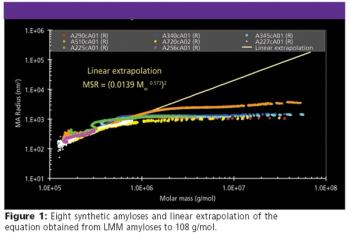
Amylose is an occasionally-branched biopolymer and, together with amylopectin, the hyper-branched component, a constituent of starch. Determination of branching in amylopectin on the basis of amyloses may be performed with the help of synthetic amyloses. Synthetic amyloses from enzymatic (phosphorolytic) reaction were checked for their linearity.

i1-547852-1408670696082.jpg

The Application Notebook

Like any other segment of the world economy, current events and the realities of the world around us go a long way toward shaping the direction of chromatographic research and development, and consequently, the financial trends that have a direct impact on the industry in which we all live and work. In this sense, the LCGC Application Notebook has become something of a market barometer over the years.

i1-547880-1408670608464.jpg

The Application Notebook

The United States Pharmacopeia (USP) has implemented a revised method for the determination of residual solvents, chapter 467; this revision has brought the methodology of USP 467 into close alignment with European Pharmacopeia (EP) method 2.4.24. The USP and EP determination of class 1 and class 2 residual solvents is performed with static headspace (HS) sample introduction and gas chromatography (GC) with flame ionization detection (FID); class 3 has flexibility in the technique, however, it is often included in the HS analysis.

i2-547877-1416914492717.gif

The Application Notebook

Urea and allantoin are added to cosmetic products for skin protection and regeneration, especially for the treatment of dry skin, and analyzed for QC purposes. As polar compounds, they are not ideal for reversed-phase HPLC separations. Neutral hydrophilic compounds like urea and allantoin are best analyzed by hydrophilic interaction chromatography (HILIC). Traditional HILIC columns use silica modified with a hydrophilic group such as diol or cyano. Analytes are adsorbed and subsequently eluted with mobile phases containing high percentages of organic solvent (>75%).

i2-547864-1408670667571.gif

The Application Notebook

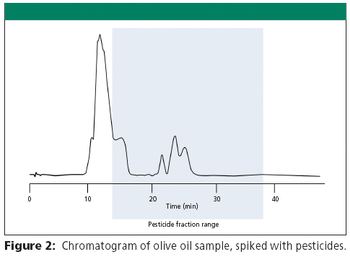
Gel permeation chromatography (GPC) has been used as an effective cleanup procedure for removing high molecular weight interfering molecules such as lipids, pigments, proteins, and polymers before GC or HPLC analysis. The GPC cleanup method has been extensively documented (1–3) and is also recommended in US EPA SW-846 Method 3640A. To demonstrate the efficacy of this method to extract polar and nonpolar substances by using the KNAUER Smartline GPC Cleanup Unit 6500, olive oil samples were investigated by spiking these with different types of organic pollutants, including PAHs, phthalates, phenols, and triazine.

i1-547879-1416914488847.jpg

The Application Notebook

The QC for the pharmaceutical industry is based on methods developed on a variety of columns. At Orochem, we have attempted to address method development utilizing unique chemistries such as the OROSIL C18 to analyze a wide range of acidic, basic, and neutral compounds. Data is presented on a few representative compounds and unique separation criteria with their associated chromatograms.

i3-547859-1408670678251.gif

The Application Notebook

The continuing and growing trend toward high-speed analysis in all fields of chromatography is also reflected in enantiomer separations. A variety of new 3-μm columns has been designed to meet this need. Applications of CHIRALCEL® OD-3 and CHIRALPAK® AD-3 in some enantiomer separations demonstrate the benefits of transitioning to such media.