

All News
Advertisement

The Column
Incognito challenges commonly held views about consultants. Are you missing out on their valuable insight and know-how?
Advertisement

The Column
Detecting estrogens at trace concentrations in biological fluids is key to understanding their role in the induction - and treatment - of disease. Researchers from the University of Texas Arlington, USA, have developed a method using restricted access-media (RAM) that enables the detection of trace levels of estrogen's using LC–MS–MS without liquid–liquid extraction (LLE) or solid-phase extraction (SPE).

The Column
Click the title above to open The Column February 19, 2015 Europe & Asia issue, Volume 11, Number 3, in an interactive PDF format.
The Column
Click the title above to open The Column February 19, 2015 North American issue, Volume 11, Number 3, in an interactive PDF format.
LCGC Europe
Ultra-high performance liquid chromatography (UHPLC) enables fast, efficient separation of biomolec-ular samples. Compared to standard SEC, UHP-SEC provides improved resolution, higher throughput, less solvent and smaller sample consumption for analysis of precious biological samples.
Advertisement
In response to recent accusations levied by the New York State Attorney General’s office that herbal supplements sold by four major retailers contained little or no primary ingredient, the supplements industry is planning further testing of the affected products.

There are often times in my work when I need to 'mess about' with column dimensions and particle morphologies. For 'mess about' read improve or transfer.
The Column
Pharmaceutical and personal care products (PPCPs) entering water supplies have been widely studied, but there is little information on the activity of these compounds in swimming pool water. Researchers have applied a PPCP analysis method previously developed for the detection of 32 PPCPs in wastewater to survey indoor swimming pools in the USA.

Mycotoxins are an important group of secondary metabolites produced by fungi that can cause disease in humans and animals. Active in the field of mycotoxin analysis is Rudolf Krska from BOKU, IFA-Tulln in Vienna and in this video he discusses his work investigating the human metabolism of Fusarium mycotoxins and gives his view on the future direction of mycotoxin research.
Advertisement

LCGC North America
The lives, careers, and achievements of the 2015 LCGC Award winners - Joseph Jack Kirkland, the winner of the 2015 Lifetime Achievement in Chromatography Award, and Caroline West, the 2015 Emerging Leader in Chromatography - are highlighted here.

I have been at The University of Texas at Arlington for almost 10 years, and I have taught approximately seven different classes in my time here. Yet, the one that I have had the most opportunities to teach, and the most time to reform, is our junior/senior-level Instrumental Analysis (IA) course.
On Monday, February 2, the New York State Attorney General’s office sent letters to four major retailers accusing them of selling fraudulent herbal supplements and demanding that they remove the products from their shelves. To the surprise of many analytical chemists, however, the accusations were based on DNA barcoding technology rather than chromatographic analysis.
The Column
A QuEChERS-based ultrahigh-performance liquid chromatography triple quadrupole tandem mass spectrometry (UHPLC–QqQ–MS–MS) method was used to determine pesticides in nutraceutical products from green tea (Camellia sinensis),

The Column
A simple and rapid ultrahigh-performance liquid chromatography tandem mass spectrometry (UHPLC–MS–MS) method to identify new psychoactive substances (NPS) in hair has been published.

The Column
LCGC Blogger Kevin Schug offers his insights into superficially porous particles (SPPs) versus fully porous particles (FPPs).

The Column
A snapshot of what’s on offer for chromatographers at Pittcon 2015 from 8–12 March 2015 at the Ernest N. Morial Convention Center in New Orleans, Louisiana, USA.
The Column
Click the title above to open The Column January 2015 Europe & Asia issue, Volume 11, Number 2, in an interactive PDF format.
The Column
Click the title above to open The Column February 04, 2015 North American issue, Volume 11, Number 2, in an interactive PDF format.
The Column
Ten aldehydes have been discovered in simulated interstellar ice that could be the precursor to comets and other extraterrestrial bodies.

LCGC Europe
Why are LC retention times sometimes so slow to stabilize?
LCGC Europe
HPLC 2015 - The 42nd International Symposium on High Performance Liquid Phase Separations and Related Techniques

LCGC Europe
An excerpt from LCGC's e-learning tutorial on GC column selection at CHROMacademy.com

LCGC Europe
This instalment of “Questions of Quality” looks at problems with an operational liquid chromatograph to see if they can be picked up in the performance qualification (PQ) or prevented in the operational qualification (OQ).
The Application Notebook
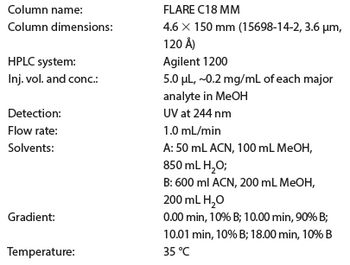
Avermectins are a series of 16-membered macrocyclic lactone derivatives that are used extensively in animal and crop protection.
LCGC Europe
Click the title above to open the LCGC Europe February 2015 regular issue, Vol 28, No 2, in an interactive PDF format.
LCGC North America
Click the title above to open the LCGC North America February 2015 regular issue, Vol 33 No 2, in an interactive PDF format.
Advertisement
Advertisement
Trending on LCGC International
1
Using UHPLC-MS/MS to Help Pinpoint Time of Death
2
LC-MS/MS Reveals Fentanyl Tolerance in Users
3
Detecting Anabolic-Androgenic Steroids in E-cigarettes Seized from Scottish Prisons using GC–MS
4
GC-MS Uncovers Cocoa Variety's Chocolate Aroma
5