

All News
Advertisement
Advertisement
Advertisement

LCGC North America
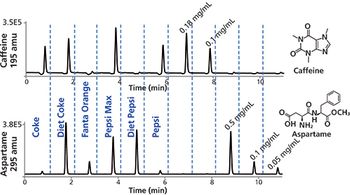
In this study, we describe a simple and rapid liquid chromatography–mass spectrometry (LC–MS) method for the evaluation of caffeine, taurine, and aspartame in teas, soft drinks, and energy drinks using high performance liquid chromatography (HPLC) coupled with electrospray ionization (ESI)-MS detection and multiple injections in a single experimental run (MISER) analysis.
LCGC North America
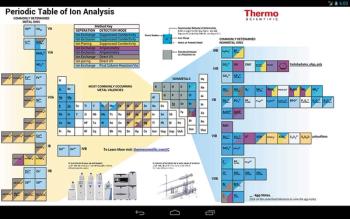
The Periodic Table of Ion Analysis app is designed as a reference of optimal methods for separating and detecting the most commonly determined ions on the periodic table
Advertisement

LCGC North America
The modern analytical laboratory generates enormous amounts of data. These data are typically stored in vendor-specific, proprietary file formats

LCGC Europe
This article describes a simple and rapid LC–MS method for evaluation of caffeine, taurine, and aspartame in teas, soft drinks, and energy drinks using HPLC coupled with electrospray ionization mass spectrometry detection and MISER analysis.

LCGC Europe
Spreadsheet computer simulations can identify the influencing factors for the set-up of a calibration function such as the number of calibration points and their distribution or the position of the experimental points. By using a Monte Carlo approach, the quality of the experimental results (bias and standard deviation) can be studied under different conditions. This article presents a spreadsheet for the simulation of unweighted and weighted linear least-squares fit.

LCGC Europe
When converting methods from LC to UHPLC, don’t get confused by flow-rate settings.

LCGC Europe
Our annual review of new liquid chromatography columns and accessories, introduced at Pittcon and throughout the previous year. This year, Michael Swartz, former author of our “Innovations in HPLC” and “Validation Viewpoint” columns, steps in as a guest columnist to write the review.
LCGC Europe
Click the title above to open the LCGC Europe April 2015 regular issue, Vol 28, No 4, in an interactive PDF format.
LCGC North America
Click the title above to open the LCGC North America April 2015 regular issue, Vol 33 No 4, in an interactive PDF format.
Special Issues
Click the title above to open the LCGC North America April 2015 Recent Developments in HPLC and UHPLC Supplement, Vol 33 No s4, in an interactive PDF format.

The Column
Click the title above to open The Column March 31, 2015 Europe & Asia issue, Volume 11, Number 5, in an interactive PDF format.
The Column
Click the title above to open The Column March 31, 2015 North American issue, Volume 11, Number 5, in an interactive PDF format.
The Column
Incognito continues with his “back to basics” focus. This time is the turn of the analytical balance.
The Column
Fish from the Baltic Sea are a major source of lipophilic environmental pollutants for consumers in Finland. Surrounded by land, the Baltic Sea is one of the most threatened marine environments, making fish from the Baltic Sea a major source of lipophilic environmental pollutants including polybrominated diphenyl ethers (PBDEs).

The Column
Paralytic shellfish toxins (PSTs) are naturally occurring toxins produced by some species of microscopic algae that can accumulate in filter feeding shellfish. These toxins are a threat to shellfish aquaculture and pose a serious hazard to public health when ingested. A group of scientists has developed a method using hydrophilic interaction liquid chromatography coupled to ultrahigh?performance LC tandem mass spectrometry (HILIC UHPLC–MS–MS) to determine PSTs in a variety of shellfish species as part of the Safe New Zealand Seafood Research programme.

The Column
Researchers from the California Animal Health and Food Safety Laboratory at the University of California Davis in the USA have developed an ultrahigh-performance liquid chromatography–mass spectrometry (UHPLC–MS) method for the detection of desmethylbromethalin (DMB) residues in animal tissues.

LCGC Europe
A crude extract of gingerol is used to evaluate the capacity of Spot Prep II system to work with analytical column. Method development was first done on LaChrom Elite analytical HPLC system and transferred to Armen Spot II system.
Advertisement
Advertisement
Trending on LCGC International
1
LC-MS/MS Reveals Fentanyl Tolerance in Users
2
Automated Sample Preparation for Oligonucleotide Bioanalysis Using Magnetic SPE
3
GC-IMS Detects Early Mold Warning Signs in Cigar Tobacco
4
Detecting Anabolic-Androgenic Steroids in E-cigarettes Seized from Scottish Prisons using GC–MS
5