

The Column
Click the title above to open The Column March 09, 2015 North American issue, Volume 11, Number 4, in an interactive PDF format.
The Column
Click the title above to open The Column March 09, 2015 North American issue, Volume 11, Number 4, in an interactive PDF format.

In this blog installment, I would like to share a little advice with those of you who are attending your first major conference.

Gas chromatography (GC) is often regarded as a mature technology and some say that the application base has become routine; however, conventional detectors may not be able to keep up with the speed of separations that can be achieved today. In this new video Kevin Schug from the University of Texas Arlington, USA, talks about the development of a new vacuum ultraviolet (UV) detector, from the initial idea to the fundamentals of its operation.
The 2015 Chromatography Forum of the Delaware Valley Dal Nogare Award will be presented to Mark R. Schure, adjunct professor of chemical engineering at the University of Delaware, on Monday morning at Pittcon 2015.
For the first time this year, the winners of the LCGC Awards will be honored in an oral symposium at Pittcon. Jack Kirkland of Advanced Materials Technology will receive the 2015 LCGC Lifetime Achievement Award at 1:30, and Caroline West, of the University of Orléans, will receive the 2015 LCGC Emerging Leader Award at 3:40 pm, just after the break.
This organized contributed session was arranged by Andy Miles and Paul Wrezel of Regis Technologies, Inc. Miles will preside over the session, which will start at 1:30 p.m. this afternoon.
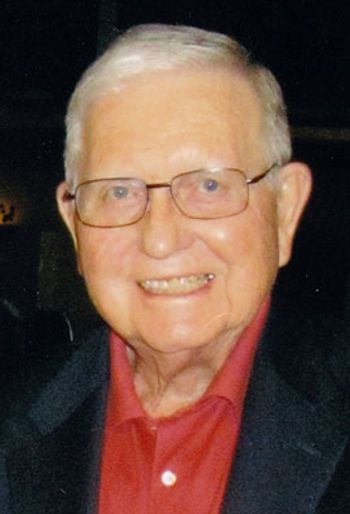
Joseph Jack Kirkland, considered by many to be one of fathers of high performance liquid chromatography (HPLC), is the winner of LCGC’s 2015 Lifetime Achievement Award.
LCGC North America
Shodex introduces the VG-50 4E column packed with a durable polymer based packing material modified with chemically stable tertiary amino functional groups. Shodex VG-50 4E is suitable for saccharide analysis and provides a fast reliable method for the determination of lactose and lactulose.

LCGC Asia Pacific
There has been a revival of supercritical fluid chromatography (SFC) in recent years, especially in the chiral preparative field, but also more recently in the analytical area. However, SFC is considerably more complex than liquid chromatography (LC), mainly because of the compressibility of the mobile phase. One can say that SFC is a “rubber variant” of LC where everything considered constant in LC varies in SFC. In this review, we go through advances in theory, instrumentation, and novel applications.
LCGC Asia Pacific
A stepwise process is described to help isolate and identify the cause of a method failure.

LCGC Asia Pacific
31st International Symposium on MicroScale Bioseparations

LCGC Asia Pacific
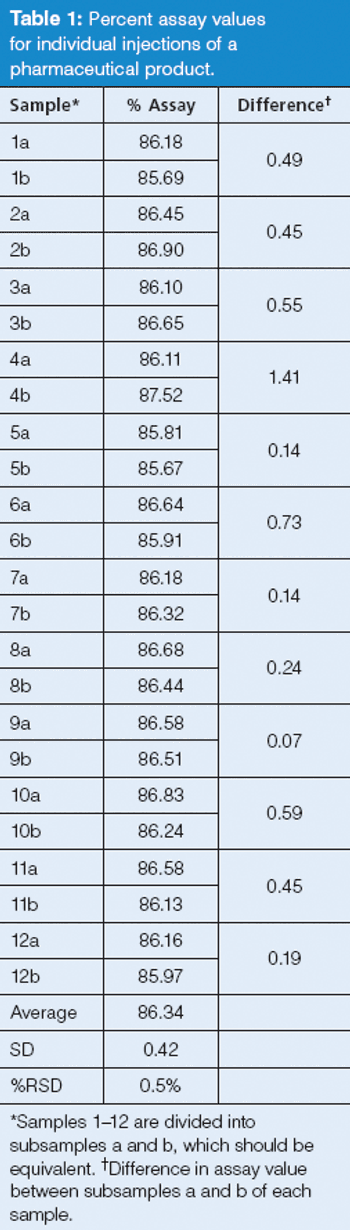
The numerous advantages of translating gradient chromatographic methods between the differing formats of LC have been explored and discussed. While translations in principle obey well defined chromatographic theories, the authors investigate a number of potential pitfalls that may result in poor translations as exhibited by selectivity differences, changes in efficiency, and hence failure to meet resolution system suitability criteria.
LCGC Asia Pacific
The transit of peaks through a gas chromatography (GC) column depends strongly on the thermal profile they encounter on the way. Gas chromatographers primarily rely on the classic hot?air?bath type of oven, but several alternatives are also in use. This instalment examines ovens for GC in several forms plus how oven thermals affect peak retention behaviour.


LCGC Europe
Redox reactions are integral parts of many cellular processes. They are therefore extensively studied in vitro and in vivo. Electrochemistry (EC) represents a purely instrumental approach to characterize direct and indirect effects of redox reactions on bioorganic molecules. This review highlights important trends and recent developments.
LCGC Europe
This instalment examines ovens for GC in several forms plus how oven thermals affect peak retention behaviour.

LCGC Europe
A stepwise process is described to help isolate and identify the cause of a method failure.

LCGC Europe
Event: 21st International Symposium on Separation Sceinces (21st ISSS 2015)

LCGC Europe
A guide to selecting the correct HPLC stationary phase.
Special Issues
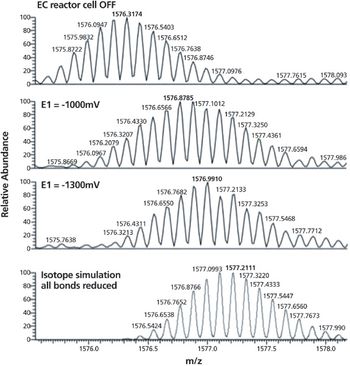
Antec introduced the ROXY as an electrochemical reactor up-front MS. The electrochemically-assisted reduction of disulphide bonds followed by on-line mass spectrometric (MS) detection is presented.

Special Issues
Accurate steroid measurement is essential for the diagnosis of various disorders, for example in sexual differentiation or gonadal function.

Special Issues
Pain management LC analyses can be difficult to optimize because of the limited selectivity of C18 and phenyl-hexyl phases.
Special Issues
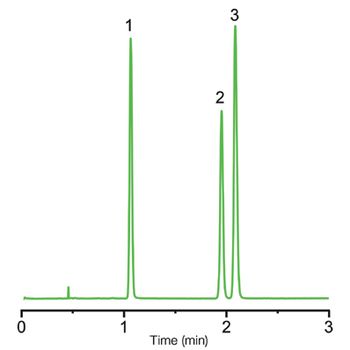
Supercritical fluid chromatography (SFC) has been used by scientists in laboratories and manufacturing facilities for several decades.

Special Issues
Multi-angle light scattering (MALS) represents a uniquely powerful technique to determine the absolute molar masses and sizes of proteins in solution. MALS detectors cover a wide detection range of sizes and masses and enable the characterization of protein molecules as monomers, dimers, or higher order aggregates.

Special Issues
The physical properties and behaviour of polymers depends strongly on the properties of the polymer molecules themselves

Special Issues
There has been a significant resurgence in the development of antibody-drug conjugates (ADC) as target-directed therapeutic agents for cancer treatment.
LCGC E-Books
LCGC Asia Pacific
Click the title above to open the LCGC Asia Pacific March 2015 regular issue, Vol 18, No 1, in an interactive PDF format.
LCGC Europe
Click the title above to open the LCGC Europe March 2015 regular issue, Vol 28, No 3, in an interactive PDF format.
LCGC North America
Click the title above to open the LCGC North America March 2015 regular issue, Vol 33 No 3, in an interactive PDF format.