

All of the most important sessions, awards and events from Pittcon 2010 covered here in this convenient and easy-to-read daily e-newsletter.
All of the most important sessions, awards and events from Pittcon 2010 covered here in this convenient and easy-to-read daily e-newsletter.
Special Issues
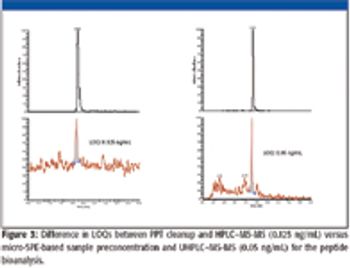
In preclinical development, the absolute quantification of peptides in biological matrices becomes a challenge due to the limited availability of stable label internal standards and affinity-based cleanup. This puts a renewed emphasis on matrix effects, especially for the bioanalysis of hydrophobic peptides. While the impact of matrix effects has been studied for extensively singly charged small molecules, their effect on multiply charged compounds has yet to be characterized fully. This article discusses initial results from matrix effect experiments in relation to the bioanalysis of hydrophobic peptides and techniques used to minimize matrix effects.

LCGC Asia Pacific
Hydrogen carrier gas can be an effective replacement for helium in many gas chromatography (GC) and GC–mass spectrometry (MS) applications.
LCGC Europe eNews
Interchim has announced the acquisition of the flash chromatography branch of Armen Instrument, a French manufacturer of scientific instruments.

LCGC Asia Pacific
This month in "GC Connections," John Hinshaw discusses issues that can arise when deciding to upgrade or replace gas chromatography technologies.

LCGC Asia Pacific
What can be expected when the column diameter is changed?
LCGC Asia Pacific
The method developed runs on a fully automated platform integrating solid-phase extraction (SPE) and LC (Symbiosis Pico) without any manual pretreatment step(s). Automatic pretreatment results in high throughput, low CVs and high precision. Sample preparation has been simplified to just one operator step before the system takes over the automated analysis of the samples.

LCGC Europe
The regular maintenance of gas chromatography components, including symptons, causes and remedies.
LCGC North America
Click the title above to open the LCGC North America March 2010 regular issue, Vol 28 No 3, in an interactive PDF format.
E-Separation Solutions
Tuesday?s morning session, ?Best Practice of Stability-Indicating HPLC Method Development,? was arranged by LCGC contributor Michael W. Dong of Genentech. Dong will begin the session with his opening remarks on the topic promptly at 8:00 a.m.
Buyer's Guide
GPC/SEC, often coupled with RI, Viscometry and/or LS detection, is the method of choice to characterize polymers and proteins.
This program will discuss the nature of GPC/SEC columns, describe how to read a chromatogram and help to identify column-caused artifacts and problems.
With over 40 years of innovation and the industry?s largest installed base, Agilent?s best-in-class portfolio of MS technologies delivers what you expect from a mass spectrometry leader.
Waters Empower 2 Chromatography Software controls chromatography systems from multiple vendors helping you maximize your instrument investment.
Waters ACQUITY UPLC H-Class System: Designed to Replace HPLC Systems and Accelerate UPLC Adoption among HPLC Users
Fast analysis of chlorinated pesticides in under 10 minutes results in shorter cycle times and improved productivity.
E-Separation Solutions
This Tuesday morning session will be presided over by Matthew Klee of Agilent Technologies (Wilmington, Delaware), who also arranged the session. Capillary gas chromatography (GC) continues to be a workhorse separations technique in the analytical laboratory.
E-Separation Solutions
The Pittcon Heritage Award will be given to Dr. Walter Jennings, Professor Emeritus of the University of California Davis and co-founder of J&W Scientific, on Sunday afternoon at Pittcon 2010.
E-Separation Solutions
Sunday afternoon?s plenary lecture at Pittcon 2010 will be presented by Alan G. Marshall, Robert O. Lawton Professor of Chemistry and Biochemistry, Florida State University (Tallahassee, Florida), and Director of the Ion Cyclotron Resonance Program at the National High Magnetic Field Laboratory.
E-Separation Solutions
Good morning, and welcome to this, the opening day of LCGC?s coverage from Pittcon 2010 at the Orange County Convention Center in Orlando, Florida. The staff of LCGC is proud to bring readers three days of coverage from this, the premier event in the field of analytical chemistry.
E-Separation Solutions
Welcome to this special Pittcon 2010 Preview, brought to you by the staff of LCGC. Pittcon 2010, set to run from February 28 to March 5 in the Orange County Convention Center in Orlando, Florida, promises to be one of the most anticipated events in the field of analytical chemistry ? primarily because of its continuing position as the premier event in the industry, but also because of its added importance this year as a bellweather for the state of the conference industry as a whole.
E-Separation Solutions
Good morning, and welcome to Day 2 of LCGC's E-Show Dailies from Pittcon 2010. Pittcon is officially in full swing, with a host of technical sessions, awards, and other events taking place today, all covered here by the staff of LCGC.
E-Separation Solutions
Monday morning LCGC North America and LCGC Europe will launch the first Pittcon Theater sessions. This cutting-edge multimedia project will include live interviews with leading experts from the world of analytical chemistry and will cover the latest developments, applications and trends in the fields of chromatography and spectroscopy. Editor-in-chief of LCGC North America, Dave Walsh and Editorial Director of LCGC Europe, Peter Houston, will host these illuminating sessions.
E-Separation Solutions
Tuesday morning LCGC North America and LCGC Europe continue with the second part of the Pittcon Theater sessions. Today's sessions will cover MS/Hyphenated techniques and Spectroscopy.
E-Separation Solutions
The James L. Waters Annual Symposium recognizes pioneers in instrumentation development and explores the origins, development, implementation, and commercialization of important scientific instrumentation. This Monday afternoon session was arrranged for by Janeth K. Pifer and Arnit Ghosh of PPG Industries (Pittsburgh, Pennsylvania). Pifer is slated to preside over the session.
LCGC Europe eNews
Chiral Technologies Europe has announced that it has signed a non-exclusive distribution agreement with Hichrom to better serve its customers in the United Kingdom.
E-Separation Solutions
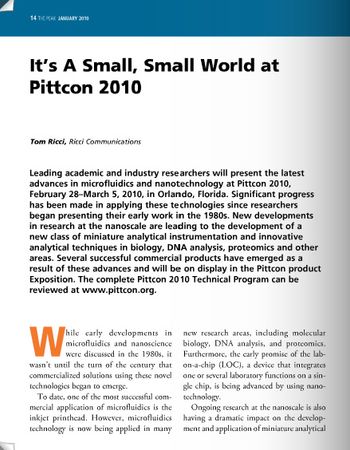
Leading academic and industry researchers will present the latest advances in microfluidics and nanotechnology at Pittcon 2010, February 28-March 5, 2010, in Orlando, Florida.
E-Separation Solutions
At Pittcon 2010, leading scientists will once again present their latest research made possible by sophisticated chromatography, MS, hyphenated, and tandem instrument techniques.