

Linde Gases has been granted GBW certification by the Chinese State Bureau of Quality and Technical Supervision.
Linde Gases has been granted GBW certification by the Chinese State Bureau of Quality and Technical Supervision.
In 2010 Forum LABO & BIOTECH Becomes The Meeting Place for All Laboratories From Research to Industrial Microanalysis

LCGC Europe
Over the years, the International Symposium on Capillary Chromatography (ISCC) has established its reputation as a forum for microcolumn separation techniques. Since the first meeting in Hindelang in 1975, the most important developments in capillary gas chromatography, microcolumn liquid chromatography and electromigration techniques have been presented in this symposium series.
Special Issues
This discusses using generic chiral stationary phase screening to find the optimum column, smaller diameter columns for HPLC and SFC, clones of off-patent phases, and new concepts in CSP development.
Special Issues
Ron Majors reports on some of the improvements that have been made over the years focusing on efficiency, stability, and selectivity.

Special Issues
In this article, Chris Pohl summarizes some of the stationary phases that have been developed for modern ion-exchange and ion chromatography.
Special Issues
Improvements in HPLC column technology continue. Since the last Special Supplement on columns in 2008 (1), the continued need for high-throughput separation, the encountering of more complex samples, the need to analyze very polar compounds more easily, and the increased availability of very high pressure instruments has placed additional demands on the HPLC column. In terms of high throughput, no less than 24 companies have responded and have developed small particle columns of 2 µm and under. In addition, the number of superficially porous particle (SPP) columns has expanded, and users are finding that the high-efficiency-at-low-pressure advantage brings them added advantages. With more complex samples, longer columns packed with sub-2-µm particles require higher pressures with pumps now available to 1300 bar. It will be of interest to see if the lower pressure, high-efficiency SPP columns and monoliths, the latter of which have seen advances in the research of polymeric monoliths for applications to..

LCGC Europe
In this Practical Data Handling column, method development for drug impurity profiling is discussed.
Special Issues
Liquid chromatography has long been used for the separation, analysis and purification of biomacromolecules.
Special Issues
Monolith pioneer Frantisek Svec brings readers up to date on the latest developments in monoliths for use in chromatography.
LCGC Europe
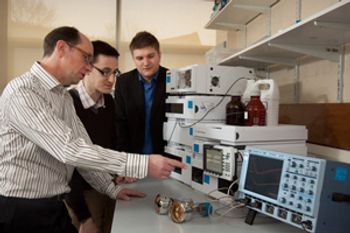
NEW HIGH PERFORMANCE LIQUID CHROMATOGRAPHY SYSTEM FROM VARIAN, INC. OFFERS SPEED AND FLEXIBILITY TO ANALYTICAL CHEMISTS
LCGC North America
Click the title above to open the LCGC North America April 2010 regular issue, Vol 28 No 4, in an interactive PDF format.
LCGC Europe eNews
LabLogic Systems has entered into a two-year research partnership to develop the next generation radio-HPLC flow-through detector.

LCGC Europe eNews
Dionex has announced that the company is to supply 42 ion chromatography systems to the Polish Environmental Inspectorate.
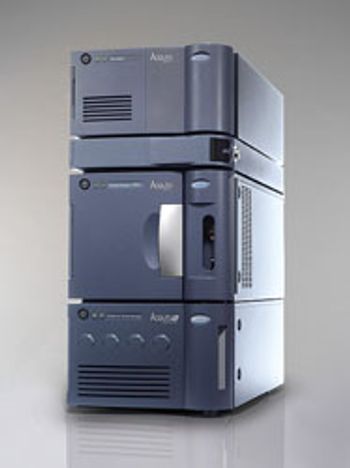
Designed to Replace HPLC Systems and Accelerate UPLC Adoption among HPLC Users

Waters designed every component of The Xevo Family with Engineered Simplicity in mind.
The Applications Book July/August author guidelines...
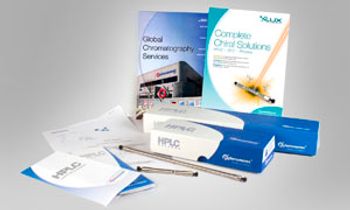
Phenomenex has announced a chiral screening service for customers in pharmaceutical and natural products research and development.

LC•GC Europe's Applications Books are now published quarterly offering you the chance to catch up on research across a range of industries.
LCGC Europe eNews
Analytical technology company AB SCIEX is to collaborate with the University of Geneva's Mass Spectrometry Centre to create new workflows and analytical strategies intended to improve drug discovery and development.

The Column
Validation is not an easy task. It is an ongoing complex process that evaluates the entire, sample specific process, products and analytical methods.
E-Separation Solutions
The authors look at comprehensive gas chromatography as a choice for the quantitative speciation of trace alkyl phosphates in petroleum samples.

E-Separation Solutions
Participants in this installment of the Technology Forum are from ALMSCO International, Restek Corporation, Sigma-Aldrich/Supelco, Teledyne Tekmar and Thermo Fisher Scientific.
LCGC Europe eNews
Shimadzu Scientific Instruments and Cerno Bioscience have announced that they will team up to offer Cerno's MS software on Shimadzu's LC–MS quadrupole systems.

The Column
Analytica 2010 - an international trade fair that takes place in Munich, Germany from 23–26 March 2010 for the 22nd time.
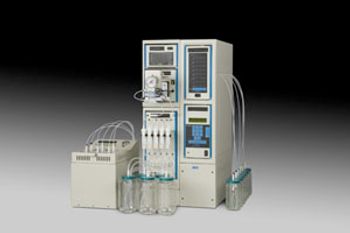
The FMS PowerPrep SPE system is the first Total Sample Prep technology to combine SPE Extraction and Concentration into one step.
AB SCIEX and its distribution partner Labindia Life Sciences are to supply the government of India with a food safety testing solution. This is part of a project with the Ministry of Agriculture to help reinforce new food safety standards through better monitoring for contamination.
LCGC Europe eNews
Repligen has announced that it acquired the assets of BioFlash Partners for $1.8 million, which includes a technology platform for the production of pre-packed, ?plug and play? chromatography columns.
The Column
High-sensitvity bioanalytical assays are critical for the full elucidation of pharmacokinetic profiles of drugs at very low exposure; and are also required when sample volume is limited as in the case of pediatric samples or low-volume samples from small rodent studies.