

E-Separation Solutions
The purpose of this application note is to demonstrate the use of the Oasis® HLB SPE Disk, with the Horizon Technology SPE-DEX® 4790 Extractor System.
E-Separation Solutions
The purpose of this application note is to demonstrate the use of the Oasis® HLB SPE Disk, with the Horizon Technology SPE-DEX® 4790 Extractor System.
E-Separation Solutions
Polysaccharide-based chiral stationary phases (CSP) are widely used due to their wide chiral recognition ability. Several cellulose and amylose derivatives are extremely effective in the separation of a wide range of compounds of interest in the pharmaceutical industry (1).
E-Separation Solutions
Varian, Inc. has published an application note entitled Enhanced ELSD Sensitivity of Parabens using Sub-Ambient Evaporation. Parabens are widely used as food additives, in personal care products and pharmaceutical formulations.
The Column
"Green HPLC" - A Status Review Björn-Thoralf Erxleben Comprehensive Two-Dimensional Gas Chromatography for Achieving Nitrogen Speciation in Middle Distillates F. Adam, F. Bertoncini, N. Lahoutifard, A.Addinall, D. Thiébaut, M.-C. Hennion and Marion Courtiade A Dissolved/Particulate Baseline Study of Polyaromatic Hydrocarbons in Particulate-Laden Water Friederich Werres and Robert S. Johnson News Tolerable levels for daily intake of melamine, a GPC/SEC training course, a company acquisition and a patent license agreement are featured this month. Incognito Overcoming the Acetonitrile Crunch... Follwing a decrease in the global production of acetonitrile, Incognito considers the alternatives for those using this as a solvent in important HPLC separations. Market Trends and Analysis Market Profile: Dissolution Testing Glenn Cudiamat
LCGC Europe June 2008 BPA Statement
LA Finalist - Novotny
LCGC Europe
I regularly receive e-mails from readers with a wide variety of questions. Some of these blossom into full-blown columns, but many are answered with just a short response. As I cleaned out my inbox recently, I chose a few of these to share. There is no central theme this month, but hopefully you will pick up some useful information from these topics related to practical operation of the liquid chromatography (LC) system.
LA Finalist - Wyatt
EL Finalist - Schug
EL Finalist - Podgornik
LA Finalist - Ettre
EL Finalist - Soice
LA Finalist - Carr
LA Finalist - McNair

LCGC Europe
Hypercrosslinked polystyrene-type (solid-phase extraction) SPE materials exhibit a unique ability to enter p-interactions with aromatic, heterocyclic and unsaturated compounds. This property permits selective extraction and pre-concentration of the above classes of species from non-polar media and fatty matrices. The principle has been exploited for developing analytical protocols to determine polar furan derivatives in mineral transformer oil, polyaromatic hydrocarbons (PAHs) in smoked fish and for the fractionation of polychlorinated aromatic compounds in environmental matrices.

LCGC Europe
Microextraction by packed sorbent (MEPS) is a new technique in sample preparation that can be connected on-line to gas chromatography (GC) or liquid chromatography (LC) without any modifications.
Dr. Philip J. Wyatt, the CEO and founder of Wyatt Technology Corporation (Santa Barbara, California) has been awarded the 2009 Prize for Industrial Application of Physics by the American Physical Society (APS).
LCGC Europe eNews
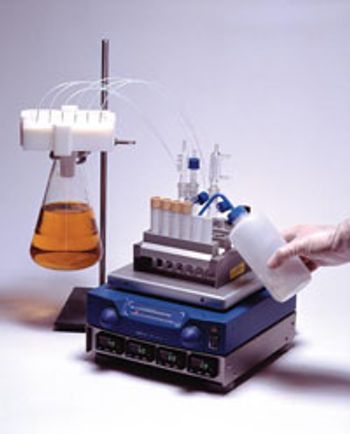
Activotec is to deliver a PLS organic synthesizer for performing high throughput solution and solid-phase chemistry research to a leading Swiss biopharmaceutical company...

LCGC Europe eNews
Dr Philip J. Wyatt, the CEO and founder of Wyatt Technology Corporation has been awarded the 2009 Prize for Industrial Application of Physics by the American Physical Society (APS)...
The Column
LCGC will continue to redefine its long-held role as the market leader in the field of digital publications and products.
Phenomenex Inc., (Torrance, California), will present a workshop, "A Critical Analysis of Fast LC Technologies," at the 2009 Pittsburgh Conference in Chicago.
Phenomenex Inc. (Torrance, California), will be holding a workshop on "Recent Advances in Chiral Chromatography" at the 2009 Pittsburgh Conference in Chicago.
Pittcon announced the recipients of 11 prestigious awards recognizing the significant contributions of leaders in analytical chemistry and applied spectroscopy.
Thar Instruments, Inc. (Pittsburgh, Pennsylvania) announced that its TharSFC International Users Meeting will be held at the Hilton Newark Penn Station in Newark, New Jersey on February 6, 2009.