

The authors evaluate the performance of multiplexed 96-lane CE with laser-induced fluorescence detection for high-throughput separation–based assays using fluorescein isothiocyanate as a model compound and fluorescein as an internal standard.

The authors evaluate the performance of multiplexed 96-lane CE with laser-induced fluorescence detection for high-throughput separation–based assays using fluorescein isothiocyanate as a model compound and fluorescein as an internal standard.
The Death Cap mushroom is the cause of most mushroom-related poisonings in the world. The author has developed a highly efficient, sensitive CE technique that toxicologists and forensic analysts can use to determine the poisonous peptides in body fluids of affected patients.

The authors review current strategies for amino acid analysis and explain their novel approach for simplified sample preparation of body fluids for amino acid analysis...

This "CE Currents" column examines the use of capillary electrophoresis (CE) in three important areas of pharmaceutical analysis.

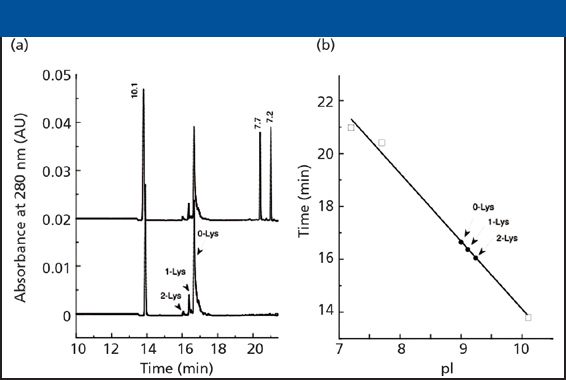
In this article, the authors review recent developments in the research of whole-column-imaging detection for capillary electrophoresis (CE). Whole-column-imaging detection was developed for capillary isoelectric focusing, for which it proved to be an ideal detector. Several whole-column-imaging detectors -- including refractive index gradient imaging, UV-absorption imaging, and fluorescence imaging detectors -- have been studied. The capillary isoelectric focusing UV-absorption imaging technique even has been commercialized. The development of whole-column-imaging detection itself facilitates CE studies in many directions such as in electrophoretic dynamics within narrow channels, new separation modes, and two-dimensional separations. Whole-column-imaging detection also finds application in capillary zone electrophoresis.

Wehr examines developments discussed at "CE in the Pharmaceutical Industry," a symposium sponsored by the California Separation Science Society.

Capillary electrophoresis (CE) is a useful and versatile technique for a large number of applications. Devoting some discussion to the development of these reported methods to illustrate the separation approaches and strategies to obtain reproducible results, they also compare CE's advantages and disadvantages with those of the more typical method for each type of analysis.

This month's installment of "CE Currents" deals with problems that may arise when using capillary electrophoresis for unattended, long-term operation, such as sample carryover, evaporation effects, capillary conditioning, capillary surface changes, buffer handling, capillary breakage, and detector lamp deterioration.

By adopting standard buffers, analysts can gain a great deal of operating efficiency and significantly reduce method development and validation costs.

Despite their different levels of technological maturity, CE and LC coupled with electrospray ionization MS techniques can be operated at the same level of automation. However, they differ in their configuration, selectivity, sensitivity, and method development.

The author describes an ultrathin-layer agarose gel electrophoresis approach that combines the advantages of the multilane format of conventional slab and the performance of capillary gel electrophoresis.

This month's "CE Currents" continues an examination of problems that users may find in routine CE work. Readers can avoid these problems by adopting the working practices suggested by the authors.