PharmTech LCGC Sciex Webinar 11.10

Environmental Analysis

Latest News


The Column

Gas chromatography-mass spectrometry using a single-quadrupole instrument is the workhorse technique of the environmental lab. It normally falls short for applications that require high mass accuracy. It is shown here that with proper calibration techniques, this technique can indeed readily obtain high mass accuracies to within a few millidaltons and become a powerful tool for unknown compound identification.

i12_t-302246-1408683546864.gif

LCGC North America

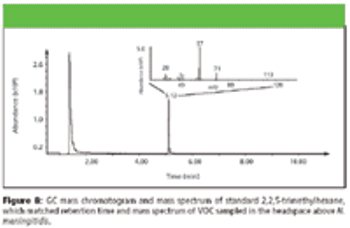
A method for the identification of key volatile organic compound (VOC) markers associated with infection by Neisseria meningitidis bacteria by gas chromatography–mass spectrometry (GC–MS) was developed. Headspace samples of bacterial VOCs were trapped on triple-sorbent bed tubes and then thermally desorbed into a laboratory GC–MS system for separation. Identification was carried out by comparison of GC retention time and electron ionization mass spectra to the National Institute of Standards and Technology (NIST) database. Further confirmation was obtained by GC–MS of known standard chemicals. A total of 75 VOCs were detected, five of which can be considered key VOC markers for Neisseria meningitidis. These peaks were identified as 1,2-dimethylcyclopropane, 2-methylpropanal, methacrolein, N-2-dimethyl-1-propanamine, and 3-methylbutanal by the NIST database.

LCGC North America

As environmental legislation becomes more stringent, the need to deliver quantitative results in shorter times and greater volumes is necessary for routine environmental analysis. Most of the high-throughput screening methods used to analyze pharmaceutical compounds are, however, useless for environmental monitoring. This is because these methods primarily aim to retrieve as much information from a single sample using the broadest range of techniques. The chromatographic separation process is considered to be the bottleneck in the process. This is not the situation for environmental procedures, in which the bottleneck is the sample preparation step and is usually very tedious and time-consuming.