


LCGC Europe
An overview of contemporary techniques in environmental analysis.
LCGC Europe
An overview of contemporary techniques in environmental analysis.
LCGC Europe
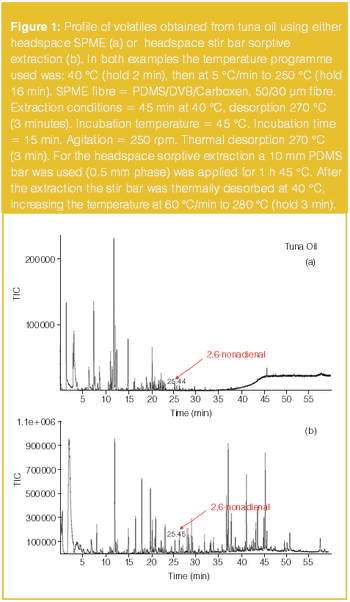
A review of the role of Solid-phase Microextraction (SPME) in quality control (QC) in the fish oil industry.

LCGC North America
A selective and highly sensitive capillary gas chromatographic-mass spectromic approach has been developed for the detection of PBDEs and PBBs that utilizes dissociative resonance electron capture and selected ion monitoring.

E-Separation Solutions
How are HPLC solvents affected by exposure to light, heat, and humidity? What are the best procedures for short-term storage of HPLC solvents and buffers to avoid degradation?
Special Issues
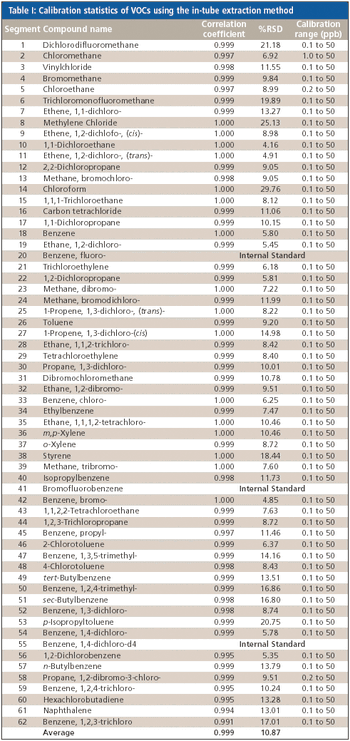
Over the last 10 years, several solvent-free microextraction techniques for gas chromatography (GC) and mass spectrometry (MS) have been developed. Two of these techniques, solid-phase microextraction (SPME) and stir-bar sorptive extraction (SBSE), are available commercially for the analysis of volatile compounds, such as flavors in foods and beverages, and toxic organic compounds in environmental applications. Other techniques, such as open tubular trapping, inside needle capillary adsorption trap (1), in-tube SPME, capillary microextraction, needle trap, and headspace solid-phase dynamic extraction (2), were also developed for different applications. The basic principle for all of these techniques is essentially the same. Volatile and semivolatile compounds are adsorbed on a sorbent coating, often packed on the interior surface of a capillary column or stainless steel needle. After the sample is concentrated on the coating, the compounds are desorbed thermally in the heated injection port of a gas..

Special Issues
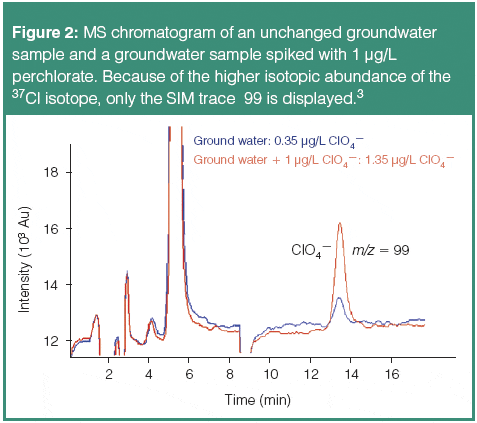
Liquid chromatography with tandem mass spectrometry (LC–MS-MS) led to a revolution in environmental testing. The coupling of liquid chromatography with tandem mass spectrometry created a powerful analytical tool for the analysis of emerging environmental contaminants. Pharmaceuticals and personal care products, perfluorinated compounds, brominated flame retardants, and disinfection byproducts were chosen as examples to illustrate the use of this new technique in environmental analysis.
LCGC Europe
Hian Kee Lee speaks with Alasdair Matheson about "environmentally friendly" sample preparation techniques.

The Application Notebook
Contamination of public buildings with PCBs used as softeners in the 1970's in sealants and wall and ceiling paints can still be detected. If certain threshold values in indoor air are exceeded the source has to be decontaminated. This requires an effective and fast determination of the PCB concentration in indoor air. Thermodesorption GC–MS is a method especially suitable for this purpose. Polychlorinated Biphenyls (PCBs) are highly toxic and carcinogenic chemical substances. Although first prepared in 1864, they have been industrially manufactured since 1929. The highest production amounts worldwide were recorded in the 1960s and the beginning of the 1970s. In the 1970s their use as additives for building materials was widespread because of their flame inhibiting and noise reduction properties.

The Application Notebook
Pesticides are widely used by farmers to control pests, weeds and molds that would otherwise decrease crop production. While this has significantly increased worldwide food productions, these same pesticides pose health risks to humans. The restrictions for specific pesticides differ from one country to the next and as world trade increases, the potential threat to other countries' populations increases. For this reason, pesticides and other food related allergens are currently the subjects of increasing scrutiny and regulation.
The Application Notebook
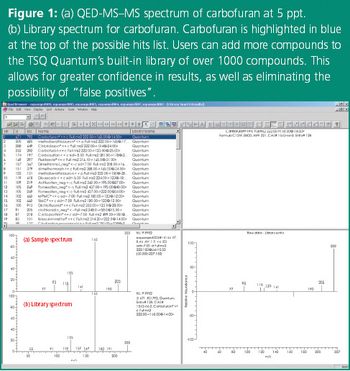
This application note describes an LC–MS–MS method for on-line sample preparation and concentration of drinking water samples prior to analysis using a triple quadrupole with full scan Q3 confirmation.

The Application Notebook
AC Analytical Controls developed a new chromatographic solution that complies with all ASTM & EN chromatographic test methods listed in biodiesel specifications: the AC all-in-one Biodiesel analyser. Analysis results demonstrate that the AC analyser complies with EN 14103, EN 14105, EN 14106, EN 14110 & ASTM D6584 methods.

LCGC Europe
In addition to the universal detectors used in gas chromatography (GC), selective detectors have also played an important role in the rapid spreading of the utilization of the technique. Probably the most important selective GC detector is the electron-capture detector, with a very high sensitivity to organic compounds containing chlorine and fluorine atoms in their molecules. The electron-capture detector had a vital role in environmental protection and control - its use helped to prove the ubiquitous presence of chlorinated pesticides in nature and halocarbons in our atmosphere, and made us aware of the global extent of pollution. It was the electron-capture detector that made concentration ranges of parts-per-billion (ppb: 1:109) or even parts-per-trillion (ppt: 1:1012) detectable. Today, these terms are used routinely without realising how formidable such a sensitivity really is: 1 ppb means that a spaceship (or a UFO, depending upon one's inclination) could pick up a particular family of six from..

LCGC North America
Triclosan is an ubiquitous antibacterial, antimicrobial chemical found in numerous consumer health care products today. This article demonstrates that triclosan can be quantitatively determined in commercial hand soaps using reversed-phase solid-phase disk extraction coupled to quantification using capillary gas chromatography-atomic emission detection while avoiding emulsions.
E-Separation Solutions
The exact method used depends upon the type of hydrocarbon contamination in the soil.

LCGC Asia Pacific
Suppressed conductivity detection is a well-developed method for detecting charged species. Reversed-phase high-performance liquid chromatography (RP-HPLC) is a well developed method of separating substances on the basis of hydrophobicity. There are some situations where it is advantageous to use these two methods together. Perfluoro-acids (PFOAs) are one class of compounds that are ionic, hydrophobic and have low UV absorbance and are, therefore, suited to this combination.

LCGC Asia Pacific
Polycyclic aromatic hydrocarbons (PAHs) are commonly found throughout the environment in soil, water and adsorbed to fine particulate matter in air. Of the 16 common PAHs, 7 have been classified as animal carcinogens by the International Agency for Research on Cancer (IARC). Resulting from this classification, PAHs are monitored and regulated in the environment.

The Column
Negative chemical ionization GC-MS, used in conjunction with automated cold-on-column injection, provides efficient and sensitive quantification of explosive residues for environmental and forensic applications.

LCGC Asia Pacific
William Goodman and Thomas Meaker, PerkinElmer Life and Analytical Sciences

LCGC North America
This article presents the findings from an analysis conducted on sensitivity in GC on the basis of the complex group of polycyclic aromatic hydrocarbons and PAH derivatives.

LCGC Europe
Traditional methods for the sample preparation of insoluble solid materials have represented one of the more time consuming and labour-intensive efforts in analysis. In this instalment of "Sample Prep Perspectives", Ron Majors examines modern sample preparation methods for solids that often involve increased temperature and higher pressure to speed up the extraction process. In addition, modern sample preparation methods have been automated to relieve analysts of the drudgery associated with traditional methods. Here, he reports on automated Soxhlet extraction, supercritical fluid extraction, pressurized fluid extraction–accelerated solvent extraction, and microwave-assisted extraction and updates earlier coverage.

LCGC North America
Capillary extraction (CEx) is used to study the solventless in-tube extraction of naphthalene, acenaphthene, phenanthrene, fluoranthene, chrysene, benzo(a)pyrene and coronene in aqueous samples prepared by analyte spiking into clean waters or, as an alternative, by using the generator–column method of sample preparation. Analysis of laden extractors is conveniently performed by high-resolution gas chromatography (GC), with a flame-ionization detector (FID). Extraction set-ups and main extraction variables are investigated from a practical point of view. For 2- to 4-ring polycyclic aromatic hydrocarbons (PAHs), equilibrium times are within a few minutes, analytical sensitivity is in the parts-per-billion (ppb) range and reproducibility is better than 10% relative standard deviation (RSD) (n = 6). Coronene behaviour is unique and presumably determined by extreme hydrophobicity and thus very negligible aqueous solubility: in-tube extraction of coronene seems possible only if starting from..

The Application Notebook
Glyphosate [N-(phosphonomethyl) glycine] is a broad spectrum, non-selective herbicide, which acts by inhibiting the shikimic acid pathway in plants. Recent studies have raised global health and environmental concerns about glyphosate's use.1 Glyphosate readily breaks down into aminomethyl phosphonic acid (AMPA) in the environment; requiring accurate measurement. Both highly polar compounds present an analytical challenge to the chromatographer (Figure 1). Typical silica based reversed-phase C18 columns experience difficulty with the retention of such polar compounds, and may generate non-resolved co-eluting peaks, often with polar analytes eluting in the void volume. Traditional analytical methods require complex eluents and time consuming derivatization steps to achieve retention on a reversed-phase support.
LCGC Europe
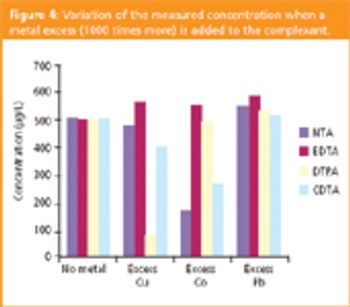
Chelating agents such as NTA, CDTA and DTPA are considered by ANDRA (the French national agency for radioactive waste management) as compounds to be investigated because they may enhance the release of radioactive isotopes in the environment.

LCGC Europe
Capillary extraction (CEx) is used to study the solventless in-tube extraction of naphthalene, acenaphthene, phenanthrene, fluoranthene, chrysene, benzo(a)pyrene and coronene in aqueous samples prepared by analyte spiking into clean waters or, as an alternative, by using the generator–column method of sample preparation. Analysis of laden extractors is conveniently performed by high-resolution gas chromatography (GC), with a flameionization detector (FID). Extraction set-ups and main extraction variables are investigated from a practical point of view. For 2- to 4-ring polycyclic aromatic hydrocarbons (PAHs), equilibrium times are within a few minutes, analytical sensitivity is in the parts-per-billion (ppb) range and reproducibility is better than 10% relative standard deviation (RSD) (n = 6). Coronene behaviour is unique and presumably determined by extreme hydrophobicity and thus very negligible aqueous solubility: in-tube extraction of coronene seems possible only if starting from oversaturated..

The Application Notebook
This application note will demonstrate a GC–MS analysis of common polybrominated diphenyl ether (PBDE) congeners. An optimized method will allow the Clarus GC–MS to provide ample separation and high yields of all PBDE congeners. The extended mass range of the Clarus 500 MS and high-mass calibration will produce mass spectra with very high levels of accuracy.