


E-Separation Solutions
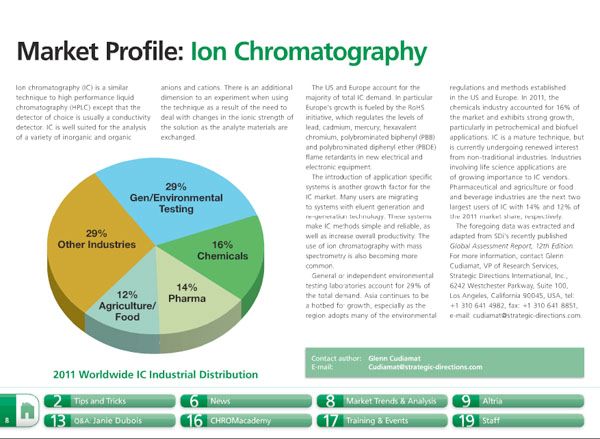
Ion chromatography (IC) is a similar technique to high performance liquid chromatography (HPLC) except that the detector of choice is usually a conductivity detector.

E-Separation Solutions
Ion chromatography (IC) is a similar technique to high performance liquid chromatography (HPLC) except that the detector of choice is usually a conductivity detector.
The Application Notebook
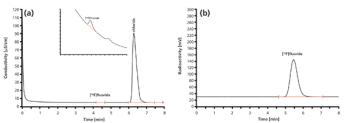
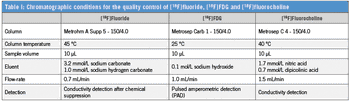
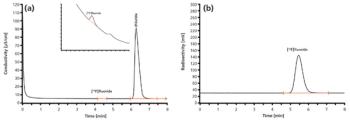
Positron emission tomography (PET) is one of the most powerful non-invasive diagnostic tools for tracing organ functioning. Quality control of the short-lived radiopharmaceuticals is challenging, not least because of the tough time limits, the radiation issue and the near nanomole radiotracer quantities.

The Application Notebook
Positron emission tomography (PET) is one of the most powerful noninvasive diagnostic tools for tracing organ functioning. Quality control of the short-lived radiopharmaceuticals is challenging, not at least because of the tough time limits, the radiation issue, and the near nanomole radiotracer quantities.
The Application Notebook
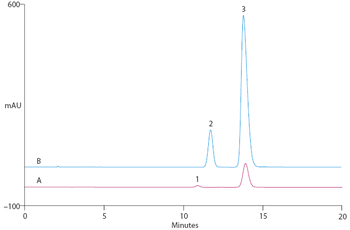
Risedronate, a pyridinyl bisphosphonate, is one of the most popular first-line drugs in the treatment of osteoporosis, Paget's disease, and other bone fragility conditions. In October 2010, the United States FDA approved a second-generation risedronate in a delayed-release formulation.
The Application Notebook
Metrohm Application Note
LCGC Europe
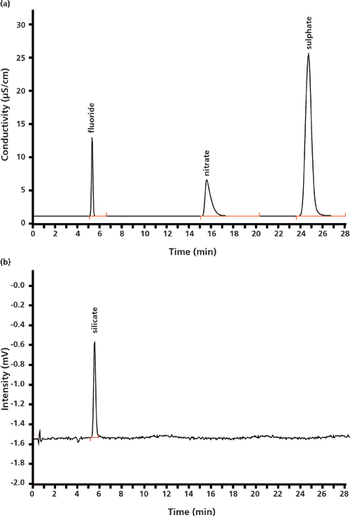
This article describes a 2D matrix elimination ion chromatography method to analyse samples containing high levels of matrix ions.
The Application Notebook
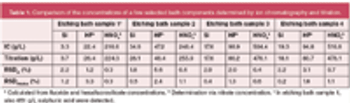
The presented ion chromatographic method is used for the simultaneous determination of HF, HNO3, H2SO4, short-chain organic acids and H2SiF6 in acidic texturing baths that are used in the wet chemical etching process of solar cell production.
LCGC Asia Pacific
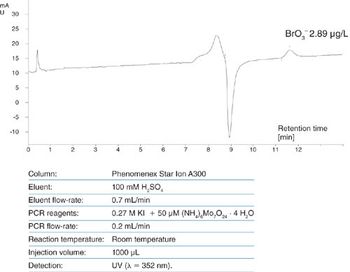
A review of separations of chlorite, chlorate and bromate in water using ion chromatography and their determination.

LCGC Europe
A review of separations of chlorite, chlorate and bromate in water using ion chromatography and their determination.
The Column
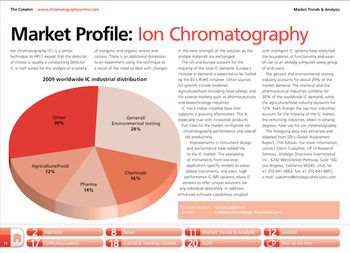
Ion chromatography (IC) is a similar technique to HPLC except that the detector of choice is usually a conductivity detector.
E-Separation Solutions
Ion chromatography (IC) is a similar technique to HPLC except that the detector of choice is usually a conductivity detector. IC is well suited for the analysis of a variety of inorganic and organic anions and cations.
The Application Notebook
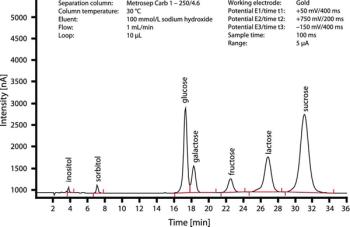
This article describes a straightforward ion chromatographic method that uses isocratic elution and pulsed amperometric detection (PAD) to sensitively determine water-soluble polyols and sugar alcohols as well as mono-, di- and oligosaccharides in essential and non-essential foodstuffs. While carbohydrate determination of most foodstuffs requires only minimal sample preparation such as dilution and filtration, samples with interfering matrices such as protein-containing dairy products have to be dialysed before injection.
Special Issues
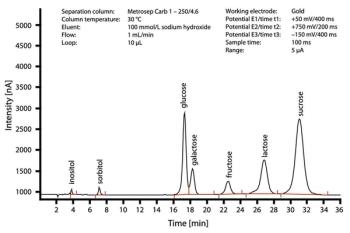
This article describes a straightforward ion chromatographic method that uses isocratic elution and pulsed amperometric detection (PAD) to sensitively determine water-soluble polyols and sugar alcohols as well as mono-, di- and oligosaccharides in essential and nonessential foodstuffs.
LCGC Asia Pacific
Metrohm Application Note

LCGC Europe eNews
Joining us for a discussion on ion chromatography this month are experts from Dionex, Metrohm and Merck.
E-Separation Solutions
Joining us for a discussion on ion chromatography this month are experts from Dionex, Metrohm and Merck.

Metrohm Application Note

The Application Notebook
The fully automated combustion ion chromatography (CIC) system presented here combines a highly efficient combustion system with the separation power of ion chromatography (IC). CIC allows for the simultaneous, speciated trace analysis of halide (F, Cl, Br and I) and sulphur compounds (as sulphate) from sub-ppm to percent levels in any nonaqueous sample matrix.
The Application Notebook
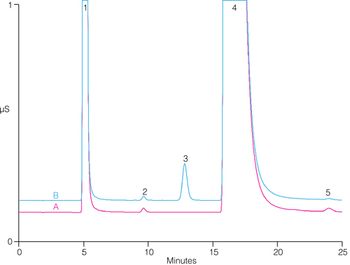
Methacholine chloride is a synthetic analogue of the neurotransmitter acetylcholine used to assess bronchial asthma of subjects in respiratory function labs and epidemiological field studies.

LCGC North America
The basics of IC are reviewed and recent advances that may extend this technology to new applications are discussed.

LCGC Asia Pacific
Metrohm Application Note
The Application Notebook
The fully automated combustion ion chromatography (CIC) system presented here combines a highly efficient combustion system with the separation power of ion chromatography (IC).
The Application Notebook
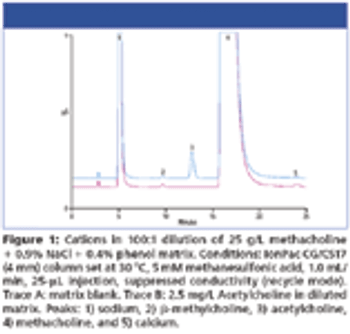
Methacholine chloride is a synthetic analogue of the neurotransmitter acetylcholine used to assess bronchial asthma of subjects in respiratory function labs and epidemiological field studies (1).