

LCGC E-Books
LCGC E-Books
LCGC E-Books

The Column
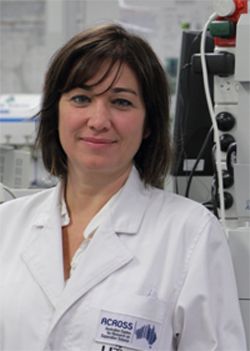
The Column spoke to Rajmund Michalski from the Polish Academy of Sciences, Institute of Environmental Engineering in Zabrze, Poland, about the application of ion chromatography in speciation analysis.

E-Separation Solutions
LCGC spoke to Rajmund Michalski from the Polish Academy of Sciences, Institute of Environmental Engineering in Zabrze, Poland about the application of ion chromatography in speciation analysis.

The Column
Ion chromatography (IC) is often used for the chromatographic separation of a wide range of compounds. In a laboratory that already uses HPLC or UHPLC, will the implementation of IC be expensive in terms of instrumentation or resources?The Column spoke to Ade Kujore of Cecil Instruments Limited to find out.

The Column
The first commercial capillary ion chromatography (IC) systems became available in 2010, but uptake of the technique has been slow even though it has many benefits. Here, we review those benefits and present selected application areas where it is proving especially useful.

The Application Notebook
Metrohm
E-Separation Solutions
Today, three free tutorial sessions are offered to HPLC conferees. Today?s talks, from Steven Soper, Emily Hilder, and Chris Pohl, cover microfluidics, monoliths, and ion chromatography.

The Column
Scientists from the University of Florence in Italy have developed a novel fast ion chromatographic (FIC) method for the analysis of fluoride in Antarctic snow and ice. Data from fluoride analysis has the potential to assist scientists to build up a picture of past volcanic activity.

The Application Notebook
Monoamine neurotransmitters (adrenaline, dopamine, noradrenaline, and acetylcholine) are released from the brain and peripheral nervous system in minute amounts.


LCGC North America
Ion chromatography (IC) is a similar technique to HPLC except that the detector of choice is usually a conductivity detector. IC is well suited for the analysis of a variety of inorganic and organic anions and cations.

The Column
The Column spoke to Dr Ailsa Benton - an "ice core" analytical scientist from the British Antarctic Survey (BAS) research team - about the role of chromatography in climate change.

The Column
Ion chromatography (IC) is an important analysis tool for chromatographers. Typically, emphasis is placed on the hardware components and chemistry to achieve the ideal level of separation. However, the flow path itself is often overlooked, and there are some relatively simple steps that can be taken to ensure that the system's flow path positively affects the overall chromatographic results achieved.
Special Issues
Computer-based methods can simulate separations for a wide variety of analytes, columns, and eluents.

Special Issues
A summary of the latest in new ion-exchange phases for ion chromatography, with a focus on general aspects of phase design and then a review of anion-exchange and cation-exchange columns introduced in the past few years

Special Issues
The authors present the most common and fundamental techniques that address common matrix issues and discuss the critical chemistry considerations.
Special Issues
A summary of the latest in new ion-exchange phases for ion chromatography, with a focus on general aspects of phase design and then a review of anion-exchange and cation-exchange columns introduced in the past few years

Special Issues
A brief introduction to this special supplement by Guest Editor Ron Majors

Special Issues
A look at the current status of detection in ion chromatography, focusing on the most popular detectors in IC: the conductivity detector and the charge detector
Special Issues
A look at the current status of detection in ion chromatography, focusing on the most popular detectors in IC: the conductivity detector and the charge detector

Special Issues
The speed of IC has been limited by pressure and flow limits of the hardware. Recent advances are enabling faster IC separations.
Special Issues
From the invention of eluent suppression to today's "just add water" concept, pivotal developments over the last 40 years are chronologically highlighted from a chemical and instrumental viewpoint.
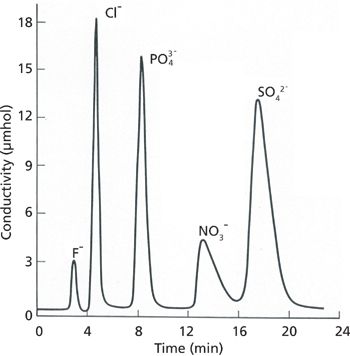
Special Issues
From the invention of eluent suppression to today's "just add water" concept, pivotal developments over the last 40 years are chronologically highlighted from a chemical and instrumental viewpoint.

Editors' Series: Industrial Problem Solving Using Ion Chromatography