

The Application Notebook
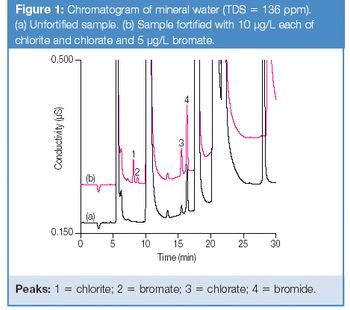
This article describes the use of combined ion chromatography-mass spectrometry (IC–MS) and ion chromatography-inductively coupled plasma mass spectrometry (IC-ICP–MS) to analyse potentially harmful compounds.
The Application Notebook
This article describes the use of combined ion chromatography-mass spectrometry (IC–MS) and ion chromatography-inductively coupled plasma mass spectrometry (IC-ICP–MS) to analyse potentially harmful compounds.

The Application Notebook
This article describes the use of combined ion chromatography-mass spectrometry (IC–MS) and ion chromatography-inductively coupled plasma mass spectrometry (IC-ICP–MS) to analyze potentially harmful compounds.

Determination of Fluoride in Acidulated Phosphate Topical Solutions Using Reagent-Free Ion Chromatography-Dionex Application Note
Determination of Parts-Per-Trillion Concentrations of Strontium by Pre-Concentration with Ion Chromatography and Suppressed Conductivity Detection- Dionex Application Note
The Application Notebook
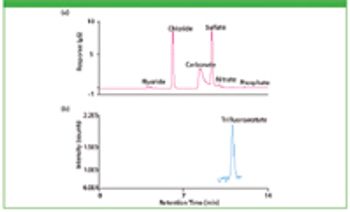
Perflourinated organic acids are ubiquitous and found at relatively low concentrations in the environment (1). Trifluoroacetic acid (TFA) is the persistent atmospheric degradation product of hydrofluorocarbons (HFCs) that are increasingly used as an alternative to banned, ozone-damaging chlorofluorocarbons (CFCs). However, debate surrounds the use of HFCs because of their potential to contribute to global warming and demonstrated toxicity to the environment (2). TFA is also widely used in pharmaceutical and biotechnology purification processes. It is crucial to monitor for TFA in environmental risk assessment and in products intended for human use. TFA can be measured by gas chromatography (GC) after sample preparation and chemical derivatization (3), ion chromatography (IC) (4), and capillary electrophoresis (5). This paper describes an IC-MS method to separate TFA from common anions based on Reagent-Freeâ„¢ IC (RFICâ„¢) technology with sensitive and selective mass spectrometric detection.
The Application Notebook
Run a difficult food sample on your IC and you stand a big chance that you will wreck the column. Of course, you can waste a lot of time on tedious sample preparation steps to eliminate undesired matrix components. Or you can go for Metrohm's automated compact stopped-flow dialysis providing optimum separation while protecting your column from detrimental compounds.
The Column
Ionic liquids have the potential to replacing classic organic solvents in numerous applications.

E-Separation Solutions
This month, Chromatography Online's Technology Forum looks at the topic of HPLC/ Ion Chromatography and the trends and issues surrounding it. Joining us for this discussion is Chris Pohl of Dionex Corporation, Jody Clark of Selerity Technologies, Scott Anderson and Laura Kaepplinger of Grace Davison Discovery Sciences, and Doug McCabe of Waters Corporation.

The Application Notebook
This article describes a straightforward ion chromatographic method that uses isocratic elution and pulsed amperometric detection (PAD) to sensitively determine water-soluble polyols and sugar alcohols as well as mono-, di- and oligosaccharides in essential and nonessential foodstuffs. While carbohydrate determination of most foodstuffs requires only minimal sample pretreatment such as dilution and filtration, samples with interfering matrices such as protein-containing dairy products have to be dialyzed prior to injection.
The Application Notebook
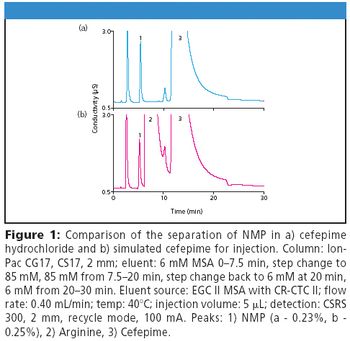
Cefepime is a fourth generation cephalosporin (1). During preparation and storage, cefepime degrades by release of the N-methylpyrrolidine (NMP) side chain and opening of the beta-lactam ring. An NMP concentration increase will directly affect the potency of the active component of the drug. Therefore, it is critical to determine the amount of NMP in cefepime. The US Pharmacopeia (USP) monograph specifies the limit of NMP to <0.3% in cefepime hydrochloride and <1% in cefepime for injection (2,3). The latter is a dry mixture of cefepime hydrochloride and L-arginine. The current USP method uses cation-exchange chromatography with non-suppressed conductivity detection to determine the limit of NMP in cefepime. There are several disadvantages to this method, such as the ~3-4 h time required per injection, a lack of retention time stability for NMP in standard and sample solutions, and a lack of sensitivity. In this paper, we describe an improved method using a hydrophilic, carboxylate-functionalized cation..
The Application Notebook

E-Separation Solutions
This month's Technology Forum looks at the topic of HPLC/Ion Chromatography Focus and the trends and issues surrounding it. Joining us for this discussion is Chris Pohl, VP and Chief Science Officer at Dionex Corporation, Larry Tucker from Metrohm-Peak, and Yuichi Fusho of Shodex.
LCGC North America
Ion chromatography (IC) is well suited for the analysis of a variety of inorganic and organic anions and cations. There is an additional dimension to an experiment using the technique as a result of the need to deal with changes in the ionic strength of the solution as the analyte materials are exchanged.

E-Separation Solutions
Ion chromatography (IC) is well suited for the analysis of a variety of inorganic and organic anions and cations.
LCGC Asia Pacific
Brian De Borba and Jeffrey S. Rohrer, Dionex Corporation
LCGC Europe
In this article, the authors describe a method based on the accelerated and automated extraction of hexavalent chromium from solid samples followed by ion chromatography analysis using spectrophotometric detection. The experiments were performed on different samples of sludge and soil.
The Application Notebook
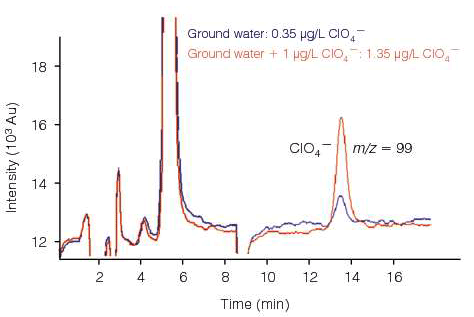
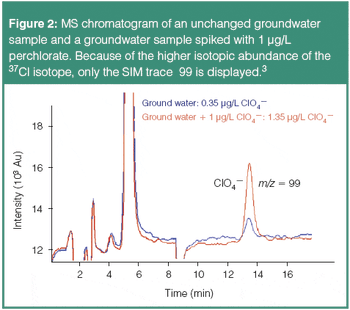
Perchlorate salts are being used as rocket propellants in fireworks...
LCGC North America
IC analysis of a cholinergic drug using suppressed-conductivity detection and eluent generation. (Dionex Corporation)
The authors demonstrate a new detection method for various anions and cations separated by ion chromatography and point out the main advantages of this method.

The authors demonstrate a new detection method for various anions of weak acids separated by ion chromatography and point out the main advantages of this method.

The authors developed an ion chromatography method to separate 31 cations in a single chromatographic run using inductively coupled plasma–mass spectrometry, liquid scintillation counting, and gamma counting. The high-level radioactive waste samples contained trace radionuclides in concentrations of only a few hundred disintegrations-per-minute-per-milliliter.