

The Application Notebook
Aminopolycarboxylate chelating agents form stable complexes with transition metals, thereby increasing metal solubility, preventing metal-catalyzed reactions, and removing heavy metal contamination in soil remediation.
The Application Notebook
Aminopolycarboxylate chelating agents form stable complexes with transition metals, thereby increasing metal solubility, preventing metal-catalyzed reactions, and removing heavy metal contamination in soil remediation.
The Application Notebook
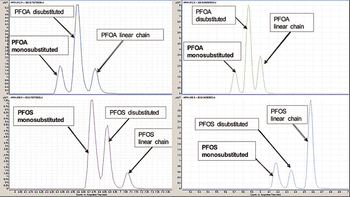
Perfluorinated compounds (PFC) are considered as emerging contaminants that attract high interest from the international scientific community.

The Application Notebook
Using a bonded polymeric zwitterionic stationary phase, in HILIC mode, polar quaternary herbicides like Diquat can easily be retained, with good peak symmetry.
The Application Notebook
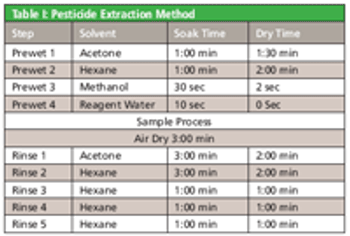
Pesticide pollution is a subject of global concern, and although many countries have now banned the use of organochlorine pesticides, they linger in the environment and can contaminate water sources.

Special Issues
Using a bonded polymeric zwitterionic stationary phase, in HILIC mode, polar quaternary herbicides like Diquat can easily be retained, with good peak symmetry.

The Application Notebook
ISOLUTE EPH columns have been developed to fractionate pentane or hexane based soil extracts into aliphatic and aromatic hydrocarbon fractions (C8?C40 aliphatics, C10?C22 aromatics).

The Application Notebook
In developing the Atomx automated sample prep system, Teledyne Tekmar integrated both a P&T concentrator and a multi-matrix autosampler into a single platform system that can be used in the analysis of soil, water, and soils requiring methanol extraction.

The Application Notebook
Burning mosquito coils to repel these pests is common in many countries; however the emission of various, potentially toxic volatile organic compounds (VOCs) is cause for concern.

The Application Notebook
N-Nitrosodimethylamine and other structurally similar nitrosamines are classified as probable carcinogens by the U.S. EPA, and their presence has been reported in California drinking water since 1998.
The Application Notebook
In this application note we present an online SPE-LC method for the determination of trace-level endocrine disruptive compounds (EDCs) in seawater using the new SolEx HRP cartridge as the solid-phase extraction (SPE) phase.

The Application Notebook
A sample of ambient cabin air from a commercial airliner was collected by stir bar sorption extraction (SBSE) and analyzed by thermal desorption GCxGC-TOFMS.
The Application Notebook
Electrochemical detection (ECD) is both selective and extremely sensitive. However, relatively few compounds are electrochemically active, therefore limiting its application.

The Application Notebook
Gel-permeation chromatography (GPC) is a highly effective postextraction cleanup method for removing high molecular-weight interferences such as lipids, proteins, and pigments from sample extracts prior to analysis.

The Application Notebook
The fully automated combustion ion chromatography (CIC) system presented here combines a highly efficient combustion system with the separation power of ion chromatography (IC). CIC allows for the simultaneous, speciated trace analysis of halide (F, Cl, Br and I) and sulphur compounds (as sulphate) from sub-ppm to percent levels in any nonaqueous sample matrix.
The Application Notebook
Bisphenol A (BPA) is widely used in high production volume manufacturing of polycarbonate plastics (for example, food containers and plastic bottles) and epoxy resins.
The Application Notebook
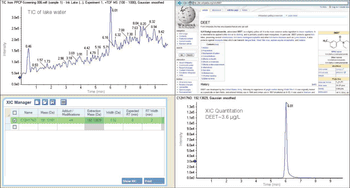
This paper describes the use of the AB SCIEX TripleTOF 5600 LC–MS–MS system for the screening and identification of unexpected contaminants in lake water, demonstrating the value of high-resolution, accurate-mass data and retrospective data processing for the identification of nontargeted compounds.
The Application Notebook
Carbonyl compounds, in particular aldehydes, are reactive volatile substances. They are of concern to the public, because they are emitted as air pollutants by a large range of industrial processes and other combustion sources.

The Application Notebook
Comprehensive two dimensional gas chromatography–mass spectrometry is a powerful method to identify target analytes in complex matrices. An example is shown of identification of pesticides in citrus oil.

The Application Notebook
Due to the mutagenic and carcinogenic properties of polycyclic aromatic hydrocarbons (PAHs), the determination of these analytes is an important field in environmental analytical chemistry.

The Application Notebook
Odor causing compounds can find their way into drinking water from a number of sources. One of the most common compounds causing a "musty" or "earthy" smell is geosmin, which is released when microbes such as blue-green algae and actinobacteria die.

The Application Notebook
Volatile organic compounds (VOCs) are one chemical group that has been linked to increase ozone levels. When present in indoor spaces at high enough levels they can produce sick building syndrome symptoms in people.

The Application Notebook
Eosin Y is an important tracer in groundwater studies for determining water migration paths and identifying the distribution of environmental pollutants.

The Application Notebook
Gel permeation chromatography (GPC) is a very effective sample clean-up technique, key to an accurate and sensitive analysis of pesticide, PCBs, mycotoxin, PAHs, and other similar compounds.

The Application Notebook
The U.S. EPA Office of Groundwater and Drinking Water released Method 524.3, "Measurement of Purgeable Organic Compounds in Water by Capillary Column Gas Chromatography/Mass Spectrometry, Version 1.0," in the Federal Register on August 3rd, 2009 (1, 2). This new method contains an updated list of 76 VOCs that includes fuel oxygenates and two emerging contaminants of interest.
The Application Notebook
Bisphenol A (BPA) is widely used in high production volume manufacturing of polycarbonate plastics (for example, food containers and plastic bottles) and epoxy resins (1).

The Application Notebook
This paper describes the use of the AB SCIEX TripleTOF 5600 LC–MS-MS system for the screening and identification of unexpected contaminants in lake water, demonstrating the value of high-resolution, accurate-mass data, and retrospective data processing for the identification of nontargeted compounds.

The Application Notebook
The U.S. EPA Office of Groundwater and Drinking Water released Method 524.3, "Measurement of Purgeable Organic Compounds in Water by Capillary Column Gas Chromatography/Mass Spectrometry, Version 1.0," in the Federal Register on August 3rd, 2009 (1, 2).
The Application Notebook
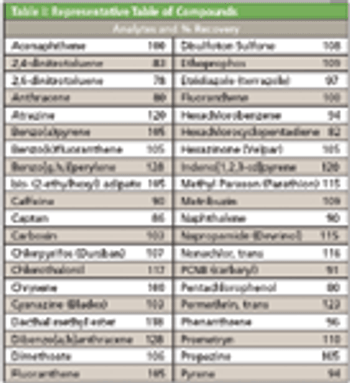
The extraction and analysis of semi-volatile organic (SVOC's) compounds can be problematic due to the wide range of analyte types and polarities.

The Application Notebook
Glyphosate (GP) is a non-selective, postemergence herbicide widely used for weed and vegetative control.

The Application Notebook
The determination of PCBs, as well as other environmental contaminants, in fish tissue requires extensive sample cleanup prior to analysis by gas chromatography with an electron capture detector (GC-ECD).