

Application Notes: Environmental
Advertisement

Special Issues
Disinfection by-products (DBP) are an ever-present nuisance in the efforts to purify drinking water, wastewater, and municipal waters from various sources.

The Application Notebook
Initial precision was demonstrated by spiking four 1-L volumes with one Snip and Pour pre-measured standard, each (40 mg). The data for four replicates was collected for 47 mm Disks and 100 mm Disks. The average percent recovery is excellent and meets the criterion specified of 83–101% HEM recovery for both size disks. The standard deviation is better than the criterion specified of 11% for HEM.
The Application Notebook
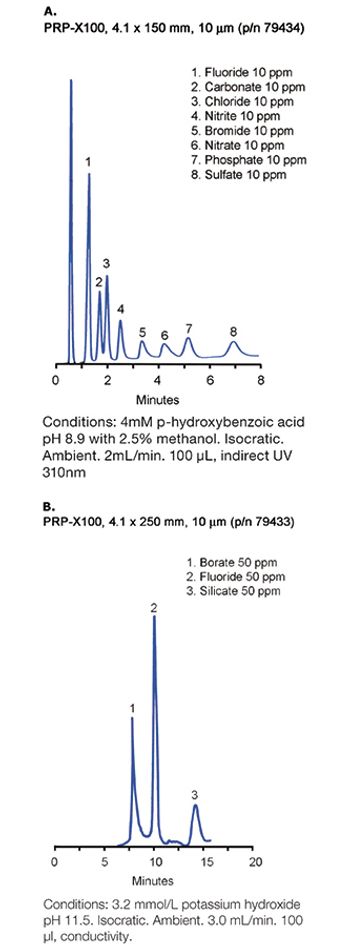
Hamilton PRP-X100 and PRP-X110 are the perfect solution for anion analysis in water or environmental samples. The robust design and covalent surface modification of the packing material lead to a highly increased lifetime as compared to the competition. The production process is compliant to ISO 9001 ensuring an outstanding column-to-column and lot-to-lot reproducibility.

Special Issues
This automated SPE methodology is a solution that will reduce analyst labor, solvent usage, and turn-around-time while maintaining the high quality results required within today's laboratories.

Special Issues
The US EPA has implemented an exposure research program aimed at conducting drinking water research on methods as part of the Microbiological and Chemical Exposure Assessment. This research is aimed at evaluating the chemical pollutants and their role and levels in which there is an unacceptable risk to either humans or wildlife, as well as evaluating the methodologies currently being used to determine levels of chemical pollutants.

The Application Notebook
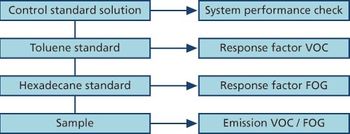
Diesel range organics or DRO is the cumulative analysis of extractable alkanes between the ranges C10 through C28 as measured on a flame ionization detector.

The Application Notebook
This project will evaluate the performance and versatility of the AutoMate-Q40 for the extraction of Imidazolinone herbicides.
The Application Notebook
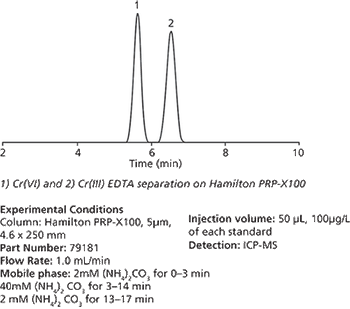
Analysis of chromium species is made challenging due to the nature of the element and diverse sample matrices
Advertisement
Special Issues
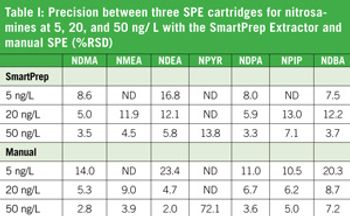
Disinfection by-products (DBP) are an ever-present nuisance in the efforts to purify drinking water, wastewater, and municipal waters from various sources. An emerging class of DBP compounds with health effects is nitrosamines which result from chloramination or chlorination if the water is nitrogen-rich. Five of these nitrosamines have been listed on the US EPA’s new Contaminant Candidate List (CCL-3). Of the nitrosamines, the most common and problematic is N-nitrosdimethylamine (NDMA). The maximum admissible levels set by the US EPA are 7 ng/L for NDMA and 2 ng/L for N-nitrosodiethylamine (NDEA).

The Application Notebook
Generally speaking, chromate - Cr(VI) - is classified as allergenic, carcinogenic, and extremely toxic and is subject to strict monitoring. Cr(VI) can occur in various concentrations in different areas, for example, drinking water, toys, or textile and leather products. Metrohm has developed ion chromatographic determination methods for determining Cr(VI) in various concentration ranges (ng/L to mg/L) with inline sample preparation techniques for various matrices. The method can be almost entirely automated. In the following application note, we present the analysis of hexavalent chromium in toys, leather, and drinking water.
The Application Notebook
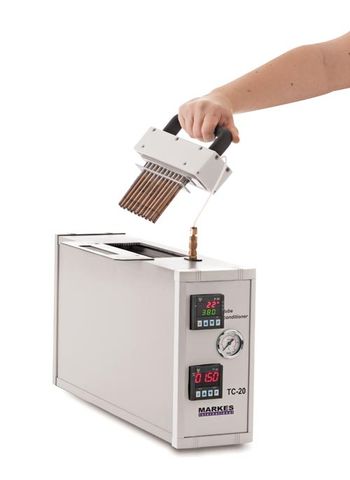
Rigorous conditioning of sorbent tubes is an essential part of any sampling and analysis protocol. This application note will explore the cost savings and productivity enhancements that can be made by off-line conditioning, rather than on‑line with the thermal desorber itself. In particular, we will focus on the revenue resulting from running more analytical samples, the cost-effectiveness of increasing sample capacity by this approach, and the benefits that stem from using nitrogen rather than helium.

The Application Notebook
Used extensively from the 1940s through the 1960s, organochlorine pesticides are chlorinated hydrocarbons used in agriculture and mosquito control. The organochlorine pesticides accumulate in the environment, presenting an ongoing issue with adsorption and accumulation in the population as a result of ingestion.
The Application Notebook
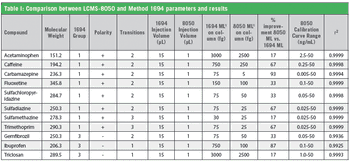
This method increases sensitivity and reduces data acquisition time for a subset of pharmaceuticals and personal care products from the original EPA Method 1694 specifications.

The Application Notebook
Organochlorine pesticides are among the more notorious organic pollutants. Gaining wide spread attention into the latter part of the 20th century, and ultimately leading to their ban, OCPs remain with us as a legacy contaminant in the environment.

The Application Notebook
US EPA wastewater method 624 Purgeables was originally published as 40 CFR Part 136 Appendix A in the mid 1980s.

The Application Notebook
In recent years, the increasing cost and uncertain availability of helium have prompted many labs to explore the use of hydrogen as an alternate carrier gas.
The Application Notebook
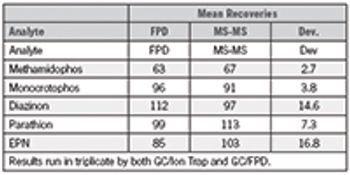
Organophosphate pesticides (OPPs) are widely used globally for agricultural pest control.

The Application Notebook
Pharmaceutical and personal care products (PPCPs) are products used for personal health or cosmetic reasons.


The Application Notebook
UCT, LLC

The Application Notebook
Pharmaceutical and personal care products (PPCPs) are products used for personal health or cosmetic reasons.
The Application Notebook
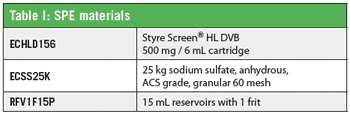
This application describes a solid phase extraction (SPE) method for EPA method 8141B analytes, including organophosphorus compounds, and triazine herbicides in water.

The Application Notebook
Shimadzu Europa GmbH
The Application Notebook
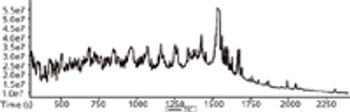
Gas chromatography coupled to high resolution time-of-flight mass spectrometry (GC–HRT) was used to identify halogenated organic compounds based on their mass defects in fish tissue extracts.

The Application Notebook
US EPA method 529 is the procedure to determine explosives and related compounds in finished drinking water.

The Application Notebook
Chromium (Cr) is a metal with an interesting relationship to the environment. Whereas trivalent chromium (Cr(III)) is an essential nutrient, hexavalent chromium (Cr(VI)) is a poison to humans and aquatic life and poses serious environmental and ecological threats.

The Application Notebook
EPA 8270D calls for the extraction for analysis of semi-volatile analytes in various matrices. Target analytes mentioned in the method cover a wide range of compound classes resulting in reporting lists that often approach 100 compounds.

The Application Notebook
Laboratories taking in a high volume of aqueous semi-volatile samples know that every sample is different.
Advertisement
Advertisement
Trending on LCGC International
1
Using UHPLC-MS/MS to Help Pinpoint Time of Death
2
LC-MS/MS Method Detects Rat Poison in Cats
3
The Case for Radical Cations: Bringing EI-Style Spectra to LC–MS
4
Peaks & Pioneers: Isabelle Kohler on Life Beyond the Traditional Academic Track
5