

Sponsored Content - NA
A fast analytical method including both sample preparation and LC–ƒMS/MS analysis of ibuprofen in human plasma.
Sponsored Content - NA
A fast analytical method including both sample preparation and LC–ƒMS/MS analysis of ibuprofen in human plasma.
Sponsored Content - NA
SPE is used in combination with LC–MS/MS to analyze a panel of opiates from a urine sample.
Sponsored Content - EU
Optimize the LC–MS/MS workflow by using a SPE solution that provides in-well urine hydrolysis to save time.
Sponsored Content - NA
Optimize the LC–MS/MS workflow by using a SPE solution that provides in-well urine hydrolysis to save time.
Sponsored Content - NA
A reliable and efficient method was developed to determine the concentration sterols in olive oil by GC-FID.
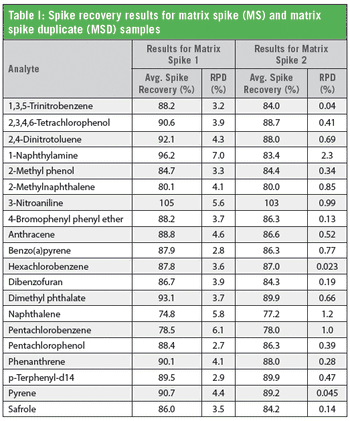
This applicate note presents the use of an automated solid-phase extraction (SPE) system to improve the accuracy and precision of semivolatile extractions, in compliance with EPA Method 8270.

The Application Notebook
This application note outlines the performance benefits achieved with UCT’s LipiFiltr® cleanup cartridge for the analysis of pesticides in oil-based cannabis products using LC–MS/MS analysis.


The Application Notebook
New separation techniques for the analysis of polar and ionic analytes have aroused great interest in the field of metabolomics and environmental investigation in the past two decades. Hydrophilic interaction liquid chromatography (HILIC) is a promising tool to address this challenge. HILIC separation is based on the polarity of analytes, which generally show stronger retention with increasing polarity according to the HILIC separation mechanism. Furthermore, the high content of organic solvent in the mobile phase leads to good ionization properties in the electrospray ionization (ESI), and consequently enhances the detection sensitivity by hyphenated mass spectrometry (MS) detector.
The Application Notebook
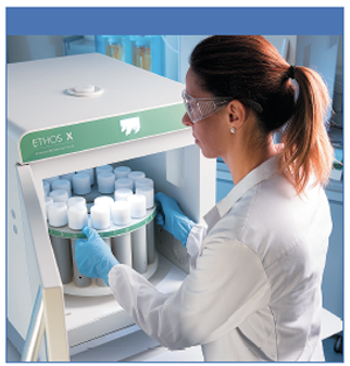
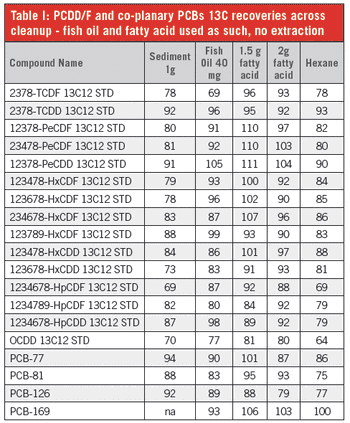
Microwave extraction becomes faster and easier with the new Milestone ETHOS X with its FastEX-24. This application note shows the use of Milestone technology for extraction of dioxins from environmental matrices, with emphasis on one of the most common challenge of this application: the carryover effect. The unique design of the FastEX-24 rotor with disposable glass vials allows easy and efficient dioxin extraction, and other organic pollutants, to be performed, avoiding any memory effect. The FastEX-24 simplifies the routine pollutants extraction process and provides superior productivity at lower costs.


Special Issues
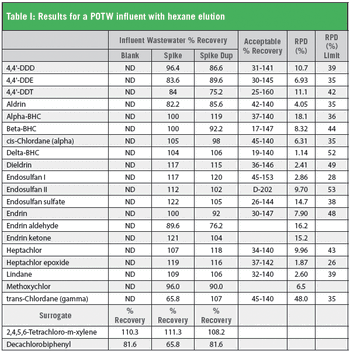
This application note will present the data collected as part of the demonstration of disk solid phase extraction validation for US EPA method 625.1.

Special Issues
By switching to a Raptor C18 column, labs can process more samples per hour while still meeting fluorochemical method requirements.

The Application Notebook

The Application Notebook


Special Issues
With the recent legalization of cannabis in several states, there is a growing need for robust, reliable, and cost-effective analytical methods to facilitate routine testing for potency and contaminants. Here we present an LC–MS/MS method that uses the budget-friendly SCIEX Triple Quad 3500 LC–MS/MS system for the simultaneous detection and quantification of cannabinoids, pesticides, and mycotoxins in cannabis products using the Scheduled MRM algorithm.
Special Issues
Drinking water is an important part of environmental exposure, especially for small children. Countries around the world have put regulations in place to monitor drinking water quality for a wide range of hazardous compounds.

Special Issues
By switching to a Raptor C18 column, labs can process more samples per hour while still meeting fluorochemical method requirements.
Special Issues
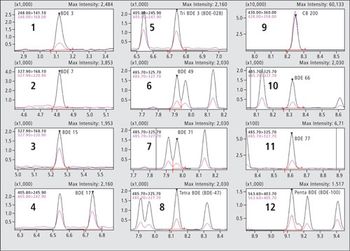
Determination of PBDE congeners can be performed at high sensitivity with good accuracy using the GCMS-TQ8050.
The Application Notebook

The Application Notebook

The Application Notebook

The Application Notebook


The Application Notebook

The Application Notebook