Application Notes: Environmental

i1_t-547870-1408670652045.gif

This application note describes a fast and sensitive LC-MS method using a Hypersil GOLDâ„¢ column on a Thermo Scientific LC-MS system for the quantitative analysis of two widespread PFCs, perfluorooctanoic acid (PFOA) and perfluorooctansulfonate (PFOS).

i2-547864-1408670667571.gif

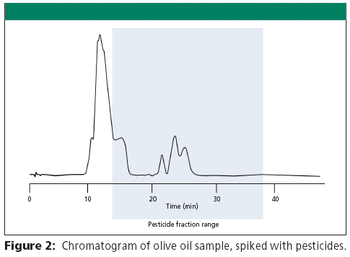
Gel permeation chromatography (GPC) has been used as an effective cleanup procedure for removing high molecular weight interfering molecules such as lipids, pigments, proteins, and polymers before GC or HPLC analysis. The GPC cleanup method has been extensively documented (1–3) and is also recommended in US EPA SW-846 Method 3640A. To demonstrate the efficacy of this method to extract polar and nonpolar substances by using the KNAUER Smartline GPC Cleanup Unit 6500, olive oil samples were investigated by spiking these with different types of organic pollutants, including PAHs, phthalates, phenols, and triazine.

i4-479365-1408664971539.jpg

Contamination of public buildings with PCBs used as softeners in the 1970's in sealants and wall and ceiling paints can still be detected. If certain threshold values in indoor air are exceeded the source has to be decontaminated. This requires an effective and fast determination of the PCB concentration in indoor air. Thermodesorption GC–MS is a method especially suitable for this purpose. Polychlorinated Biphenyls (PCBs) are highly toxic and carcinogenic chemical substances. Although first prepared in 1864, they have been industrially manufactured since 1929. The highest production amounts worldwide were recorded in the 1960s and the beginning of the 1970s. In the 1970s their use as additives for building materials was widespread because of their flame inhibiting and noise reduction properties.

i1-479364-1408664974400.jpg

Pesticides are widely used by farmers to control pests, weeds and molds that would otherwise decrease crop production. While this has significantly increased worldwide food productions, these same pesticides pose health risks to humans. The restrictions for specific pesticides differ from one country to the next and as world trade increases, the potential threat to other countries' populations increases. For this reason, pesticides and other food related allergens are currently the subjects of increasing scrutiny and regulation.

i4-517915-1409049226625.jpg

Root diseases caused by soilborne plant pathogens are responsible for billions of dollars of losses annually in food, fiber, ornamental, and biofuel crops. The use of pesticides often is not an option to control plant diseases because of economic factors or potential adverse effects on the environment or human health. For this reason, many Americans are now buying pesticide-free organic foods. Organic agriculture has few options for controlling pests and thus must make full use of natural microbial biological control agents in soils that suppress diseases.

i1-435032-1408659427471.jpg

Polycyclic aromatic hydrocarbons (PAHs) are commonly found throughout the environment in soil, water and adsorbed to fine particulate matter in air. Of the 16 common PAHs, 7 have been classified as animal carcinogens by the International Agency for Research on Cancer (IARC). Resulting from this classification, PAHs are monitored and regulated in the environment.

i1-409920-1408660232072.jpg

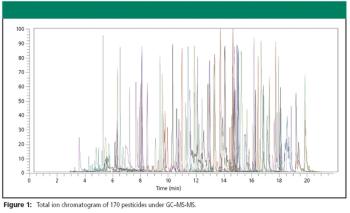
Pesticide contamination of foodstuffs has become a worldwide concern, prompting various levels of regulation and monitoring. Traditionally, pesticides are quantified with gas chromatography (GC) combined with selective detectors (ECD, FID, etc.). Selective GC detectors are great tools to quantify one or two classes at a time. However, screening for a number of different classes of pesticides requires multiple runs utilizing various GC configurations to achieve sufficient chromatographic resolution for unambiguous quantification. Gas chromatography–mass spectrometry (GC–MS) provides positive confirmation of various pesticides in a single analytical run because its superior selectivity allows interference-free quantification even with peak coelution. GC–MS has become a preferred technique for pesticide analysis because of its single-run capability.

i3-389398-1408682807836.gif

Glyphosate [N-(phosphonomethyl) glycine] is a broad spectrum, non-selective herbicide, which acts by inhibiting the shikimic acid pathway in plants. Recent studies have raised global health and environmental concerns about glyphosate's use.1 Glyphosate readily breaks down into aminomethyl phosphonic acid (AMPA) in the environment; requiring accurate measurement. Both highly polar compounds present an analytical challenge to the chromatographer (Figure 1). Typical silica based reversed-phase C18 columns experience difficulty with the retention of such polar compounds, and may generate non-resolved co-eluting peaks, often with polar analytes eluting in the void volume. Traditional analytical methods require complex eluents and time consuming derivatization steps to achieve retention on a reversed-phase support.