

The Application Notebook
Shimadzu Europa GmbH
The Application Notebook
Shimadzu Europa GmbH

Special Issues
Over the last decade the use of pharmaceuticals and personal care products (PPCPs) has doubled in the United States.
Special Issues
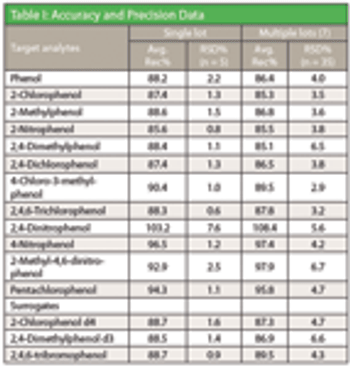
US EPA Method 528 determines 12 phenols in finished drinking water using solid phase extraction (SPE) and GC–MS detection.


The Application Notebook
LECO Corporation
The Application Notebook
Shodex/Showa Denko America Inc.

The Application Notebook
Horizon Technology, Inc.

The Application Notebook
FMS, Inc.

The Application Notebook
UCT, LLC

The Application Notebook
FMS Inc.
The Application Notebook
Horizon Technology, Inc.

The Application Notebook
Phthalates are plasticizers that are added to plastics to make them softer and more flexible. Plastics that contain phthalates are commonly used in the manufacturing of toys. Since phthalates are not permanently bonded to plastics, they can be released from toys through touching, licking, and chewing.

The Application Notebook
EPA Method 8270 is used to determine the concentration of semi-volatile organic compounds in extracts prepared from solid waste matrices such as soils, air sampling media, and water samples. Extractions from water samples can be particularly difficult and time consuming due to the problematic analytes that need to be extracted, concentrated, and analyzed.
The Application Notebook
CUSTODION SPME Syringes provide a simple, low cost methodology to collect and introduce samples to an analytical instrument. The low cost and convenience of SPME allows multiple samplers to be deployed simultaneously.
The Application Notebook
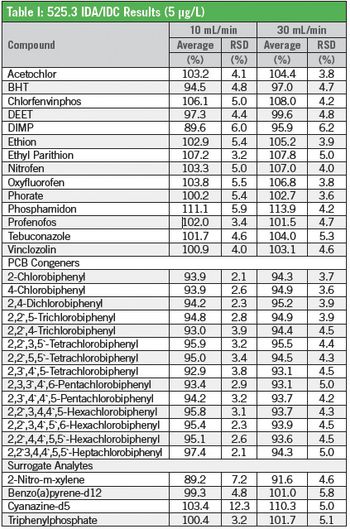
Method 525.3 is similar in many ways to its predecessor, method 525.2 (Rev 2.0 – 1995), however there are significant changes which make the newer 525.3 a vastly improved method during sample collection, extraction, and analyzing.

The Application Notebook
Due to increased concern over the hydrofracturing process and the release of methane and other chemicals into the local drinking water, a need has developed for fast and accurate analysis of methane in water.

The Application Notebook
The update to the SANCO guidelines in 2009 recognized the power and potential of TOF mass spectrometry for pesticide screening applications. When compared with historical screening tools (such as the use of triple-quad mass spectrometry), high performance accurate mass TOF systems offer several advantages for screening applications.

Special Issues
Pickering Laboratories, Inc.


The Application Notebook
Gas chromatography coupled with tandem mass spectrometry (GC–MS-MS) operated in MRM mode is a powerful technology for multi-residue analysis in complex food matrices. Good GC separation combined with MS-MS selectivity facilitates monitoring hundreds of MRM transitions within a short cycle time which allows for analysis of large number of compounds in complex food matrices. Nevertheless, MRM method development is time consuming and labor-intensive, which mainly comes from mapping retention time, MRM transition set-up and post-data processing.

The Application Notebook
Water samples from six urban and rural locations were extracted and analyzed by GC?GC–TOFMS. GC?GC–TOFMS provided an analysis approach for the detection of known EDCs as well as other non-targeted persistent pollutants.
The Application Notebook
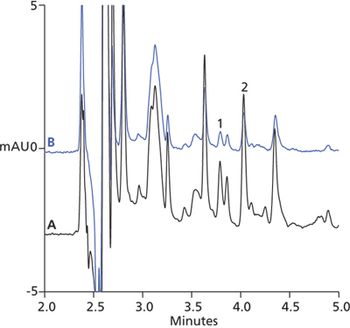
N-Methylcarbamates are widely used agricultural pesticides. For their determination, reversed-phase high-performance liquid chromatography (RP-HPLC) with fluorescence detection following postcolumn derivatization, per U.S. EPA Methods 531.2 and 8318, is typically used.

The Application Notebook
Residuals of pesticides widely used in agriculture are monitored in foods for human consumption through the use of statutory maximum residue levels (MRLs). Regulation EC 396/2005 adopted in the European Union sets MRLs for over 500 pesticides in over 300 food commodities, many at a default value of 0.01 mg/kg (the typical routine analytical method limit of determination).

The Application Notebook
Organochlorine pesticides are man-made organic chemicals with a history of wide spread use in both the United States as well as globally. Tending to be very persistent in the environment, they have found their way into sediments and drinking water supplies posing serious health risks. Organochlorines have a wide range of both acute and chronic health effects, including cancer, neurological damage, and birth defects. Many organochlorines are also suspected endocrine disruptors.

The Application Notebook
Often used for weed control, triazine herbicides have been found to have detrimental environmental and health effects. Much debate has focused on the level at which these compounds negatively impact health. To monitor and control human exposure to these herbicides, regulatory bodies have established allowable limits of triazines in drinking and wastewater.
The Application Notebook
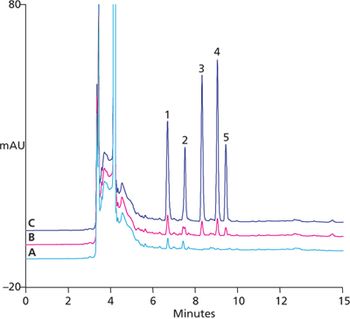
Aniline is an organic compound widely used in the polymer, rubber, pharmaceutical, and dye industries. Aniline and its derivatives (e.g., nitroanilines) are suspected carcinogens and are highly toxic to aquatic life. Because these compounds are thermolabile and polar, the traditional analytical methods require a derivatization step prior to GC analysis.

The Application Notebook
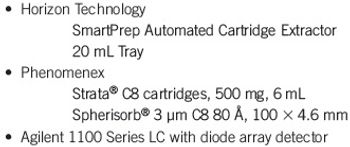
This application note will highlight the extraction of EPA Method 508.1 analytes from an aqueous matrix. It will use the SmartPrep Extractor and the DryVap Concentrator system to achieve excellent recoveries while maintaining minimal user-interface.

The Application Notebook
This application demonstrates that stringent sensitivity requirements for the detection of potentially harmful primary aromatic amines can be fulfilled when using an Agilent 1290 Infinity LC system equipped with the 1290 large volume injection kit.

The Application Notebook
Underground storage tanks (USTs) for various petroleum-based substances such as gasoline, diesel fuel, and fuel oil are monitored for leaks as authorized by the Resource Conservation and Recovery Act (RCRA).