Columns | Column: Biopharmaceutical Perspectives

Antibodies, immunoglobulin Ig proteins 3D medical background. Immune system, IgM, IgG, IgE, IgD, IgA antibodies glycoproteins, specific antigens against coronavirus sars-cov-2 covid-19 influenza virus | Image Credit: © Corona Borealis - stock.adobe.com

In this study, we applied a high-sensitivity MAPPs workflow using magnetic bead-based HLA-DR/DP/DQ immunoprecipitation and high-resolution mass spectrometry (HRMS) to assess the immunogenicity risk of six marketed mAbs across a panel of 10 HLA-typed donors.

Ribonucleic acid strands consisting of nucleotides important for protein bio-synthesis entering cell wall | Image Credit: © Christoph Burgstedt - stock.adobe.com

Hydrophilic interaction liquid chromatography (HILIC) has emerged as a promising alternative to traditional ion-pair reversed phase liquid chromatography (IP-RPLC) methods for separating oligonucleotides (ON). This work investigates the application of HILIC to the separation of ON sequence and length variants, duplexes, and single-stranded components.

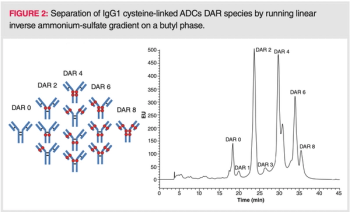
In the second part of this review of the current state of HIC, some practical considerations are explained, including method development, selection of the phase system, combined salt systems, and possibilities to combine HIC with other chromatographic modes.

figrue 6 L.png

Monoclonal antibodies (mAbs) are being developed at an explosive rate and have attracted great interest from both smaller biotech firms and big pharmaceutical companies. Developing mAbs and next-generation antibody–drug conjugates (ADCs) is highly demanding in many ways. From an analytical perspective, handling mAbs and ADCs presents many new challenges. This article describes how size-exclusion chromatography (SEC) combined with high-resolution mass spectrometry (HRMS) can be applied to the detailed characterization of mAbs and ADCs.

figure 1 L1552484426198.png

CZE–ESI‑TOF‑MS for the characterization of the mAb infliximab and its variants is presented. Infliximab was analyzed using a middle-up approach involving either reduction or digestion with the enzyme IdeS. A multilayer capillary coating of PB-DS‑PB in combination with a background electrolyte of 40% acetic acid provided efficient separation of the obtained antibody fragments, that is, LC and HC, as well as F(ab’)2 and Fc/2 parts. C-terminal lysine variants were also resolved. Recorded mass spectra of HC and Fc/2 fragments permitted assignment of 13 glycoforms and provided a quantitative profile, with G0F the most abundant glycoform (~50%). CZE–ESI-TOF-MS represents an efficient means for the straightforward analysis of a monoclonal antibody and its proteoforms.

figure 1 L.png

Glycosylation is a critical quality attribute (CQA) that can impact on product safety and efficacy of protein biopharmaceuticals. Characterization of N-glycans is therefore of paramount importance for the pharmaceutical industry. Hydrophilic interaction liquid chromatography (HILIC) combined with fluorescence detection (FLD) and 2-aminobenzamide (2-AB) labelling is the golden standard for the analysis of N-glycans enzymatically liberated from biopharmaceuticals. However, for phosphorylated N-glycans, that is, those attached on lysosomal enzymes, irreproducible data and recovery issues are observed on conventional liquid chromatography (LC) instrumentation and columns, which can be attributed to the interaction of the phosphate moieties with stainless steel components in the flow path. This article demonstrates the analysis of phosphorylated glycans with full recovery on a bio-inert LC system and PEEK-lined HILIC column.

figure 11528818335195.png

Federal regulations concerning the safety and efficacy of biopharmaceuticals require the implementation of a comprehensive toolbox of physicochemical and biological characterization methods. In order to demonstrate consistent overall structure, even minute differences in primary structure and post‑translational modifications (PTMs) have to be detectable in therapeutic proteins. Because of their remarkable capability of revealing small changes in molecular structure, high performance liquid chromatography (HPLC) and mass spectrometry (MS) rate among the most powerful technologies for comprehensive protein analysis. This article details the potential of both methods with regard to revealing methionine oxidation, a chemical modification that may be induced during downstream processing and storage of biopharmaceuticals. The benefits and limitations of bottom-up, middle-down, and top‑down HPLC–MS analysis will be demonstrated for the detection of oxidation variants in a therapeutic monoclonal antibody (mAb).

figure 1 L1520961703523.png

Monoclonal antibodies are becoming a core aspect of the pharmaceutical industry. Together with a huge therapeutic potential, these molecules come with a structural complexity that drives state-of-the-art chromatography and mass spectrometry (MS) to its limits. This article discusses the use of micro-pillar array columns in combination with mass spectrometry for peptide mapping of monoclonal antibodies (mAbs) and antibodyÐdrug conjugates (ADCs). Micro-pillar array columns are produced by a lithographic etching process creating a perfectly ordered separation bed on a silicon chip. As a result of the order existing in these columns, peak dispersion is minimized and highly efficient peptide maps are generated, providing enormous structural detail. Using examples from the author’s laboratory, the performance of these columns is illustrated.

Biopharm.jpg

These are exciting times to be involved in monoclonal antibody (mAb) and biopharmaceutical analysis. Advances in instrumentation, column technology, and reagents are providing analysts with a new set of tools to broaden their understanding of the highly complex products they are studying. A good example is hydrophilic interaction chromatography (HILIC). While the technique has been used for more than 20 years to profile enzymatically released and fluorescently labelled N-glycans, the introduction of new columns (sub-2-µm and widepore) has paved the way to explore the technique further. Remarkable separations at all levels of analysis, including protein, peptide, and glycan levels, have been demonstrated. With data from the authors’ laboratories, the versatility of HILIC in mAb analysis will be demonstrated in this month’s “Biopharmaceutical Perspectives”.

figure 1 L.png

Two-dimensional liquid chromatography (2D-LC) has in recent years seen an enormous evolution, and with the introduction of commercial instrumentation, the technique is no longer considered a specialist tool. One of the fields where 2D-LC is being widely adopted is in the analysis of biopharmaceuticals, including monoclonal antibodies (mAbs) and antibody–drug conjugates (ADCs). These molecules come with a structural complexity that drives state-of-the-art chromatography and mass spectrometry (MS) to its limits. Using practical examples from the authors’ laboratory complemented with background literature, the possibilities of on-line 2D-LC for the characterization of mAbs and ADCs are presented and discussed.