
The Application Notebook
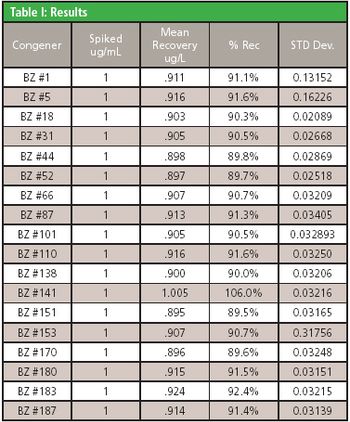
PCBs are a group of synthetic organic chemicals that contain 209 individual compounds (known as congeners) with varying harmful effects. PCBs enter the environment as mixtures containing a variety of individual components.
The Application Notebook
PCBs are a group of synthetic organic chemicals that contain 209 individual compounds (known as congeners) with varying harmful effects. PCBs enter the environment as mixtures containing a variety of individual components.
The Application Notebook
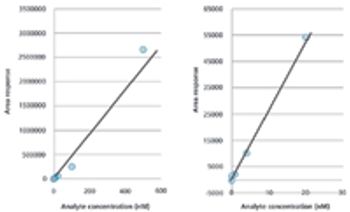
High performance time-of-flight mass spectrometry (TOF-MS) is applied to the analysis and characterization of complex biological samples. High mass accuracy, high resolution, and accurate relative isotope abundance are all applied to the determination of analytes covering a range of concentrations in complex matrices including plasma and urine. Qualitative and quantitative evaluations are provided and include demonstrations of the impact of high-performance MS on sensitivity and selectivity. The ability to leverage high-performance MS in conjunction with a broad dynamic range in rapid ultrahigh-pressure liquid chromatography (UHPLC) analyses to identify unknowns and to propose putative metabolic biomarkers is demonstrated. The impact of speed of analysis and selectivity to the depth of coverage and accuracy of the analyses are discussed.

The Application Notebook
Glyphosate is a broad-spectrum herbicide widely used around the world. Monitoring of glyphosate in crops and water is mandated in many countries.
The Application Notebook
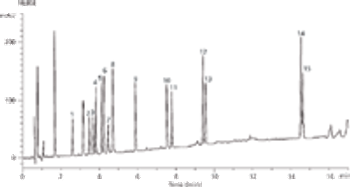
This study evaluates the performance of a C18 core-shell phase that incorporates a C18 ligand with iso-butyl side chains. The Kinetex? XB-C18 HPLC/ UHPLC column delivers a fast and effective separation of several common preservatives in cosmetics.
The Application Notebook
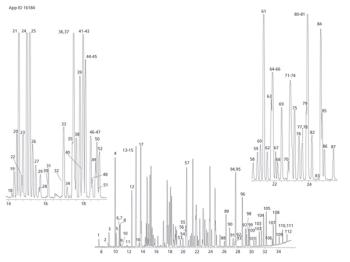
Due to the increasing number of toxic pesticides being used throughout the world, a robust method for positively identifying low levels of multiple classes of pesticides is required. A Zebron? ZB-MultiResidue? column is used with GC–MS to identify over 100 common pesticides.
The Application Notebook
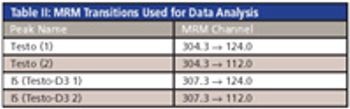
Testosterone was extracted from human serum by strong anion exchange polymeric SPE and analyzed using a Kinetex C18, 30 ? 2.1 mm, 1.7 ?m column and positive polarity ESI LC–MS-MS system. Kinetex sub-2 ?m core-shell technology offers higher efficiencies than traditional sub-2 ?m columns, producing greater chromatographic resolution, sensitivity, and higher peak capacities.

The Application Notebook
The Consumer Product Safety Improvement Act of 2008 (CPSIA) requires testing of child care products and toys for selected phthalate esters by GC–MS.

The Application Notebook
This note describes the use of the AB Sciex TripleTOF? 5600 LC–MS-MS system and data processing using the XIC Manager software to screen extracts of fruit and vegetable samples for pesticide residues.
The Application Notebook
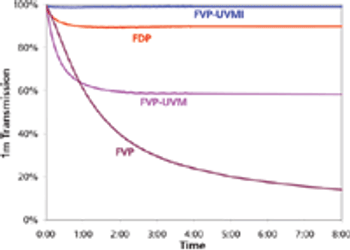
Optical fibers are routinely used in liquid chromatographic detectors as a means of simplifying optical designs. Selection of the appropriate fiber is an important factor in achieving optimal system performance.

The Application Notebook
With advances in instrumentation and without regulatory method constraints, 1,4-dioxane can be detected at the part-per-billion (ppb) level, despite its poor purge efficiency. This application will manipulate purge and trap, as well as GC–MS parameters, to create a more efficient method to reduce cycle times. This study will utilize a Teledyne Tekmar Atomx Automated Sample Prep System in conjunction with an Agilent 7890/5975 GC–MS. A linear calibration and method detection limits (MDLs) for 1,4-dioxane will be established using this method.

The Application Notebook
Vitamin D deficiency has become a topic of interest in recent publications (1–3). Vitamin D is present in two forms, Vitamin D3 and Vitamin D2. D3 is produced after ultraviolet light-stimulated conversion of 7-dehydrocholesterol in the skin (3).
The Application Notebook
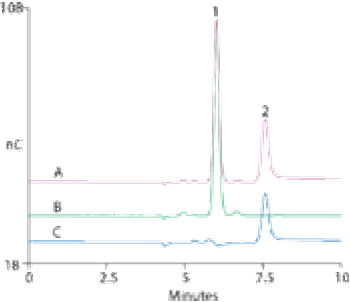
Kanamycin and amikacin are aminoglycoside antibiotics used to treat serious bacterial infections. Amikacin is used for infections resistant to other aminoglycosides because it is less susceptible to enzymatic reactions.

The Application Notebook
Click the title above to open the LCGC North America June 2011 Application Notebook, Vol 29 No s6, in an interactive PDF format.