

LCGC North America
LCGC North America
LCGC North America
LCGC North America
LCGC December 2006 BPA

The Column
Electronic pressure control (EPC) methods are more commonly being used where manual regulation does not address the growing needs of instrument manufacturers who need to provide their endusers with automated control, error correction, and increased functionality. This overview of EPC technology covers requirements with operating ranges of 0?150 psig with control ranges as low as 0.005 psi and resolutions down to 0.001 psi, typical uses, advantages, and suggested guidelines for development and implementation of high-performance EPC.

The Column
In this month's issue features two new articles entitled "Gas Stream Purity Myths Disproven" and "Electronic Pressure Control: Making Smart Choices."

The Column
Solving common myths to help chromatographers save time and money.
Thermo Fisher Scientific Inc. (NYSE: TMO), the world leader in serving science, today announced it has acquired Massachusetts-based Cohesive Technologies Inc., a manufacturer of advanced sample extraction and liquid chromatography products. Cohesive has annual revenues of approximately $15 million.
Solvay Pharmaceuticals and Novasep have signed a five-year strategic manufacturing alliance which includes the exclusive synthesis of two active pharmaceutical ingredients for Solvay Pharmaceuticals.
The Pittsburgh Conference announced today that the Science Week Committee has selected the science department at the Nancy B. Jefferson Alternative High School as the recipient of the Pittcon 2007 Science Education Award which will be presented at McCormick Place, Chicago, IL, on January 5, 2007.
Thermo Fisher Scientific announced a new partnership with Interfus?o to market, distribute and deploy Thermo Scientific-branded laboratory information management systems (LIMS) and chromatography data systems (CDS) to Brazil's growing metals, minerals and mining industries.
Agilent Technologies Inc. has announced that it has launched a new product demonstration center at its Santa Clara, Calif., corporate headquarters, showcasing its life sciences and chemical analysis capabilities.
The Column
News All the news from December 2006 Opinion Zosimus complains about the poor quality of some speakers at conferences and proposes to compile a database of good presenters for all to view. Market Trends & Analysis Glenn Cudiamat reports on the water analysis market that is heavily driven by government regulations Systematic Development of Stability-Indicating Methods Michael McBrien and Margaret Antler Supplies and Services SPE Product Directory Profiles from Biotage, Gerstel and Gilson

LCGC Europe
In the June 2006 issue of LCGC Europe we featured a display wall that may be the future for molecular modelling. Here we preview another possibility - an interesting helmet from electronics manufacturer Toshiba that enables the wearer to experience a full 360? view on a 40 cm dome-shaped screen. The full-faced helmet, known as the Head Dome Projector, weighs 3 kg and exhibits a wide viewing angle of 120? horizontally by 70? vertically without head tracking and 360? ? 360? with head tracking.

LCGC Europe
Velocity11 has announced the relocation of its European headquarters to larger purpose built offices in the UK. This move reflects the company's successful product introductions and an increase in installed systems during the last 18 months.

LCGC North America
Over the last ten years or so, information gathered by applying atmospheric ionization techniques in mass spectrometry teaches us two things: 1) that liquid is a vestigial remnant of condensed-phase liquid chromatography and 2) that solvent in the gas phase limits ionization to molecules that are more basic than the solvent.

LCGC North America
Laboratories use paper notebooks to document research, experiments and procedures, similar to that of a personal journal or, in some cases, a scrapbook. Laboratory notebooks are essential wherever scientific research is conducted, where data is collected, and where ideas that could be patented are developed. The lab notebook is often considered to be a legal document and can be used in court as evidence.

LCGC North America
This month, Leslie Ettre briefly investigates whether the principles of chromatography - either consciously or unconsciously - were used in some ancient work.
LCGC North America
Waters Corporation (Milford, Massachusetts) announced its sponsorship of two American Chemical Society Achievement Awards.

LCGC North America
Excess variability is not acceptable in a pharmaceutical method.
LCGC North America
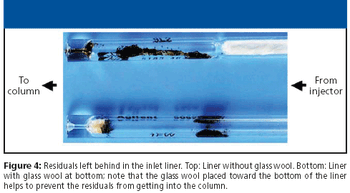
Modern gas chromatography (GC) capillary columns are rugged and forgiving but some care should be taken when handling and using these high-efficiency columns. In this installment of "Column Watch," the authors discuss the issues surrounding avoiding column breakage, stationary phase damage, and column contamination. Prolonging the life of a column by keeping an oxygen-free system, providing a cleaner sample, and not exceeding the upper temperature limit of the stationary phase are highlighted in this practical discussion.

LCGC North America
LCGC North America
LCGC North America
LCGC North America
LCGC North America
LCGC North America
This month's issue features two new articles entitled "High-Resolution GC?MS as a Viable Solution for Conducting Environmental Analyses" by Dirk Krumwiede and Hans-Joachim Huebschmann and "Pittcon: A Platform for Scientific Innovation Part I: Years 1950?1980" by Thomas M. Ricci
GenTech Scientific, Inc. announced today the official opening of GenTech Asia, located in Taichung City, Taiwan. The venture marks the company?s first ever expansion and positions itself as one of few analytical instrument service companies in the Asia/South Pacific area.