

LCGC Europe
Hewlett-Packard (HP) has announced that its researchers have developed a miniature wireless data chip that could provide broad access to digital content in the physical world.
LCGC Europe
Hewlett-Packard (HP) has announced that its researchers have developed a miniature wireless data chip that could provide broad access to digital content in the physical world.

LCGC Europe
Producers of mass spectrometers design their instruments to work well within specific parameters.

The Column
In month's issue features two new articles entitled "Characterization of Liposomes and Viral Particles Using Asymmetrical Flow Field-Flow Fractionation Coupled to Multiangle Light Scattering" and "High-Stakes Competition: Advances in Chromatography Stay Ahead of Dopers."
LCGC North America
Waters Corporation announced today it will expand its research collaboration with Imperial College London by equipping the Waters Laboratory of Molecular Spectroscopy at Imperial College London with three high-end research instruments - the Waters ACQUITY UPLC System, and Waters Q-Tof Premier and GCT Premier Mass Spectrometers.
Thermo Electron Corporation, world leader in analytical instrumentation was recently awarded the NorthFace ScoreBoard Award, for a second consecutive year, in recognition for providing Excellence in Customer Service to its customers. The award presented to Thermo included two categories: Installation Service Representative and Field Service Engineer.
LCGC Europe Wall Planner 2007
LCGC Europe's 2006 Wall Planner
LCGC North America
Aspectrics, Inc., the innovator of Encoded Photometric Infrared Spectroscopy (EP-IR) analyzers, has just concluded a strategic agreement with the Center for Process Analytical Chemistry (CPAC) of the University of Washington.
Thar Technologies, Inc., the only company worldwide providing supercritical fluid chromatography (SFC) systems spanning from analytical to preparative to process scale, announced today that it has entered into an agreement to develop SFC applications with the Norwegian University of Life Sciences (NULS).
The Pittsburgh Conference announced today the recipients of twelve prestigious annual awards that recognize the significant contributions of leaders in the fields of Analytical Chemistry and Applied Spectroscopy.
A Modesto winemaker is using the latest 21st century analytical chemistry technology to supplement the time-honored practice of tasting a mouthful of grapes to determine when the fruit is ready for picking.
PerkinElmer, Inc., a global leader in Health Sciences and Photonics, today announced the acquisition of Avalon Instruments Limited, based in Belfast, Northern Ireland. The acquisition expands and complements PerkinElmer?s Molecular Spectroscopy product portfolio through adding a family of innovative bench-top dispersive Raman spectrometers.
The Column
News All the news from September 2006 Opinion Zosimus calls for a restructuring of the academic year to prevent final examinations falling in the height of the hayfever season. Market Trends & Analysis Glenn Cudiamat reports on dissolution testing and its importance to the pharmaceutical and other industries. Country Focus This month we look at the recent analytical activities of Germany and Austria. Determination of Chloramphenicol in Food using Automated Solid-Phase Extraction and LC-MS Norbert Helle and Kaj Peterson Q&A Andrew Tipler, senior scientist at the chromatography business unit of PerkinElmer Instruments talks to The Column about thye new Clarus 600 gas chromatograph. Supplies and Services
LCGC North America
LCGC North America
LCGC North America
LCGC North America
LCGC North America

The Application Notebook
Ted Szczerba and Francis Mannerino, Regis Technologies, Inc.

LCGC Europe
Applied Biosystems has joined the Genographic Project as a supporting sponsor for the generation of one of the world's largest databases of information, which will reveal the sources of humankind's diversity. The company has signed a multi-year agreement to provide laboratory research equipment and services to each of the ten participating global research centres. The terms of the agreement were not disclosed.

The Application Notebook
John Ervin, Eksigent Technologies
LCGC Europe
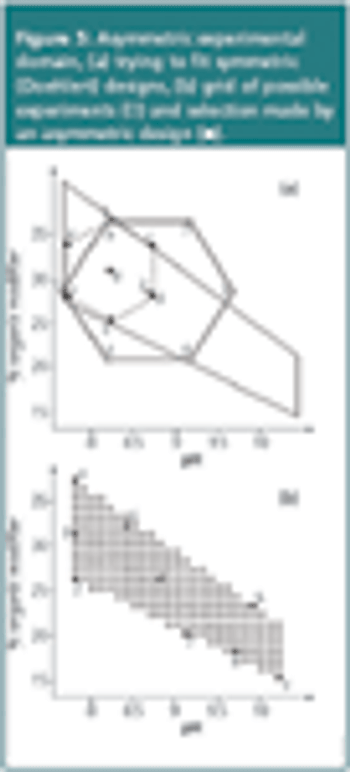
An experimental design can be considered as a series of experiments that, in general, are defined a priori and allow the influence of a predefined number of factors in a predefined number of experiments to be evaluated.
LCGC North America
Sigma-Aldrich Corp. (St. Louis, Missouri) has acquired Pharmorphix, Ltd. (Cambridge, United Kingdom) that offers solid-form research services to pharmaceutical and biotech markets. Terms of the acquisition were not disclosed.

LCGC Europe
Now there's light in the "black hole" - of a brief case. German-based international leather and bag specialist BREE has created the first illuminated business handbag with Smart Surface Technology. Bree put their trust in innovative solutions. They say, "We had been toying with the idea of illuminating the dark insides of handbags for quite some time, but lacked an elegant solution which not only met our traditionally high demands with regard to style and function, but was also technically feasible."
The Column
In month's issue features two new articles entitled "Microparallel LC Methods for the Analytical Laboratory" and "Testing Tap Water with HPLC."

The Column
An isocratic HPLC method for the determination of phenol and nitrophenols (4-nitrophenol, 2-nitrophenol, 4,6-dinitro-o-cresol and 2,4-dinitrophenol) has been developed and validated using 2-chlorophenol as internal standard (IS) and a monolithic column in tap water samples. Prior to HPLC, the method requires solid-phase extraction (SPE) using polymeric Lichrolut EN cartridges. The method development involved the study of methanol and acetonitrile as organic modifiers, pH and flow-rate using a Chromolith RP-18e (150 mm x 4.6 mm i.d.) column. After comparing the performance of the separations obtained with both organic modifiers, the optimum separation of these compounds was achieved using 50 mM acetate buffer (pH 5.0)-acetonitrile (80:20, v/v) as mobile phase, 3 mL min21 flow-rate and UV detection at maximum absorbance wavelength. Under these conditions, all analytes were separated (Rs . 2.0) in an analysis time of less than 3.5 min and the most important validation parameters were evaluated. The recoveries obtained in the accuracy test for all phenols studied were in the 90-112% range using a preconcentration factor of 40, and the intraday and interday precisions [expressed as coefficient of variation (CV)] were smaller than 15%. Finally, the proposed method was applied to wastewater samples from several industries.
Waters Corporation announced today that it will work with Applied Biosystems/MDS SCIEX to develop Waters ACQUITY UPLC System software controls for use with Applied Biosystems/MDS SCIEX's Analyst software.
Waters Acquires Thermometric For $2.5 Mln