

Airgas, Inc. (NYSE: ARG) today announced a definitive agreement to acquire the U.S. bulk gas business that Linde AG (LIN.DE) is required to divest after its acquisition of The BOC Group.
Airgas, Inc. (NYSE: ARG) today announced a definitive agreement to acquire the U.S. bulk gas business that Linde AG (LIN.DE) is required to divest after its acquisition of The BOC Group.
Agilent Technologies Inc. said Friday it launched a new product demonstration center that showcases the company's life science and chemical analysis capabilities.
Waters Corp. in Milford has agreed to acquire all the outstanding stock of Environmental Resource Associates Inc. (ERA), an Arvada, CO-based firm for an undisclosed amount.
The Column
News All the news from November 2006 Opinion Zosimus questions whether fast chromatography can ever supersede intelligent human interpretation of data. Market Trends & Analysis Glenn Cudiamat reports on electronic laboratory notebooks and the quest for a paperless environment. The Low Down on Light-Scattering Detection Paul Clarke Old Questions - New Solutions: Modern Ways for Complex Polymer Analysis and Additive Tracing Peter Montag Supplies and Services Country Focus Current analytical developments from France and Switzerland are featured this month including a report from the recent 23rd LC-MS Montreux Symposium. Q&A Desty Award winner Gert Desmet from Vrije universiteit Brussels, Belgium talks about his research on shear-driven flow chromatography and micromachined HPLC columns.

Special Issues
Spectroscopy columnist Ken Busch once again brings readers his comprehensive list of common acronyms used in the field of mass spectrometry.
LCGC North America
LCGC North America
LCGC North America
LCGC North America
Thar Technologies, Inc. (Pittsburgh, Pennsylvania) announced that it has entered into an agreement to develop supercritical fluid chromatography (SFC) applications with the Norwegian University of Life Sciences (As, Norway, NULS).

LCGC North America
November 2006. The objective of a formal method transfer is to ensure that the receiving laboratory is well trained, qualified to run the method in question, and gets the same results - within experimental error - as the initiating laboratory. The development and validation of robust methods and strict adherence to well documented standard operating procedures is the best way to ensure the ultimate success of the method. This installment of "Validation Viewpoint" examines the analytical method transfer process, including protocol, documentation, and some possible chromatographic pitfalls to avoid.
LCGC North America
LCGC North America
LCGC North America
LCGC Europe
This month's instalment of "LC Troubleshooting" focuses on two column-related problems reported by readers. The first deals with a column that takes several injections to "settle down" for each batch of samples. The second relates to short column life as a result of early fouling of the column. Although both of these problems are not encountered with most liquid chromatography (LC) methods, they both appear often enough that we all should be aware of them. It is only a matter of time before you meet one of these problem types with one of your methods.

LCGC Europe
Researchers from the University of Arkansas have come up with a fibrous nanomaterial suitable for fabricating robust paper-like material and devices. Potential applications for these nanowire assemblies include armour, flame-retardant fabric, bacteria filters, oil cracking, controlled drug release, decomposition of pollutants and chemical warfare agents.
LCGC Europe
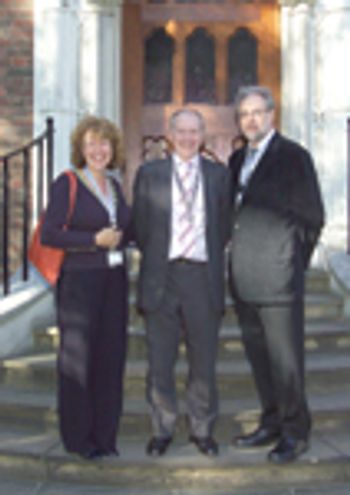
At this year's Desty Memorial Lecture the president of the Chromatographic Society, Chris Bevan, presented the Silver Jubilee medal to Peter Myers. Peter had requested that he received the award at the meeting because Denis Desty, who was the first secretary of the original Chromatography Discussion Group, was very influential in Peter's chromatographic career.

LCGC Europe
When possible, GC analysis is performed under retention time locked conditions, meaning that allergen elucidation and quantification is based on mass spectral data (scan mode or specific ion detection mode) and on retention time.
The Column
In this month's issue features two new articles entitled "The Use of Intelligent Systems and Services for the Efficient Laboratory Management of Liquid Chromatographic Systems" and "Simultaneous Determination of Chelating Agents by Ion-Suppression and Ion-Pair Chromatography in Wastewater."
Cerno Bioscience announces two major agreements have been reached with leading research institutes in China for the use of its ground-breaking MS data analysis software, MassWorks. Cerno has entered into collaborative research in drug metabolism with Dr Dafang Zhong, Director of Drug Metabolism Research at Shanghai Institute of Materia Media, Chinese Academy of Sciences. Cerno has also signed an agreement with Egret Pharma (Shanghai) Limited for extensive use of the MassWorks software in small molecule synthesis.
Waters Corporation announced today its sponsorship of two American Chemical Society Achievement Awards. The annual awards recognize outstanding accomplishments in the fields of separations science and technology and mass spectrometry.
Sigma-Aldrich Corp. bought Advanced Separation Technologies Inc., a Whippany, N.J., chiral chromatography business. Terms of the cash deal weren't disclosed. The St. Louis chemical company said Advanced Separation has $2 million in annual revenues. Sigma-Aldrich said the purchase won't affect earnings in 2006 but will help it meet growth goals over the next several years.
Grace Davison, an operating segment of W. R. Grace & Co., has established the BioFuel Technologies Group that will oversee intensified product development in the renewable fuels industry.
The Pittsburgh Conference announced its educational programs for science teachers and students, as well as grant award deadlines for its annual Science Week program held in conjunction with Pittcon 2007, McCormick Place, Chicago, Illinois. Science Week (February 24 - March 1, 2007) is an educational outreach program conducted during the annual Pittcon Expo and Conference in the host city. In addition to educational programs, Science Week offers workshops for students, a Thursday morning lecture accompanied by a demonstration, and workshops for local science teachers.
The Column
News All the news from October 2006 Opinion Zosimus evaluates the discrepancies that exist between the content off some applicants' CVs and the true value of their PhD degrees. Market Trends & Analysis Glenn Cudiamat provides a report on the worldwide life science and analytical instrument industry. Monolithic Silica Columns for Fast liquid Chromatography Sami Kamal El Deeb and Hermann Watzig Multi-Targeting Pesticides Petra Decker, Matthias Pelzing, Christian Neusub and Ralf Ketterlinus Meeting Preview 23rd LC-MS Montreux Symposium Meeting report 11th Desty Memorial Lecture for innovation in Separation Science Supplies and Services Q&A Professor Stig Pederson-Bjergaard from the School of Pharmacy, University of Oslo, Norway talks about the development and benefits of liquid-phase microextraction.
LCGC North America
The Pittsburgh Conference (Pittsburgh, Pennsylvania) announced that Charles M. Lieber will deliver a plenary lecture entitled "Nanowire Nanoelectronic Devices for Detection of and Interfacing to Biological Systems" at Pittcon 2007, 25 February–2 March 2007, in Chicago, IL. The lecture will begin the conference's technical program on Sunday, 25 February 2007.
LCGC North America
LCGC North America

LCGC North America
October 2006. This year, the Chromatography Society is celebrating its 50-year anniversary. On the occasion of this anniversary, E.R. Adlard, one of the true pioneers of GC and a leading member of the organization, reports on the most important papers presented at the symposia in the first decade.

LCGC Europe
Bio-Rad Laboratories' Informatics Division has received a gold award for its KnowItAll Informatics System spectroscopy software and a silver award for its KnowItAll Cheminformatics Edition. The company was chosen by readers of Scientific Computing in the 2006 Readers' Choice Awards.