

Chiral Technologies, Inc. recently appointed Joseph M. Barendt, to the new position of Chief Operating Officer. Previously, Barendt was president of Gabriel Performance Products, LLC.
Chiral Technologies, Inc. recently appointed Joseph M. Barendt, to the new position of Chief Operating Officer. Previously, Barendt was president of Gabriel Performance Products, LLC.
Electron spin resonance spectroscopy has recently been used by Brazilian and Danish researchers to provide evidence that rosemary could stop flavour loss associated with high-pressure processing of minced meat. The technique was used to quantify lipid oxidation in the minced chicken meat before and after 10 hours of storage.
A near-infrared spectrometer is helping scientists at the Monash Institute of Medical Research in Australian (MIMR) better monitor the health of preterm babies.
Malvern Instruments Ltd (Worcestershire, United Kingdom) has acquired the assets of Spectral Dimensions, Inc. (Olney Maryland), producer of near infrared (NIR) chemical imaging instrumentation and software.
The BBC reports that British scientists have used gas chromatography to isolated natural chemicals that make some people smell unpleasant to mosquitoes. This discovery could potentially decrease the role of blood-sucking insects as disease carriers.
Royal Society of Chemistry reports that a research team from the University of Arizona, Tuscan has showed that the separation ability of colloidal crystal was superior to that of high performance liquid chromatography (HPLC). The researchers are testing its potential for separating more complex mixtures of peptides and proteins.
Infrared spectrometers have been installed in a Kenyan national laboratory to save Kenyan farmers time and money to. Under new European good agricultural practice and environmental standards, fruit and vegetable exporters are required to carry out frequent soil analysis to determine whether their farming activities are degrading or helping in conserving the soil.
The Column
News All the news from July 2006 Opinion Zosimus tackles another controversial issue — whether all the conference organizers should pool together to create one great international conference on chromatography. Market Trends & Analysis Glenn Cudiamat takes a look at the North American market for environmental extraction techniques. Meeting Preview 29th International Symposium on Chromatography, Copenhagen, Denmark. Meeting Report New trends from HPLC 2006. Generating high-purity water for endocrine disrupter analysis Estelle Riche, Naoe Ishii and Stephanie Mabic high accurate mass profiling of biomarkers Pierre Thibault Q&A Yassin Hardi of Chromtech talks to The Column about solid-phase dynamic extraction covering its development and applications Supplies & Services

Special Issues
Brice Collaboration is replacing competitive edge when it comes to sales compliance training.
Special Issues
PhRMA and FDA are in agreement that direct-to-consumer advertising needs reform. The question is: What's the best way to get it?

Special Issues
A slow, steady process of transitioning biologicals has allayed industry concerns.
Special Issues
Dr. Steven Galson, CDER Director, on Drug Risks, Regulation and Research
Special Issues
Europe?s new advertising controls and efforts to institute anti-fraud measures are looking more and more like those in the United States.
Special Issues
The regulatory environment is changing and is starting to sweep away some of the commandments on which we have relied, and to change others almost unrecognizably. To make the transition, FDA will have to reinvent itself and industry will have to rethink the way we develop and manage our processes.
Special Issues
The new Division of Post Marketing Evaluation in the Office of New Drug Quality Assessment has implemented an improved system for managing the submission and review processes for post approval chemistry, manufacturing, and controls change supplements.
Special Issues
The world of manufacturing compliance is abuzz, and the rate of regulatory change has been evolving faster recently.
Special Issues
The FDA has been implementing several changes in the way it does business, for example, relying on third-party inspections, academia, and industry in many new ways. The implementation of process analytical technology is among these changes.
Special Issues
Pharmaceutical marketing and sales folks are now contending within creased government scrutiny of direct-to-consumer advertising and pharma-doctor relationships.
Bruker Daltonics Inc. (Billerica, Massachusetts) announced that it has obtained registration of its MALDI-TOF product line of microflex, autoflex TOF or TOF/TOF, and ultraflex TOF/TOF mass spectrometers as medical devices from the Ministry of Health and Social Development of the Russian Federation.
LCGC North America
LCGC North America
LCGC North America

LCGC North America
This month's "Milestones in Chromatography" column commemorates the centenary of the two publications of M.S. Tswett first using the term "chromatography."
LCGC Europe
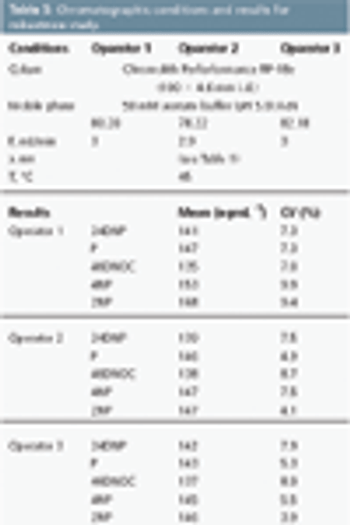
An isocratic HPLC method for the determination of phenol and nitrophenols (4-nitrophenol, 2-nitrophenol, 4,6-dinitro-o-cresol and 2,4-dinitrophenol) has been developed and validated using 2-chlorophenol as internal standard (IS) and a monolithic column in tap water samples. Prior to HPLC, the method requires solid-phase extraction (SPE) using polymeric Lichrolut EN cartridges. The method development involved the study of methanol and acetonitrile as organic modifiers, pH and flow-rate using a Chromolith RP-18e (150 mm × 4.6 mm I.D.) column. After comparing the performance of the separations obtained with both organic modifiers, the optimum separation of these compounds was achieved using 50 mM acetate buffer (pH 5.0)-acetonitrile (80:20, v/v) as mobile phase, 3 mL min-¹ flow-rate and UV detection at maximum absorbance wavelength. Under these conditions, all analytes were separated (Rs > 2.0) in an analysis time of less than 3.5 min and the most important validation parameters were evaluated. The recoveries obtained in the accuracy test for all phenols studied were in the 90–112% range using a preconcentration factor of 40, and the intraday and interday precisions [expressed as coefficient of variation (CV)] were smaller than 15%. Finally, the proposed method was applied to wastewater samples from several industries.
LCGC North America
LCGC North America

LCGC North America
Because most samples are usually unsuitable for direct analysis, extraction is perhaps one of the most important sample preparation techniques for environmental samples.

LCGC Europe
Lasers that can produce coherent infrared light in the 1–2 ?m wavelength range are essential in telecommunications, biomedical diagnosis and optical sensing.

LCGC North America
The gradient linearity and step tests are two of the most useful performance tests that can be performed for a liquid chromatography (LC) system.
LCGC North America