


LCGC North America
The establishment of a system suitability plan that focuses on the maintenance of the most important variable in any chiral separation screen - the column - is presented.
LCGC North America
The establishment of a system suitability plan that focuses on the maintenance of the most important variable in any chiral separation screen - the column - is presented.

LCGC Europe
A review of the historical development and latest trends in phase development in the field of chiral capillary gas chromatography. A range of novel applications in chiral capillary GC are also described.

The Column
Automated column and mobile phase screening is the current trend in the pharmaceutical industry to develop chiral methods. This study presents comprehensive strategies for automated rapid chiral HPLC method development including normal-phase, reversed-phase and polar organic phase separation modes.

Special Issues
update on some of the latest chiral stationary phases and their use in various separation modes

LCGC Europe
The development of chiral column technology since the review in 2008 is discussed by Thomas Beesley.

Design of a FID/MS Splitting for MS Detection in The First and Second Dimension of a Multidimensional GC–MS System

LCGC Europe
Various modes of capillary electrochromatography (CEC) for the separation of enantiomers on immobilized cyclodextrin derivatives are described. The following techniques have been used: (i) open-tubular electrochromatography (o-CEC), (ii) packed electrochromatography (p-CEC) and (iii) monolithic electrochromatography (rod-CEC). Three different strategies to prepare enantioselective cyclodextrin-coated chiral monoliths are described. The advantages and disadvantages of the various methods are outlined.

LCGC Europe
The move from conventional particle sizes (5 μm or higher) to smaller diameter packing materials is one of the most attractive approaches to achieve higher separating efficiency. Recently developed 3 μm polysaccharide-derived chiral stationary phases demonstrate characteristics of favourable mass transfer kinetics, high column efficiency and good column permeability. This allows the fast analysis of enantiomers using conventional HPLC instruments.

E-Separation Solutions
Only a generation ago, HPLC was considered an exclusive, futuristic technique that only a select few laboratories could afford to use. Today, HPLC and its various related techniques continue to dominate the world of chromatography. From HILIC to Chiral technology to hyphenated techniques such as HPLC-MS, it is without a doubt the most widespread technique currently used in the field of analytical chemistry. This month E-Separations Solutions' Technology Forum looks at the topic of HPLC-Chiral and the trends and issues surrounding it. Joining us for this discussion is Elena Eksteen, Ph.D., of Chiral Technologies, Inc., Todd Palcic of Thar Instruments, Inc., and Bill Ciccone of Microsolv.


The Column
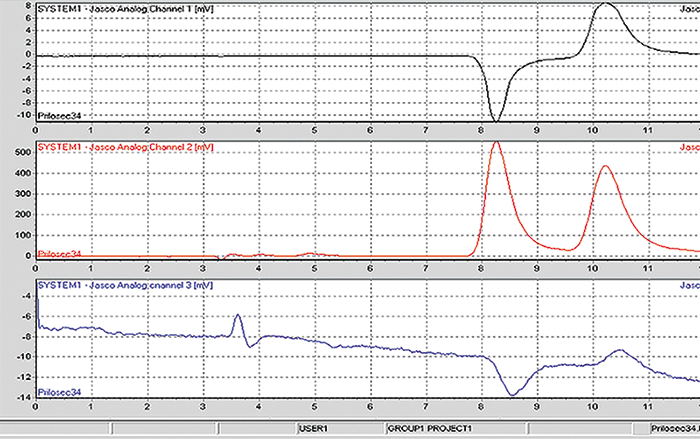
In chiral preparative supercritical fluid chromatography, samples are often over-loaded and it is difficult to determine when to start and end fractionation from UV chromatographic data. A circular dichroism detector can differentiate enantiomers and generate positive?negative responses arising from eluted chromatographic peaks.
LCGC North America
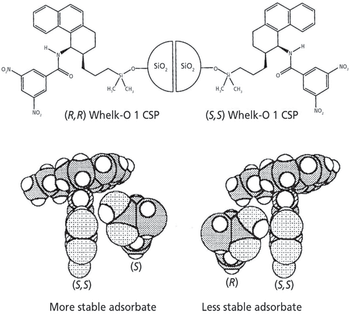
Basic information on stereochemistry is provided in this article to help readers develop a better understanding of the separation mechanisms that come into play in various separation methods used for chiral compounds. This knowledge can allow readers to select a desirable chiral separation method, based upon the molecular structure of the chiral compound of interest. Logical reasons for the selection process are discussed later in this article.
Chiral Technologies Inc., a provider of chiral chromatography columns, has announced that it will expand Latin American sales efforts by partnering with exclusive distributors.
LCGC Europe
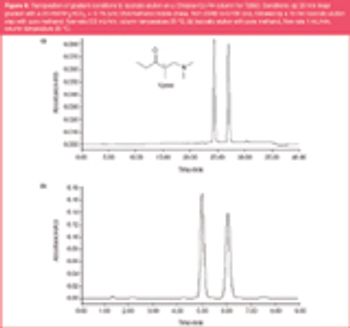
High-performance liquid chromatography (HPLC) is a powerful tool for the enantioselective separation of chiral drugs. However, the selection of an appropriate chiral stationary phase (CSP) and suitable operating conditions is a bottleneck in method development and a time- and resource-consuming task. Multimodal screening of a small number of CSPs with broad enantiorecognition abilities has been recognized as the best strategy to achieve rapid and reliable separations of chiral compounds. This paper describes the generic screening strategy developed at Johnson & Johnson Pharmaceutical Research and Development (J&J PRD) to successfully develop enantioselective HPLC methods for chiral molecules of pharmaceutical interest.

LCGC Asia Pacific

LCGC North America
Chiral technology has become a very important aspect for scientists involved in the pharmaceutical, chemical, and agricultural industries. The chiral enantiomers can have vitally different pharmacological effects in biological systems. In fact, the U.S. Food and Drug Administration mandates that only therapeutically active isomers must be introduced to the prescription drug market.

LCGC North America
Guest columnist Volker Schurig discusses the achievements of Emanuel Gil-Av in introducing enantioselectivity into chromatographic analysis.

Regis Technologies, Inc. partners with pharmaceutical, biotechnology, and other companies to help expedite drugs to market by providing synthesis and separations services. Regis Technologies announced today it has added Supercritical Fluid Chromatography (SFC) to its separations services and will offer GMP separations April 1, 2007.
LCGC North America

LCGC North America
Measurement of chiral purity is a necessary means of quality control for drug substances that exhibit chiral centers. This article describes a simple and practical approach to setting up system suitability and validation for chiral purity assays.