Chiral Chromatography

Latest News


Senior Male Research Scientist is Using a Tablet Computer in a Modern High-Tech Laboratory. Genetics and Pharmaceutical Studies and Researches. | Image Credit: © Gorodenkoff - stock.adobe.com

Researchers have synthesized a chiral metal-organic framework (MOF) called L-histidine-zeolitic imidazolate framework-67 (L-His-ZIF-67) for enantioseparation of drugs in capillary electrochromatography. The chiral MOF demonstrated excellent separation efficiency for five chiral drugs, offering promising possibilities for pharmaceutical analysis and quality control.

The talks in this Friday afternoon symposium will cover topics related to column and stationary phase development and instrumentation, along with the analytical and production-scale applications of chiral chromatography.

Armstrong.jpg

Compared to the progress made in reversed phase separations in terms of speed and efficiency, chiral chromatographers have traditionally focused on improving the selectivity of enantiomeric separations by synthetic procedures. As a result, more than 50 different types of advanced chiral stationary phase chemistries are available today. Traditionally, speed and efficiency of chiral chromatography has not received attention until recently. With the availability of superficially porous particles and sub-2-µm particles, sub-minute enantiomeric separations have been achieved with the help of improved particle technology with narrow size distribution, and systematic studies on packing columns. This article covers advances made in the field of ultrafast chiral chromatography in the last decade. The development of instrumentation technology has also contributed immensely to making sub-second chiral separations a reality. Enantiomeric separations can now compete with the speed of sensors. Future directions and unanswe

Ron-Majors_web.jpg

LCGC, the leading resource for separation scientists, is proud to announce that Ronald E. Majors and Zachary S. Breitbach are the winners of the 11th annual LCGC Lifetime Achievement and Emerging Leader in Chromatography Awards, respectively. Majors and Breitbach will be honored in a symposium as part of the technical program at the Pittcon 2018 conference in Orlando, Florida, on February 26, 2018.

Huang-Figure-5_web.jpg

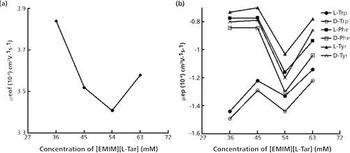
A chiral ionic liquid, namely 1-ethyl-3-methyl imidazole L-tartrate ([EMIM][L-Tar]), was applied as a new chiral ligand for the enantioseparation of tryptophan, tyrosine, and phenylalanine enantiomers by chiral ligand exchange CE. To validate the unique behavior of [EMIM][L-Tar], the performance of L-tartaric acid and 1-ethyl-3-methyl imidazole L-proline as chiral ligands was investigated to make a comparison with [EMIM][L-Tar]. Then the separation mechanism was further discussed. It was proven that [EMIM][L-Tar] was a good chiral ligand and would have good application prospects in separation science.