

Special Issues
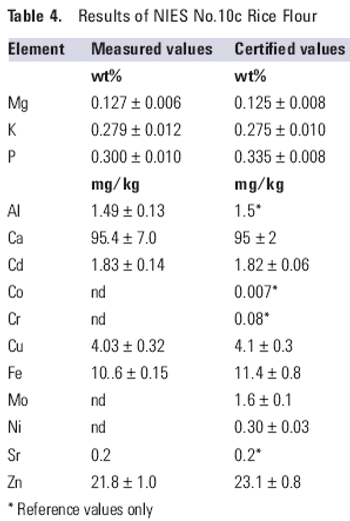
Whether the goal is food safety, ensuring quality or establishing provenance, measuring the trace element content of foods and beverages that we all consume is of paramount importance.
Special Issues
Whether the goal is food safety, ensuring quality or establishing provenance, measuring the trace element content of foods and beverages that we all consume is of paramount importance.

Special Issues
More than 1000 pesticides are currently used worldwide in the treatment of soil and crops. Many countries have established allowable levels of those pesticides in food to protect consumers. While these maximum residue levels (MRLs) vary, the default tolerance is 10 parts per billion (ppb).
Special Issues
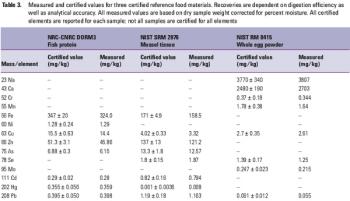
The task of efficiently monitoring chemical and biological contaminants in imported and exported food can be overwhelming. Traditionally, analysis of metals in foods has required multiple techniques in order to cover the range of elements, concentrations, and food types.

E-Separation Solutions
This afternoon session on Analysing Bioactive Compounds in Complex Food Matrices is chaired by Professor Rychlic from the Center Of Food and Life Sciences.
E-Separation Solutions
Click here to view the complete E-Separation Solutions newsletter from April 12, 2012.
E-Separation Solutions
Click here to view the complete E-Separation Solutions newsletter from April 12, 2012.

E-Separation Solutions
Traditional approaches for measuring food components are based on a ?target list? approach, whereby specific methodologies are developed for individual or related compounds. Such methods are well-suited for routine monitoring but can fail to detect emerging contamination events or to identify new prospects for product development.
LCGC Asia Pacific eNews
Direct injection for gas chromatographic profiling of alcoholic beverages is usually preferable, but where spirits and liquors contain appreciable amounts of non-volatile material, some mode of pre-treatment may be required to avoid both inlet and column contamination. This consideration applies in particular to products aged for extended periods in wooden barrels and especially products containing added sugar, as volatile artefacts from sugar decomposition in the hot injection port can also complicate the chromatogram.
The Column
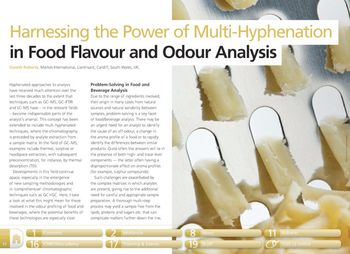
Hyphenated approaches to analysis have received much attention over the last three decades to the extent that techniques such as GC?MS, GC?FTIR and LC?MS have ? in the relevant fields ? become indispensable parts of the analyst?s arsenal. This concept has been extended to include multi-hyphenated techniques, where the chromatography is preceded by analyte extraction from a sample matrix. In the field of GC?MS, examples include thermal, sorptive or headspace extraction, with subsequent preconcentration, for instance, by thermal desorption (TD).

The Column
The two year international project "Preparation of active packaging with antioxidant and antimicrobial activity based on astaxanthin and chitosan",1 which started in 2009, was funded by FONCYCIT (Fund for International Cooperation of Science and Technology between the European Union and Mexico).
E-Separation Solutions
This Tuesday morning session will be presided over by Mary Ellen McNally of DuPont Crop Protection (Wilmington, Delaware).
The Application Notebook
Thermo Scientific Application Note
The Application Notebook
Agilent Application Note

LCGC Europe
A simple and sensitive high performance liquid chromatography (HPLC) method with ultraviolet (UV) detection was developed to analyse phenylurea herbicides: – monuron, diuron, linuron, metazachlor and metoxuron – in three soft drink brands and tap water.
Special Issues
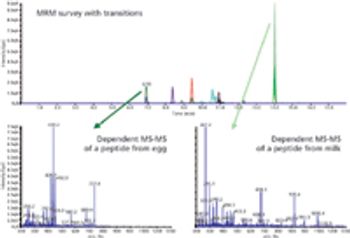
An update on the sample preparation and LC–MS-MS tools available for allergen detection, as well advantages of those techniques.

The Column
The level of pollutants present in water bodies is most commonly judged against set environmental quality standards (EQSs) that vary among different countries.

E-Separation Solutions
Chromium is a naturally occurring metal that is widely used in steel making, plating, tanning, paints, dyes, and wood preservation. The most common environmental forms are trivalent Cr(III), hexavalent Cr(VI), and the metallic form Cr.
The Application Notebook
Thermo Scientific Application Note
The Application Notebook
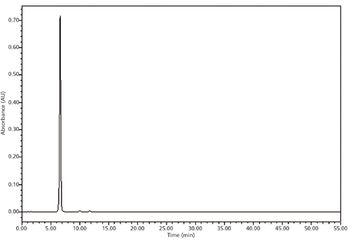
The United States Pharmacopeial Convention (USP) publishes the Food Chemicals Codex (FCC), which is a compendium of food ingredient documentary standards (monographs) that provide tests, procedures, and acceptance criteria to indicate the safety and quality of a food ingredient. Physical reference standards can be associated with the procedures of an FCC monograph and the reference standards are needed for conducting the procedures. This article describes characterization and collaborative testing of new USP rebaudioside A and stevioside reference standards and their suitability for intended uses in the FCC rebaudioside A monograph.
The Application Notebook
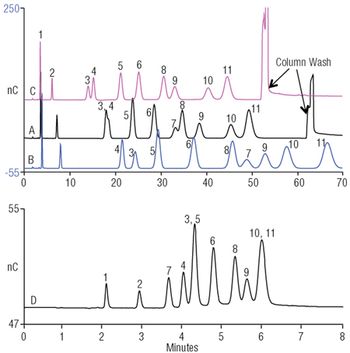
Coffee carbohydrates constitute the major part (at least 50% of the dry weight) of raw coffee beans, and are good tracers for assessing the authenticity of instant coffee.

LCGC Europe
Examples of a wide variety of sample preparation techniques for the analysis of trace-level contaminants in food and the advantages and disadvantages of each are discussed in this article.
The Application Notebook
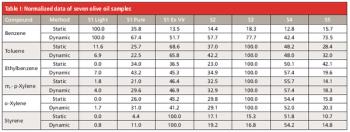
The benefits of olive oil as part of a healthy diet reaches back to the 1950's. Methods were developed to determine benzene, toluene, ethylbenzene, xylenes and styrene (BTEXS) by static headspace methods.
The Application Notebook
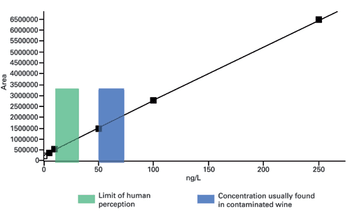
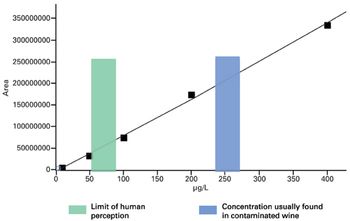
By identifying maturation tracers and molecules commonly responsible for taste defects, gas chromatography–mass spectrometry (GC–MS) augments expert opinion with objective and quantitative information. When using a solid phase micro extraction (SPME) method, GC–MS requires very small sample sizes and a minimum of sample preparation while providing rapid analysis of target molecules. GC–MS can provide an automated technique with repeatable results for detecting all of these compounds.

LCGC Europe eNews
LCGC asked a group of experts about the techniques and technologies they chose to use in food analysis, and how they made those choices.