
Science Daily, a website that features news revolving around the sciences, has published an article that describes new chromatographic techniques for the analysis of pesticides and antibiotics in food and beverage samples.


Science Daily, a website that features news revolving around the sciences, has published an article that describes new chromatographic techniques for the analysis of pesticides and antibiotics in food and beverage samples.

The Montreal Gazette published an article about the use of analytical techniques in the wine industry. The author discusses the difference between "natural" wines and "industrial" wines that are created with a certain taste profile in mind and with the assistance of gas chromatography.

The Application Notebook
A Deans switch, employing Agilent's Capillary Flow Technology, was configured on an Agilent 7890A GC equipped with dual ECD detectors. A method was developed for the analysis of fish oil for PCB contamination. The Deans switch was used to heart cut 7 indicator PCBs (IUPAC Numbers 28, 52, 101, 118, 138, 153 and 180) from the primary DB-XLB column on to a DB-200 column for further separation. Fish oil from a supplement capsule was simply diluted 1:10 in isooctane and injected directly. To prevent carryover, contamination and retention time shifts, the Deans switch was used to backflush the primary column at the end of each run.

LCGC Asia Pacific
This article describes the development of a routine method to analyse epoxidized soybean oil (ESBO) in baby food...

The Column
A fast quantitation method for the analysis of N-Methyl Carbamate pesticide residues in vegetables and grains has been developed. High recoveries were obtained for most carbamates screened in all matrices tested at 1 ppb levels. Good linearity of the calibration curves was observed for all analytes, over the range from 1 ppb to 200 ppb levels, with r2 greater than 0.99.

Scientists from the Federal Institute for Materials Research and Testing, Department of Analytical Chemistry have derived a new way to test for Ochratoxin A (OTA) in beer.

Phenomenex, Inc., a global leader in the separation sciences business, has been notified by R&D Magazine that it has won the coveted R&D 100 Award for the second year in a row.

The Application Notebook
James Morphet and Peter Hancock Waters Corporation, Manchester, UK

LCGC Asia Pacific
Very low level detection of mycotoxins in the agriculture products has become increasingly important. Mycotoxins are very resistant fungal metabolites that can remain in foods after processing and, sometimes, even after cooking. They are considered potent carcinogens and can be found in many varieties of foods. Of the mycotoxin class, aflatoxins are considered especially harmful, being both acutely and chronically toxic. Aflatoxin B1 and B2 are some of the most potent hepatocarcinogens known. Along with aflatoxins G1 and G2, even extremely low levels of these aflatoxins in the diet are important public-health concerns. With this in mind, this application note describes a specific, robust HPLC method for the low-ppb detection of aflatoxins B1, B2, G1 and G2 in corn.

LCGC North America
This month's installment of "Sample Prep Perspectives" describes a new extraction technique called QuEChERS (standing for quick, easy, cheap, effective, and safe and is pronounced "catchers") for the sample preparation of pesticides in foods and agricultural samples.

LCGC Europe
This article describes the development of a routine method to analyse epoxidized soybean oil (ESBO) in baby food based on a previous method devised by Castle et al. The aim was to simplify the work-up procedure to reduce the strain on the analytical equipment. The extraction procedure was miniaturized to improve handling, reduce the resources needed and simplify the method. After derivatization, the extracts were cleaned using gel permeation chromatography (GPC). A modified gas chromatography mass spectrometry (GC–MS) method using pulsed splitless injection was developed to determine the analyte. For quality control (QC), peak area ratios (PARs) were calculated and evaluated in terms of functionality under routine conditions. The method was validated according to EU regulations at a level of 20 ppm and showed high reproducibility. The miniaturized method proved to be applicable to all investigated baby food matrices and demonstrated the benefits of a GPC clean-up step to reduce strain on the..

The Application Notebook
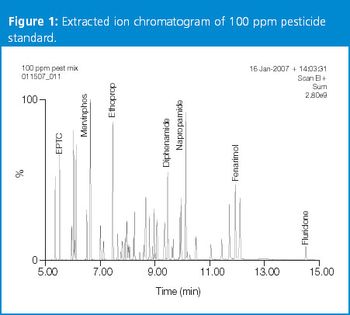
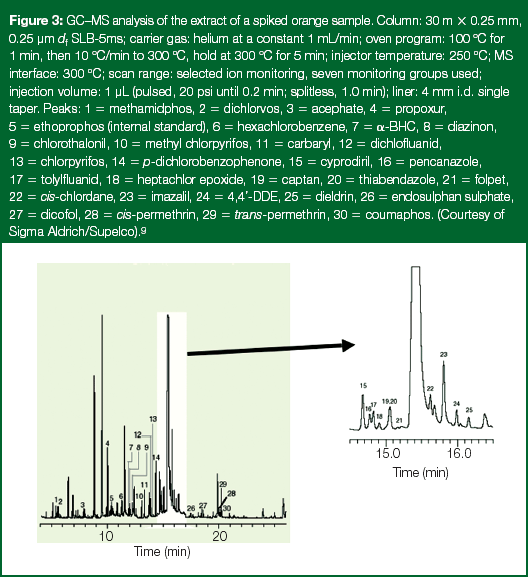
Pesticide contamination of foodstuffs has become a worldwide concern, prompting various levels of regulation and monitoring. Traditionally, pesticides are quantified with gas chromatography (GC) combined with selective detectors (ECD, FID, etc.). Selective GC detectors are great tools to quantify one or two classes at a time. However, screening for a number of different classes of pesticides requires multiple runs utilizing various GC configurations to achieve sufficient chromatographic resolution for unambiguous quantification. Gas chromatography–mass spectrometry (GC–MS) provides positive confirmation of various pesticides in a single analytical run because its superior selectivity allows interference-free quantification even with peak coelution. GC–MS has become a preferred technique for pesticide analysis because of its single-run capability.

The Application Notebook
The continual increase in sample numbers in busy labs means that it is often difficult for quality control or contract analysis labs to maintain short turnaround times, particularly when instruments are already running at full capacity. To address the need for faster analysis while retaining the quality of separation offered by dedicated amino acid analysers, an improved formulation of sodium citrate based buffers has been developed by Biochrom.

LCGC Asia Pacific
Brian De Borba and Jeffrey S. Rohrer, Dionex Corporation

LCGC Asia Pacific
Brian De Borba and Jeffrey S. Rohrer, Dionex Corporation

LCGC Asia Pacific
William Goodman and Thomas Meaker, PerkinElmer Life and Analytical Sciences

LCGC Europe
Users need to understand not only the operation of the computer system as required by their access privileges, but also the ethics and integrity required operating under any of the GMP or GLP quality systems.

The Column
Gas chromatography (GC) coupled to time-of-flight mass spectrometry (TOF-MS) offers unique solutions for various analytical applications including the analysis of food quality, authenticity and safety markers. This article provides a general overview of TOF-MS basic features, highlighting its advantages and limitations compared with GC using conventional mass analyzers. Examples of recent results obtained for selected food contaminants and flavor components are described to illustrate the potential of this recently introduced technique.

The Column
Gas chromatography (GC) coupled to time-of-flight mass spectrometry (TOF-MS) offers unique solutions for various analytical applications including the analysis of food quality, authenticity and safety markers. This article provides a general overview of TOF-MS basic features, highlighting its advantages and limitations compared with GC conventional mass analyzers. Examples of recent results obtained selected food contaminants and flavor components are described illustrate the potential of this recently introduced technique.

LCGC Europe
Gas chromatography (GC) coupled to time-of-flight mass spectrometry (TOF-MS) offers unique solutions for various analytical applications including the analysis of food quality, authenticity and safety markers. This article provides a general overview of TOF-MS basic features, highlighting its advantages and limitations compared with GC using conventional mass analysers. Examples of recent results obtained for selected food contaminants and flavour components are described to illustrate the potential of this recently introduced technique.

The Application Notebook
The analysis of peptides and additives using a new HPLC innovative column technology, Pathfinder, was shown. For the analysis of flavours in lemon juice GC–MS with a new MS library, FFNSC, with linear retention indices was used.

The Application Notebook
Soft drink formulas often include preservatives, artificial sweeteners, flavours or caffeine in their list of ingredients. Using the Acclaim OA column, as many as eight common additives may be determined in a single run. Many of these additives are hydrophilic organic acids for which this column was designed. Notably, benzoate and sorbate, which do not resolve on C18 columns at low pH, are fully separated.

Special Issues
Ultrahigh performance liquid chromatography (LC)–time-of-flight mass spectrometry –(TOF-MS) and gas chromatography (GC)–TOF-MS are powerful approaches for screening target compounds and identifying or characterizing nontarget compounds in complex mixtures. The combination of accurate mass data and newly developed software enables truly generic screening methods with TOF-MS, and the confident detection, identification, and confirmation of small molecules in a range of application areas.

LCGC Europe
Any wine can suffer from that corked wine taint. This spoilage, recognized by a distinct aroma of damp musty leaves and a damp cardboard taste, makes a wine undrinkable.

LCGC Europe
VICAM, the food safety technology business, headquartered in Watertown, Massachusetts, USA, has been acquired by Waters. The deal also included the associated net assets of VICAM and has proceeded under undisclosed terms.