


E-Separation Solutions
Click here to view the complete E-Separation Solutions newsletter from July 29, 2014.
E-Separation Solutions
Click here to view the complete E-Separation Solutions newsletter from July 29, 2014.
E-Separation Solutions
The European Food Safety Authority (EFSA) has confirmed that acrylamide in food can potentially increase the risk of developing cancer for consumers across all age groups.

E-Separation Solutions
A team of scientists from the University of Muenster and the University of Siegen in Germany has demonstrated the use of low temperature plasma desorption/ionization orbitrap high-resolution mass spectrometry (LTP?Orbitrap?HR?MS) for the analysis of pesticide residues in fruit.
The Column
Scientists from Emory University (Georgia, USA) have developed a new solid–phase extraction (SPE) method to isolate four insecticide degradates from baby food for analysis by high performance liquid chromatography tandem mass spectrometry (HPLC–MS–MS). The paper published in the Journal of Agricultural and Food Chemistry describes how the method can be applied to differentiate between exposure to insecticides or preformed degradates.

The Application Notebook
Agilent Technologies

The Column
Red wine could help to protect against oral cavities, according to research published in the Journal of Agricultural and Food Chemistry.1 The team used ultrahigh-pressure liquid chromatography tandem mass spectrometry together with electrospray ionization (UHPLC–ESI–MS–MS) to analyze phenolic compounds found in the sampled red wine.

The Application Notebook
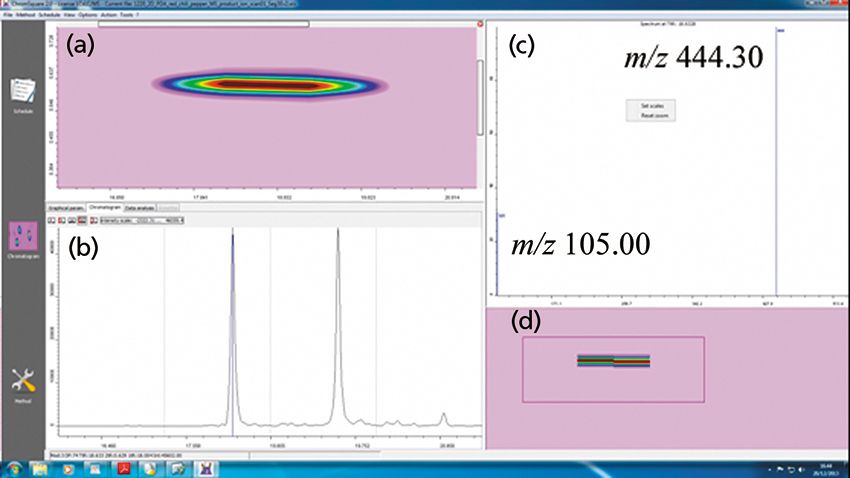
This application note demonstrates how comprehensive 2D-LC can be used to resolve the complex mixture of hydrophilic phenols found in virgin olive oil and investigates differences in the phenol composition of several olive oils.
E-Separation Solutions
Environmental and food analysis concerns have been a hot-button issue for several years. Scientists are continually working to improve the methods and equipment used for analysis in these fields, so this technical session will surely be of high interest to many. This session will start late Monday morning at 10:50 a.m. and will be chaired by Stephen Weber of the University of Pittsburgh.

Special Issues
The complexity of many food samples places a great demand in terms of both separation capabilities and specificity of detection. In this article, a novel system for fully automated comprehensive two-dimensional liquid chromatography (LC?LC) is discussed.
The Column
A team of scientists in Portugal and Spain have performed high performance liquid chromatography coupled with fluorescence detection (HPLC– FLD) to show that marinating pork meat in beer can reduce the levels of polycyclic aromatic hydrocarbons (PAHs) formed when grilled over charcoal.

Special Issues
Food for human consumption and animal feedstuffs contain a variety of mono-, di-, oligo-, and polysaccharides with different functions. In this article specific liquid chromatographic (LC) systems (column, mobile phase, and detector), which are used to determine different carbohydrates in food and feed matrices, are described.

Special Issues
Food provides the body with energy and good food is indispensable for a healthy life.

Special Issues
This article is focused on the detailed qualitative analysis of the fatty acids and the unsaponifiable constituents of a vegetable oil derived from a food-industry waste product, namely lemon seeds.
Special Issues
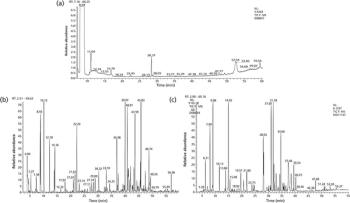
If food flavor is not as expected, it can damage consumer confidence and give the perception of poor quality. Setting analytical standards of what constitutes an acceptable flavor can be challenging, and while methods based on total volatiles or specific marker compounds can be a useful quality control check, a more investigative approach is often required.
Special Issues
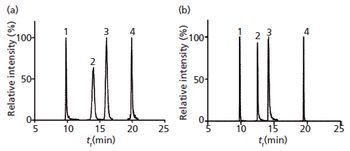
Advances in nano-ultrahigh-performance liquid chromatography (nUHPLC) and "plug-and-play" micro-UHPLC (?UHPLC) for the detection of veterinary drugs and steroids in porcine meat and urine respectively are described.

Special Issues
Edible oils and fats are complex mixtures of compounds. To understand the properties of an oil or fat, information on groups of molecules, as well as individual molecules, is needed.
The Column
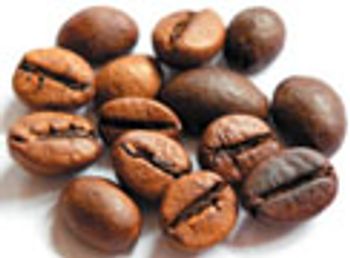
Dr Sastia Prama Putri of Osaka University, Japan, spoke to Kate Mosford of The Column about advances in metabolomics, the need for authentication of high value food products, and the important role of GC–MS in food analysis.
E-Separation Solutions
Click here to view the complete E-Separation Solutions newsletter from April 25, 2014.
E-Separation Solutions
The 2015 budget for the US Food and Drug Administration (FDA) will rise by 8.1% over the 2014 budget.

LCGC North America
A look at the various strategies and tools related to metabolomics applied to food and nutrition

LCGC Europe
The potential to accurately and rapidly measure hundreds of individual molecular species provides novel opportunities for food science and nutrition. For food and nutrition researchers, metabolomics, the screening of small-molecule metabolites, enables the molecular fingerprinting of food components. This article describes the various applications, strategies, and tools related to metabolomics in food analysis.
The Column
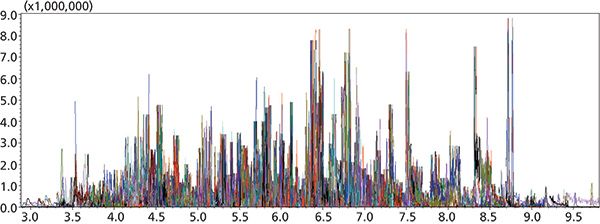
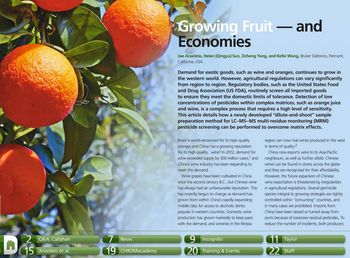
This article details how a newly developed ?dilute-and-shoot? sample preparation methodology for LC–MS–MS multi-residue monitoring (MRM) pesticide screening can enable operators to overcome the matrix effects that have traditionally hindered routine food analysis.
The Column
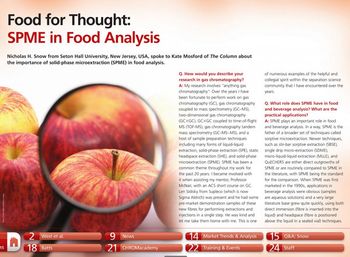
Kate Mosford of The Column about the importance of solid-phase microextraction (SPME) in food analysis.

Special Issues
Here, a method to characterize edible oils and edible oil mixtures through fingerprinting and the isolation of individual analyte differences is reported. Aroma and flavor analytes in extra virgin olive, olive, peanut, grapeseed, and vegetable oils were sampled with headspace solid-phase microextraction (HS-SPME).