

LCGC Europe
A fast clean and simple method to determine three organotin compounds in environmental samples is described
LCGC Europe
A fast clean and simple method to determine three organotin compounds in environmental samples is described

LCGC Europe
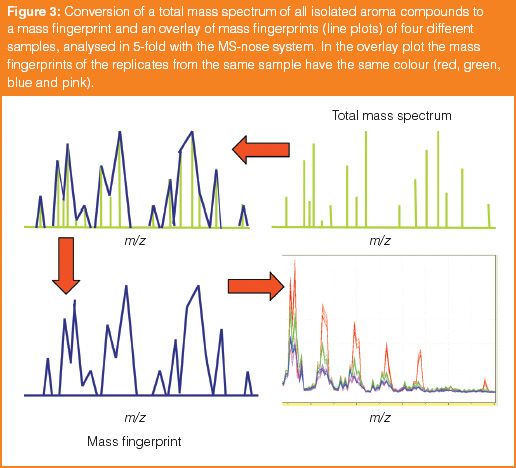
Mass spectrometry-based electronic nose technology (MS-nose technology) is a fast hyphenated technique for digital odour characterization of food and beverage products.
The Application Notebook
"Amino acid" is a generic term referring to organic chemistry compounds that have amino and carboxyl groups. There are many known types of amino acids with natural origin. In addition to being the basic unit comprising proteins (one of the main constituents of living organisms), they are the raw material necessary for synthesis of physiologically active low-weight molecules such as neurotransmitters. Even as individual units they possess various types of physiological activity. They are researched widely in the fields of medicine and food. Recently, they are being widely used in health foods such as supplements.

LCGC Europe eNews
The Food and Environment Research Agency (Fera), a UK-based government organization, has implemented a Thermo Scientific Nautilus laboratory information management system (LIMS) for use in its laboratory near York, UK.

Analysis of Elemental Contaminants in Beverages - Thermo Apps Note
Special Issues
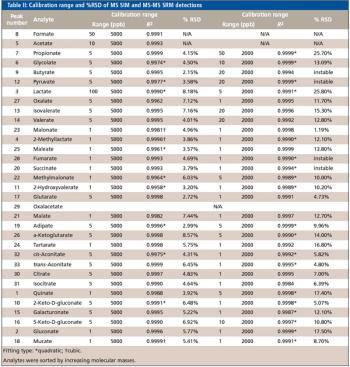
Organic acids are present in many media and play various crucial roles. Low molecular mass organic acids (LMMOAs) have been researched extensively in many areas, such as food chemistry, as these acids affect taste, shelf-life, and food safety (1–3); agriculture, ecosystems, and environmental science, as these acids act as key components in mechanisms that some plants use to cope with environmental stress (4) and fertilizer release (5); biotechnology, to better understand and optimize fermentation processes (6,7); and biomedical research (8–11). Recently, LMMOAs were found to have inhibitory effects on the bioconversion efficiencies of lignocelluloses to ethanol (12).
LCGC Asia Pacific
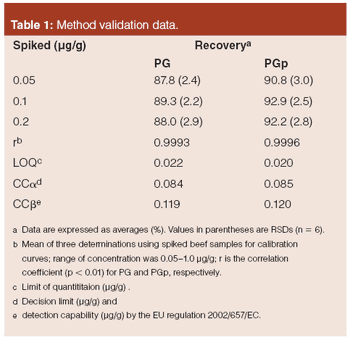
This article describes a simple, rapid and inexpensive method of sample preparation followed by RP-HPLC in beef.
Applied Biosystems will assist the Chinese government in reinforcing new standards for food safety.

Discover the advantages of using UHPLC–MS–MS for lactotripeptide analysis
High Resolution and Mass Accuracy in Food and Feed Analysis - Thermo Apps Note

E-Separation Solutions
In the past few years, the topic of food analysis and safety have come to the forefront in dramatic fashion.
LCGC Europe eNews
Phytronix Technologies and Agilent Technologies have signed an agreement to promote the Phytronix laser diode thermal desorption (LDTD) ion source with Agilent mass spectrometers.
Researchers from Univerité de Lyon (Lyon, France) have developed a chromatographic method for distinguishing 100% natural honey from adulterated or impure honey.

E-Separation Solutions
The global food, beverage, and agriculture industry caters to the population of the entire world. Even though the food industry does not rely on laboratory instrumentation to the same extent as perhaps other industries, the sheer size of the industry results in a considerable market for laboratory instruments. Many applications are related to safety, quality control, and research of new food ingredients and products.

LCGC Europe
Forensics and toxicology database; Informatics development platform; Supporting Connectivity; Metabolite database
Researchers from the University of Murcia (Murcia, Spain) developed a sample pretreatment system based on solid-phase microextraction (SPME) followed by gas chromatography with mass spectrometry detection (GC?MS).
Pesticides are extracted using acetonitrile saturated with magnesium sulfate and sodium chloride followed by a dispersive solid-phase cleanup with primary-secondary amine (PSA) and graphitized carbon black (GCB) sorbents. Analysis is performed using ultraperformance liquid chromatography-tandem mass spectrometry (UPLC-MS/MS) in ESI mode
Researchers from the Bio-Molecular Innovation Team of LGC (UK) used polymerase chain reaction (PCR) and Agilent?s DNA 1000 chip and model 2100 capillary electrophoresis (CE) system to analyze raspberry and strawberry DNA.
LCGC North America
Guest authors from South Africa review the application of membranes in the extraction, preconcentration, and separation of various contaminants in food.
The Application Notebook
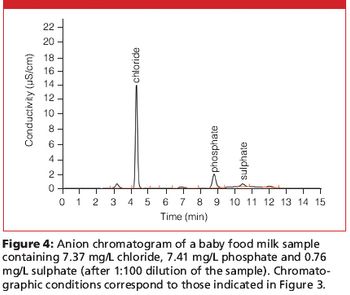
Run a difficult food sample on your IC and you stand a big chance that you will wreck the column. Of course, you can waste a lot of time on tedious sample preparation steps to eliminate undesired matrix components. Or you can go for Metrohm's automated compact stopped-flow dialysis providing optimum separation while protecting your column from detrimental compounds.

The Application Notebook
LC–MS-MS instruments operating in Multiple Reaction Monitoring (MRM) are widely used for targeted quantitation on triple quadrupole and hybrid triple quadrupole linear ion trap (QTRAP® ) systems because of their well known selectivity and sensitivity. In MRM mode, the first quadrupole (Q1) filters a specific precursor ion; the collision cell (Q2) generates fragments (product ions) which are filtered in the third quadrupole (Q3). Although this double mass filtering greatly reduces noise there is always a chance that elevated background levels or matrix signals interfere with the targeted analyte.

The Application Notebook
The analysis of chemical residues in food requires techniques sensitive enough to detect and quantify contaminants at or below the maximum residue limit (MRL) of the compound in a given sample matrix. Because of increased food safety regulations and the growing numbers of samples to be analyzed, it is critical that the analytical techniques provide high sample throughput.
Researchers from the Swedish University of Agricultural Sciences (Uppsala, Sweden) and the University of Tabriz (Tabriz, Iran) developed a solid-phase extraction method to separate sterol oxidation products in food lipids for analysis by gas chromatography (GC) and GC?mass spectrometry.
The Column
Seventeen priority pesticides were extracted using dispersive solid phase extraction which helped to remove interfering matrix components.

The Application Notebook
Melamine is an industrial chemical with a high nitrogen content that can cause kidney stones and lead to renal failure. In some instances, melamine has been added to baby formula and dairy products as a substitute for protein. This paper presents an efficient and definitive gas chromatography–mass spectrometry (GC–MS) method to identify melamine and related compounds based on the released US Food and Drug Administration (FDA) method.