Application Notes: Food and Beverage

i1-684065-1408627320410.jpg

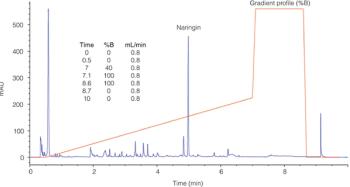
Grapefruit juice was analysed by gradient UHPLC for naringin - a major flavanoid in grapefruit juice that gives it its bitter taste. A ZORBAX Rapid resolution HD (RRHD) StableBond-C18 2.1 ? 150 mm, 1.8 ?m column was able to resolve over 60 peaks, including naringin in 7 minutes, and was re-equilibrated in just three minutes by operating at a high flow rate (0.8 mL/min). The high pressure generated (965 bar) is well within the 1200 bar operating range of the RRHD column and 1290 Infinity LC.

i1-684078-1408627266124.jpg

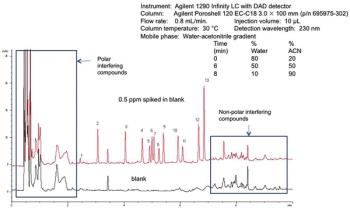
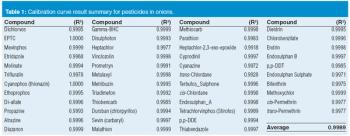
Pesticides are widely used in agriculture to protect crops and to improve efficiency of production. Consequently, governments, food producers and food retailers have a duty to ensure that any residues occurring in foods for human consumption are at or below statutory maximum residue levels (MRLs). Regulation EC 396/2005 adopted in the European Union sets MRLs for more than 500 different pesticides in over 300 different food commodities.

i2-676296-1408632565535.gif

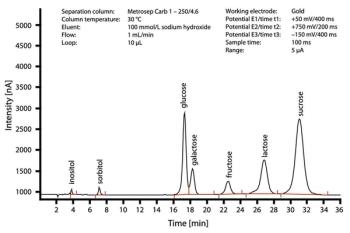
Lactose, a major disaccharide found in milk products, is catabolized into glucose and galactose by the enzyme lactase. Lactose-intolerant individuals have a lactase deficiency; therefore lactose is not completely catabolized.

i3-676284-1408632607264.gif

Grapefruit juice was analyzed by gradient UHPLC for naringin - a flavanoid that gives it its bitter taste. A ZORBAX Rapid Resolution HD (RRHD) StableBond-C18 2.1 x 150 mm, 1.8 µm column resolved over 60 peaks including naringin in 7 min, and was re-equilibrated in just 3 min by operating at a high flow rate (0.8 mL/min).

i4-648695-1408634681879.jpg

The QuEChERS method for pesticide analysis was first introduced by USDA scientists in 2003. The EN method 15662:2007 is a European variation to the QuEChERS method. The method uses acetonitrile extraction, followed by the salting out of water from the sample using anhydrous magnesium sulphate (MgSO4, NaCl and buffering citrate salts to induce liquid–liquid partitioning.

i4-648640-1416913458709.jpg

All plant foods are complex mixtures of chemicals including both nutrients and biologically active non-nutrients, referred to as phytochemicals. Soy is known for having high concentrations of several physiologically-active phytochemicals, including isoflavones, phytate (inositol hexaphosphate), saponins, phytosterols and protease inhibitors. The isoflavones are what makes soy unique.

i4-612605-1408644450222.jpg

Flavanones are a type of flavonoids occurring widely in plants, either in the aglycone backbone form itself or as glycosides. Flavonones exist in unique forms depending on the type of fruit and can be used to indicate the type of fruit that is being analysed. The following application introduces examples of high-speed analysis of flavanones in citrus juice using the Shimadzu ultra fast LC system, prominence UFLC, and the photodiode array detector SPD-M20A, focusing on narirutin, naringin, neohesperidin and hesperitin.

i1_t-612607-1408644437211.gif

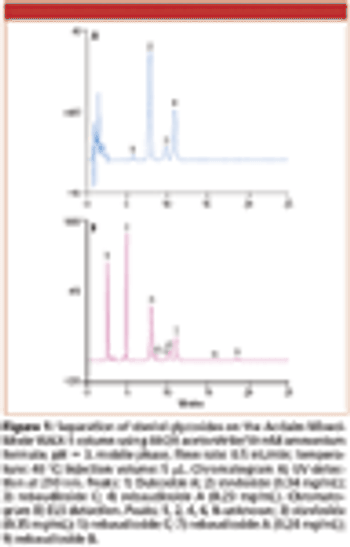
The FDA has no objection to Rebaudioside A having a generally recognized as safe (GRAS) status as a sweetener for food and drink.1 Stevia sweeteners may contain other steviol glycosides as well, mainly Stevioside, Rebaudioside C and Dulcoside A. Because the FDA GRAS confirmation is only for the use of Rebaudioside A at 95% purity or above in food and beverages, stevia extracts must be highly purified and characterized prior to use.

i8_t-611596-1408645944064.jpg

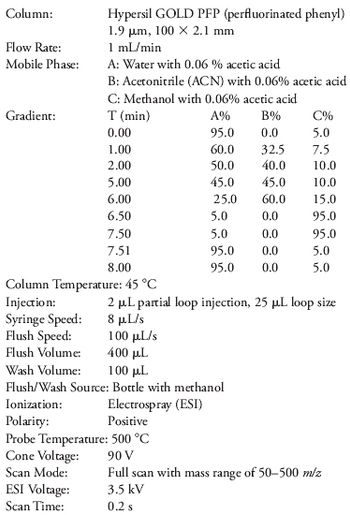
The screening of pesticides, mycotoxins, and veterinary drugs is of great importance in regulated environments such as food or feed analysis. Due to some of the limitations of traditional triple quadrupole approaches (for example, targeted analyte detection, limited number of compounds, and unidentified unknown compounds), there is currently a trend towards use of full-scan MS data for the analysis of residue samples. Current screening approaches mainly rely on the use of ToF instruments coupled to U-HPLC delivering mass accuracy (~5 ppm) at a maximum resolution of <15,000. This can produce inaccurate mass measurements due the presence of unresolved background matrix interferences. In this work we show a full-scan MS screening approach with the Thermo Scientific Exactive mass spectrometer, a novel single-stage Orbitrapâ„¢ MS capable of providing precise mass accuracies at resolutions of up to 100,000 without the need for internal mass calibration.

i4-611595-1408645947836.jpg

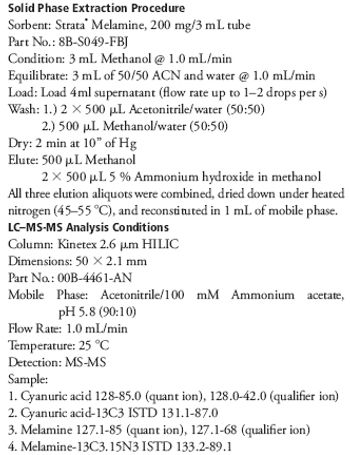
Since melamine and its metabolites are extremely polar compounds, they serve as very good candidates for HILIC chromatography. Simultaneous and fast determination and confirmation of melamine and cyanuric acid along with two other compounds using a novel amino bonded phase in HILIC mode coupled with a complete solutions approach is presented.

i28-611592-1408645956121.jpg

Melamine is an organic base and a trimer of cyanamide, with a 1,3,5-triazine skeleton. Melamine can react with formaldehyde to produce melamine resin, a very durable thermosetting plastic, and melamine foam, a polymeric cleaning product. Some end products made from melamine include countertops, dry erase boards, fabrics, glues, housewares, and flame retardants. Melamine is also one of the major components in Pigment Yellow 150, a colorant in inks and plastics.

i4-611593-1408645953546.jpg

An Agilent ZORBAX Rapid Resolution HT Eclipse Plus Phenyl-Hexyl column resolved many compounds from Stevia rebaudiana Bertoni plant extracts using an isocratic reversed phase method with UV and MS detection instead of a typical approach employing an amino column with a refractive index or other special detector. The Eclipse Plus Phenyl-Hexyl method's advantages include high peak capacity, isocratic mobile phase, low acetonitrile consumption, and MS compatibility.