Application Notes: Food and Beverage

i4-547875-1408670626749.jpg

Supercritical fluid chromatography (SFC) is a normal phase separation technique. In SFC, supercritical CO2 in combination with one or more polar organic solvents, most commonly alcohols, is used as the mobile phase. Owing to the lack of intermolecular interactions, supercritical fluid typically possesses lower viscosity and higher diffusivity than those solvents used in traditional high performance liquid chromatography (HPLC). This allows for higher flow rates, faster analyses, and the use of longer columns for higher chromatographic efficiencies. Initially deemed a niche chromatographic technique for chiral separation, the horizon of SFC applications has rapidly expanded to include achiral analyses of natural products, biodiesel, oligomer, pesticides/herbicides, and peptides. This is due, in part, to the improvements in detection choices and performances for SFC. Evaporative light scattering detectors (ELSDs) coupled with SFC have found wide use in many pharmaceutical and chemical laboratories (1).

i1-479348-1416912805113.jpg

The flavours of malt whisky result from a complex blend of long chain esters and alcohols, derived from the distillation products and the composition of the wooden barrels in which the finished product is aged. As shown below, the new VF-WAXms column from Varian, Inc. is ideal for analysing whisky, especially when trace analysis is needed. The column's ultra-low bleed increases sensitivity, extends column life and improves accuracy, even at higher temperatures. In addition, VF-WAXms columns are suitable for use with MS detectors, as the ultra low bleed eliminates interferences and permits more sensitive detection.

i4-517915-1409049226625.jpg

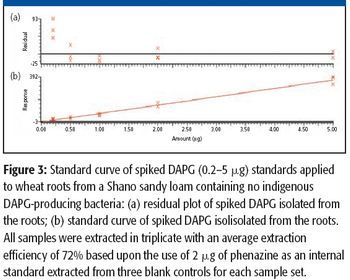
Root diseases caused by soilborne plant pathogens are responsible for billions of dollars of losses annually in food, fiber, ornamental, and biofuel crops. The use of pesticides often is not an option to control plant diseases because of economic factors or potential adverse effects on the environment or human health. For this reason, many Americans are now buying pesticide-free organic foods. Organic agriculture has few options for controlling pests and thus must make full use of natural microbial biological control agents in soils that suppress diseases.

i4-459127-1408660119782.jpg

A Deans switch, employing Agilent's Capillary Flow Technology, was configured on an Agilent 7890A GC equipped with dual ECD detectors. A method was developed for the analysis of fish oil for PCB contamination. The Deans switch was used to heart cut 7 indicator PCBs (IUPAC Numbers 28, 52, 101, 118, 138, 153 and 180) from the primary DB-XLB column on to a DB-200 column for further separation. Fish oil from a supplement capsule was simply diluted 1:10 in isooctane and injected directly. To prevent carryover, contamination and retention time shifts, the Deans switch was used to backflush the primary column at the end of each run.

i1-435033-1408659422415.jpg

Very low level detection of mycotoxins in the agriculture products has become increasingly important. Mycotoxins are very resistant fungal metabolites that can remain in foods after processing and, sometimes, even after cooking. They are considered potent carcinogens and can be found in many varieties of foods. Of the mycotoxin class, aflatoxins are considered especially harmful, being both acutely and chronically toxic. Aflatoxin B1 and B2 are some of the most potent hepatocarcinogens known. Along with aflatoxins G1 and G2, even extremely low levels of these aflatoxins in the diet are important public-health concerns. With this in mind, this application note describes a specific, robust HPLC method for the low-ppb detection of aflatoxins B1, B2, G1 and G2 in corn.

i1-409920-1408660232072.jpg

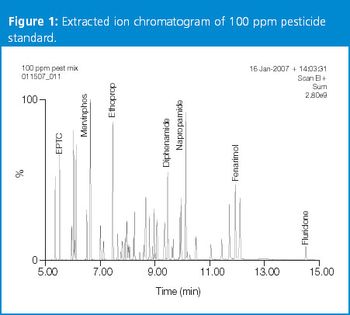
Pesticide contamination of foodstuffs has become a worldwide concern, prompting various levels of regulation and monitoring. Traditionally, pesticides are quantified with gas chromatography (GC) combined with selective detectors (ECD, FID, etc.). Selective GC detectors are great tools to quantify one or two classes at a time. However, screening for a number of different classes of pesticides requires multiple runs utilizing various GC configurations to achieve sufficient chromatographic resolution for unambiguous quantification. Gas chromatography–mass spectrometry (GC–MS) provides positive confirmation of various pesticides in a single analytical run because its superior selectivity allows interference-free quantification even with peak coelution. GC–MS has become a preferred technique for pesticide analysis because of its single-run capability.

i1-409919-1408660235408.jpg

The continual increase in sample numbers in busy labs means that it is often difficult for quality control or contract analysis labs to maintain short turnaround times, particularly when instruments are already running at full capacity. To address the need for faster analysis while retaining the quality of separation offered by dedicated amino acid analysers, an improved formulation of sodium citrate based buffers has been developed by Biochrom.

i4-397283-1408673017577.gif

Gas chromatography (GC) coupled to time-of-flight mass spectrometry (TOF-MS) offers unique solutions for various analytical applications including the analysis of food quality, authenticity and safety markers. This article provides a general overview of TOF-MS basic features, highlighting its advantages and limitations compared with GC using conventional mass analysers. Examples of recent results obtained for selected food contaminants and flavour components are described to illustrate the potential of this recently introduced technique.

i3-390802-1408681612263.gif

Soft drink formulas often include preservatives, artificial sweeteners, flavours or caffeine in their list of ingredients. Using the Acclaim OA column, as many as eight common additives may be determined in a single run. Many of these additives are hydrophilic organic acids for which this column was designed. Notably, benzoate and sorbate, which do not resolve on C18 columns at low pH, are fully separated.